How many BTUs does a gas grill need?
The guide: what the BTU number hides
The number on the box is not the number that reaches your food.
The BTU total a maker advertises is not that figure. We derived it by hand for 85 gas cookers. On 16 of them, the two numbers printed on the box do not divide to the real one. Here is how that happens, and what to read instead.
Start with what the maker prints
The DCS BFGC-30BGD-N publishes 46,000 BTU per hour and 244 square inches. Divide one by the other, as every spec-sheet comparison invites you to do. You get 189 BTU per square inch. That would be the hottest cooking surface on this site.
Most of that output is not under the food
Of the 46,000 BTU, only 12,000 fire through the main cooking surface. The other 34,000 belong to burners that heat something else entirely: side burners on the shelf, a rear rotisserie behind the food, a sear bay in its own cabinet. They are real burners. They are not cooking your steak.
And the area is padded too
The 244 square inches include 79 that the main burner never heats. The surface that matters is 165. Headline areas routinely fold in warming racks and secondary grates, and food on a warming rack is not being grilled.
The honest figure is 73
12,000 BTU over 165 square inches. That is about 2.6× lower than the headline arithmetic. Nobody lied. The two biggest numbers on the box were simply never meant to be divided by each other.
12,000 BTU under the griddle plate ÷ 165 sq in, the 15 x 11 in plate. The 46,000 BTU total decomposes as that one 12,000 BTU griddle burner plus two side burners rated 17,000 BTU each, and the 34,000 BTU of side-burner output is excluded along with the open burner-grate area DCS folds into its 244 sq in headline.
It is not one unusual grill
Each square is one gas cooker we have derived a figure for. On 16 of 85, the maker's own headline output divided by its own headline area does not reproduce the real figure. Ten more cookers are not here at all: their published figures could not be paired honestly, so we publish nothing for them rather than a guess.
That is the first practical lesson. A BTU total you cannot break down is not a specification you can use.
Mostly, the spec tells you what kind of grill it is
Split the 85 figures by how the cooker is installed and they separate almost cleanly. Portables run a median of 57. Freestanding carts, which are what most people buy, run 83. Built-in and post-mounted cookers run 106.
Which means the comparison most people make is the wrong one
A built-in is not 49 points better at searing than a tabletop. It is a fixed cabinet that can carry burners a portable cannot, bought at a different price. Across those classes the number is close to meaningless.
Within a class it is a real signal. Freestanding carts alone run from 46 to 113. That is a genuine spread, between grills a shopper is actually choosing among.
What this number cannot tell you
We have not sear-tested a single grill, and no figure on this site claims to. BTU per square inch is arithmetic over two published specifications. It is blind to most of what decides whether a steak crusts:
Heavy cast iron stores heat and gives it back to the meat; thin wire gives it up on contact. Same burners, different sear.
An infrared burner and an open tube of the same rating do not put the same energy into a steak.
Flavorizer bars, heat tents and diffuser plates all sit between the flame and the food.
A tall lid and an exposed patio each cost real temperature, and neither appears on any spec sheet.
So treat the figure as a question, not a verdict: is this cooker's fire concentrated or spread, for its kind? For the judgement rather than the ratio, that is what the six-category score is for. It is weighted and written, with a stated reason behind every number.
How to read any gas grill spec sheet in two minutes
- Find the PRIMARY cooking area
Not the total. Warming racks get folded into headline areas, and food on a warming rack is not being grilled.
- Find the MAIN burner output
Subtract anything that does not fire under that grate: side burners, rear rotisserie burners, sear bays with their own cabinet.
- Divide
That is the figure we publish. If the maker will not break the total down far enough for you to do this, that is itself worth knowing.
- Compare only within a class
Portable against portable, cart against cart. The middle half of freestanding carts runs 73 to 93.
The gas grills we rate highest
Ranked by the six-category Avid Griller Score, not by heat density. The whole point of this page is that density is not a quality ranking. Each one's figure is shown so you can see where it sits.
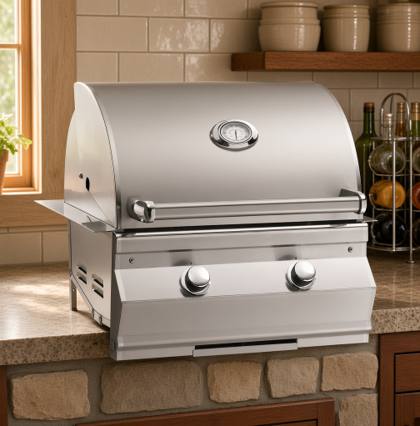
Fire Magic C430i review: 46,000 BTU over 432 sq in, 17 part numbers shared with the CM430i, and a lifetime warranty that follows the address.
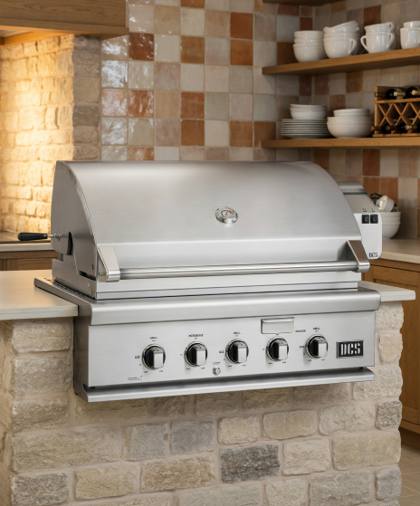
DCS BH1-36R-N review: three 25,000 BTU grill burners, a 14,000 BTU rotisserie and a 3,500 BTU smoker, on a 36in built-in wanting 45 5/16in of counter.
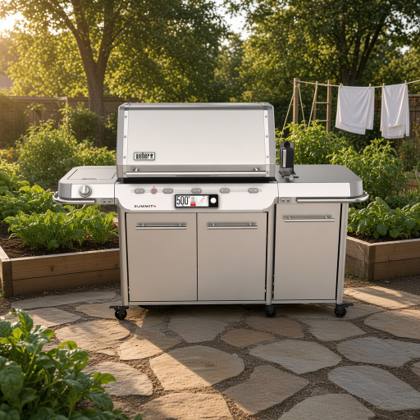
Weber Summit Smart FS38X S review: $5,299 buys a 16,000 BTU broiler firing down at the steak, and a touchscreen covered for three years.
We earn a commission on purchases made through these links, at no cost to you. It does not change a score. Every figure above comes from the same ratings table that covers all 85 gas cookers.
Straight answers
- Is more BTU better?
- No, and it is the most misread number on a grill box. A bigger total usually means a bigger grill or more burners, not a hotter cooking surface. That is why it has to be divided by the area it heats. Even then, 16 of our 85 cookers publish a total that does not describe the main grate.
- How many BTUs do I need for a gas grill?
- For a freestanding cart, the middle half of the ones we have measured fall between 73 and 93 BTU per square inch of primary grate. Below that band a grill is working hard to brown; far above it you are usually looking at a built-in with a dedicated sear burner.
- Is 30,000 BTU enough for a gas grill?
- It depends entirely on the grate it has to heat, which is the whole point. 30,000 BTU over 350 square inches is about 86 and unremarkable. The same 30,000 over 650 square inches is about 46 and genuinely thin. The total alone cannot answer it.
- Do you test searing?
- No. Every figure is derived from the maker's published output and area, by hand, with the arithmetic recorded. Where no honest pair of figures existed, we publish no figure. That happened ten times.
85 gas cookers carry a derived figure; the full table and every derivation is at heat density, grill by grill. Median across all of them is 79 BTU per square inch, with the middle half between 66 and 93.