Most portable grills get small by getting thin. Thin steel heats fast and loses it faster. One gust across an open lid can flatten a whole cook. That is the trade almost every travel grill asks you to accept.
The Weber Q 2000 refuses the trade. Model 53060001 carries cast aluminum, cast iron, and a stainless burner. That is a full-size grill’s parts list on a one-armload body. Street price runs around $249 to $299.
Which leaves the interesting question. Weber kept the materials, so the saving had to come from somewhere. It did not come out of the heat. Where it did come from shapes every section below.
First Impressions of the Weber Q 2000
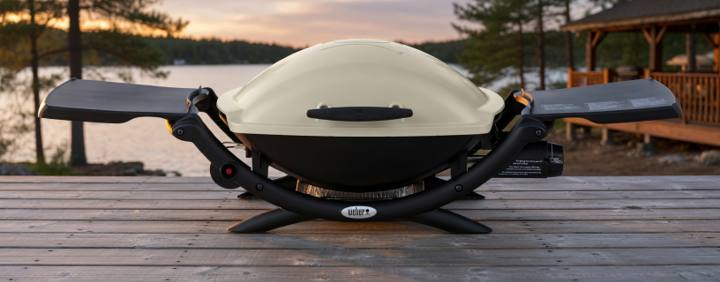
The box does most of the assembly for you. Unfold two work tables, seat the catch pan, thread on a cylinder. No tools, no second person, no exploded diagram to decode. In profile it reads like a kettle put through a press.
Lift it and the weight is cast aluminum, not folded sheet. Ten minutes with the lid closed is what we would give it first. A ribeye then lands with a hiss you hear across a parking lot. The bars leave defined marks, not the gray blush weak portables produce.
Key Features of the Weber Q 2000
Every choice on this grill points at the same stubborn goal. It is to make 280 square inches behave like a much bigger cookbox. Some of the parts below do that with mass, others with geometry. All of them earn their place.
- Perimeter burner loop: The stainless tube runs around the cookbox rim, not down the middle. Flame therefore sits under the outer grate, where cheap portables run cold. A corner sausage finishes close to the pace of a center one. Edge space stays usable space.
- Cast aluminum clamshell: Lid and body store heat and push it back down onto the food. Recovery after a lid lift takes moments, not minutes. Wind barely registers against a shell this thick. Nothing here warps the way thin steel does.
- Cast-iron: Both grate panels are cast iron under a porcelain-enamel coat. The mass is the point, since iron keeps searing when cold food lands. Splitting the grate in two keeps each panel liftable at the sink. Enamel means no seasoning routine and no rust watch after rain.
- Infinite-control valve: One dial sweeps from a hard sear down to a bare simmer. There are no click stops fighting you for the setting you want. Grates this heavy keep the low end genuinely usable. Peppers and thin fillets survive it intact.
- Push-button igniter: The piezo electrode sits down inside the cookbox, sheltered from wind. Push, click, flame, with no battery anywhere in the circuit. Nothing needs charging before a trip. It is a consumable part, and Weber sells the replacement kit.
- Stainless steel: The stainless component here is the burner tube, not the body. That is the one part that lives inside the fire. Stainless outlasts the aluminized tubing budget portables use. Weber keeps the tube orderable long after a model retires.
- Glass-reinforced nylon frame: It carries the cookbox, the valve, and both tables without steel weight. Plastic sounds like a downgrade until you carry the grill. It cannot corrode, and it takes knocks in a trunk. It does prefer a cover through a long winter.
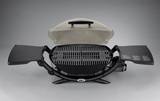
- Folding work tables: Both tables swing out from the sides of the frame. Each takes a platter, a bottle, and a pair of tongs. Fold them in and a garage shelf swallows the grill. Fold them out and you have a workspace, not a perch.
- Cylinder mount: A disposable cylinder threads straight onto the valve at the grill’s side. It hangs low and clear of the cooking area. Swapping an empty one takes seconds and needs no tools. There is no bracket, strap, or shelf to fuss with first.
- Catch pan and grease path: Grease runs down the sloped cookbox floor into a pan underneath. The pan slides out from the front in one motion. A disposable foil tray sits inside and carries the mess away. Cleanup is a bin trip, not a scrub.
- Griddle swap: One grate panel lifts out for Weber’s cast iron griddle. Eggs, smashed onions, and delicate fish get a solid surface. The other half keeps its bars for searing at the same time. Breakfast stops being a reason to go indoors.
Weber shrank the grill without shrinking the fire. Roughly 43 BTU per square inch puts this squarely in sear territory. Chicken skin tightens and crisps instead of sweating over a weak flame. A thick ribeye takes a crust in the time it takes to pour a beer.
The looped burner is why the edges behave like the middle. A corner burger is not a second-class burger here. Recovery counts just as much, because every lid lift bleeds a portable dry. Cast aluminum and heavy iron hand most of that heat straight back.
What did shrink is choice. The Q 2000 has one temperature at a time, everywhere. Turn the dial down and the whole grate goes gentle together. Turn it up and a thick thigh has nowhere cooler to wait.
Build, handling and durability
Rust ends most portable grills, and this design closes the usual doors. There is no sheet steel to perforate and no bare iron to pit. Cast aluminum does not rot, and enamel keeps water off the grates. What is left to fail is the igniter and the frame.
Both are wear items rather than design faults. Piezo igniters are consumable on every gas grill ever sold. A replacement kit goes in within minutes using a screwdriver. The frame is tough nylon, though still plastic, so a cover earns its keep.
Handling is where the money announces itself. The hinge has no slop, and the valve turns against real resistance. Both tables lock open and hold a loaded platter without sagging. The body sits low though, so plan on a table or Weber’s separate cart.
Running costs, upkeep and value
The sticker is the easy part to defend. Around $249 to $299 buys a shell that cannot rot and grates that sear. The pressure comes from inside Weber’s own range, not the bargain bin. The Q 1200 saves money by losing grate; the Q 2200 asks more and gives more.
Fuel is the line item that never stops asking. Weber sells this grill on a disposable cylinder and does not put one in the box. At full output those empty quickly, so a weekly cook pays steady rent. An adapter hose reaches a refillable tank, at some cost in portability.
Upkeep, by contrast, costs almost nothing. Brush the hot enamel, then slide the catch pan out with its foil tray. Weber warns against lining the cookbox, since blocked grease starts flare-ups. That is one shortcut we would skip.
Possible Weber Q 2000 Complaints
- No cool side: One looped burner heats the entire grate or heats none of it. Bone-in thighs and thick sausages therefore have nowhere gentler to finish. A low flame under a closed lid helps a little, no more.
- No lid thermometer: Weber lists grates, ignition, tables and catch pan, but no dome gauge. Pacing therefore runs on judgement. That is fine for burgers and genuinely awkward for a whole chicken. A probe closes the gap for a few dollars.