Weber’s own page for the Genesis E-325, part number 1500533, stopped answering in August 2026. Search weber.com for that number today and nothing comes back. The Genesis range page lists 12 grills, and this is not one of them.
Amazon still sells it, near $849, in stock. How well it cooks turns out to be the simple question. The harder question is what you are buying when the maker has stopped listing it.
The short answer sits along the control panel. There are four knobs on this three-burner grill. The red one is why the model exists.
First Impressions of the Weber Genesis E-325
It arrives boxed. Weber’s page said only that the product requires assembly, and never published a build time. Clear an afternoon and find a second pair of hands.
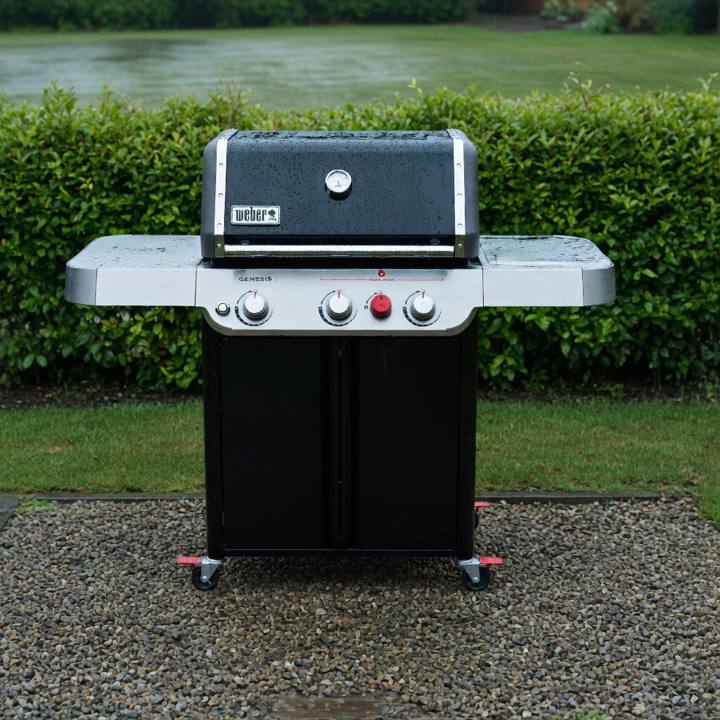
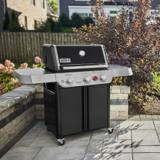
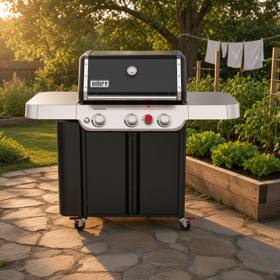
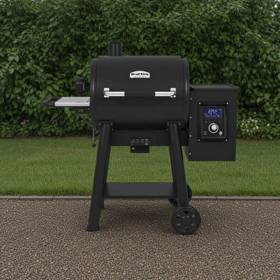
Built, the cart weighs 162 pounds and stands 48.1 inches to a closed lid. The look is quieter than the money suggests. Black porcelain-enamelled lid, pale front panel, two fixed side tables.
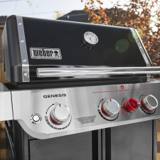
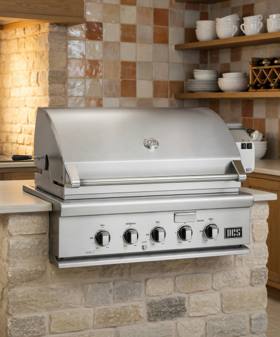
The panel is where this model explains itself. GENESIS is printed on the left. Four knobs run along it, three of them silver. The odd one is red, and a printed bracket marked SEAR ZONE arches above it.
Weber charged extra for exactly that knob, then labelled it so nobody could miss it. First cook confirms the split. Two steaks over the red burner pick up a crust. The rest of the grate stays where you left it.
Weber reckons the grate holds 17 steaks. Optimistic, but it tells you the scale. The cabinet doors open onto the bottle, and the hood carries its own dial. Nothing about the layout asks you to learn anything.
Key Features of the Weber Genesis E-325
Most of this grill is standard Genesis hardware. The interesting part is the short list you will actually touch. Four of the bullets below describe the fire. The rest describe the cart under it.
- A fourth burner with its own knob. Weber puts 13,000 BTU per hour behind that red control. It lights independently of the three main tubes, and is meant to run alone.
- Cast-iron grates, porcelain coated. Weber calls them WEBER CRAFTED grates. Cast iron is what makes the sear burner pay. It stores heat and gives it back to the meat.
- Stainless steel where the flame lives. Stainless appears twice here: in the tubes, and again in the bars over them. Fat that lands on the bars turns to smoke before it reaches the tubes.
- Electric igniter running on one AA. A single battery behind the panel fires all four burners. Keep a spare in the cabinet; nothing else here needs one.
- A warming rack of 128 square inches. It sits above the main grate and takes the overflow. Buns, rested steak, a tray of vegetables holding for the table.
- Grease that pulls out from underneath. The tray slides out from below the cookbox, not out of the back. You never reach past a hot cabinet to empty it.
- Six tool hooks and two side tables. The tables are fixed rather than folding, which sets the parked width at 57.7 inches. Hooks are spread across both.
- Four casters, two of them locking. Two swivel, two swivel and lock. On a flat patio the locking pair stops it wandering.
The propane bottle lives inside the cabinet, behind painted steel doors. It takes the standard 20 lb bottle, which Weber does not include. The cabinet swallows it completely.
The honest way to describe this fire is that there are two of them. Three tubes, 39,000 BTU per hour between them, under a 513 square inch grate. That is a comfortable working heat, not a furnace. It is spread wide on purpose.
Then there is the fourth burner, and this is the argument for the model. Weber still sells the Genesis E-315. Same 39,000 rating, same 513 grate, same 162 pounds, same footprint.
Its specification table has no sear zone row at all. Put plainly: the E-325 is an E-315 with one more burner in it. Weber now sells only the one without.
That fourth burner changes how you plan a cook. It does not raise the ceiling over the rest of the grate. You set the three main burners for the food and leave the red one off. Steaks go on it for two or three turns, then move left to finish.
The Flavorizer bars do more for the result than the burner arithmetic does. They also let the red burner run hard without setting fire to dinner. Flare-ups stay rare because the fat is intercepted before the tubes.
Weber never published how much grate the sear zone covers. Treat it as a corner, not a zone you fill.
Build, handling and durability
Weber warrants this grill at three different lengths. The split tells you what it expects to fail. Twelve years is what Weber promises against a hole in the cookbox or lid. Anything standing in the flame gets ten: burner tubes, Flavorizer bars, cast iron grates.
Everything else gets five years, including the painted steel cabinet doors. Paint is carved out separately at two years, with fading excluded. Parked outdoors, those doors will show their age first. Not the porcelain lid above them.
The lid carries a built-in thermometer, and that is the only instrument here. Weber’s own inventory for this model lists no smart parts at all. The knobs and that dial are the whole interface.
Moving it is a caster job, never a lifting job. At 162 pounds on four wheels it rolls easily. It stops dead once the two locking casters are down. Watch the height before parking it under anything: the lid needs 63 inches swinging up.
Running costs, upkeep and value
Price is where the discontinuation stops being trivia. Weber listed the E-325 at $949. It then cut the price to $849 under a $100 OFF tag. The buy button became a notify link, and then the page went.
Amazon’s price today sits near $849, which is Weber’s own final number. Now compare that with what Weber will still sell you. The E-315, the same grill without the sear burner, lists at $949. The cheapest propane Genesis on the range page is $999.
Step up to the E-415 and it is $1,299. You are being offered the extra burner for less than the version without it.
Day to day, running costs are ordinary for a propane cart. The standard bottle drops into the cabinet. The igniter eats one AA a season. Weber publishes no consumption figure for either.
Cleaning is the real cost. Oil the cast iron and brush it while it is still warm. There are four burners under those grates, not three.
The grease tray is what makes upkeep bearable. It pulls out from under the cookbox, empties, and goes back without tools. Do that regularly and the cleaning stays on the grates. That is where it belongs.
Possible Weber Genesis E-325 Complaints
- Everything except the cooking now happens without a maker’s page. Registering the grill, finding the manual, comparing specs: all of it started at one URL. That URL returns 404, and Weber’s own search cannot find 1500533. The cooking is unaffected, but save the serial number and the specification on day one.
- The cabinet doors are the weak finish on a strong shell. Painted steel carries the five-year remainder cover, while the lid above carries twelve. Paint itself drops to two years, and fading is not covered. Expect the doors to look tired long before anything stops working.