A portable grill earns its price where the power stops. Down a track, on a balcony, at the far end of a car park. Whatever it needs, it has to bring.
Weber’s Q 1200 brings a stainless burner rated at 8,500 BTU. Behind it sit cast iron grates and 189 square inches. Our record calls it model 51060001. Weber’s own page now carries 51070001, the same grill in a different colour.
It also brings a AAA battery. That is the thread worth pulling.
First Impressions of the Weber Q 1200
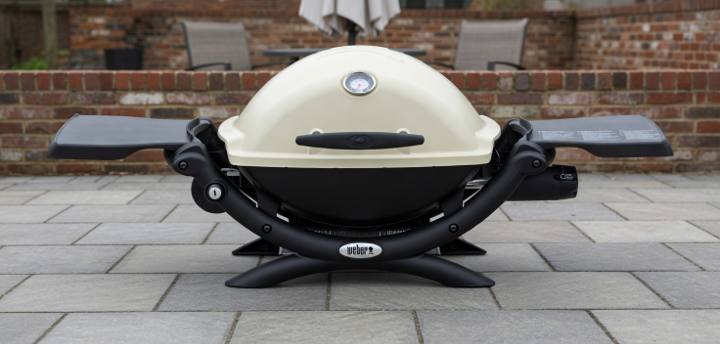
Setup is unfolding rather than building. The side tables swing out. The catch pan drops in and a cylinder threads on. Two minutes, working alone, no tools involved.
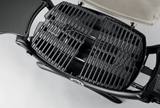
What surprises people is the heft, and it is in the right place. The grates are porcelain-enamelled cast iron, on a grill that weighs 31 pounds all in. Most portables at this weight fold thin steel instead.
The footprint is the other surprise. Tables out it spans 40.9 inches. Lid closed and folded, it is 16.5 inches deep.
So it is wide rather than bulky. That is what decides whether it shares a car boot. Work out where it goes before you buy, not when it lands.
One session at the grill argues better than the spec sheet does. Cast iron takes a while to come up, then simply stays there. Cold food does not knock the heat out of it. That is the trick thin grates never manage.
Key Features of the Weber Q 1200
Strip this grill down and there is one burner, one dial and one heavy grate. Everything below either feeds that flame or gets out of its way.
- Cast-iron: What you cook on is iron, glazed rather than painted. Weight is doing the work, not surface area. Rain and the years of it become the glaze’s problem, not yours.
- Single stainless burner: One tube carries the entire 8,500 BTU. Stainless matters most on the component that sits inside the flame. Weber warrants that tube for five years.
- Electric Igniter: Push and hold, and the burner lights. The circuit runs on one AAA battery. It is the only part of this grill that can quietly stop working.
- Lid thermometer: A dial in the lid reads what is happening under it. Weber publishes no range for it, so treat it as a trend rather than a number.
- Folding side tables: Two tables swing out for tools and plates, then fold flat for storage. On a grill with no cart, they are the only surface you get.
- Removable catch pan: Grease is funnelled into a pan that lifts straight out. Weber’s own phrasing is “easy cleanup”, and for once that is not overstating it.
- Fuel Gauge: There is none, and the cylinder is sold separately. Weber publishes no capacity for it either, so plan by spare rather than by number.
The headline BTU figure is the wrong one to read. Divide it by the cooking area instead. Call it 45 BTU per square inch on this grill. Its bigger sibling puts 12,000 BTU over 280 square inches, landing near 43.
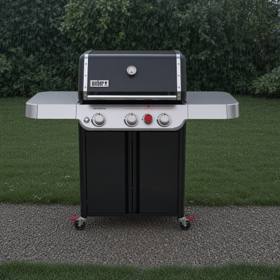
So the small Q is not the compromised one. Per square inch it runs marginally hotter than its bigger sibling. Buyers routinely assume the opposite.
That matters more than the raw BTU figure does. A burner rating on its own says nothing about how a grill cooks. Spread the same flame over more metal and everything slows down.
Cast iron is what converts that into cooking. Heat stored in the grate keeps working when a cold steak lands on it. Thin steel gives its heat away in seconds and spends the next minute recovering.
What one burner cannot give you is a second zone. No warming rack sits above, so the 189 square inches is one surface. Everything on this grill cooks at whatever the dial is set to.
Plan around that instead of fighting it. Sear first, move nothing, drop the dial for the finish. Anything needing a genuine cool corner belongs on a bigger grill.
The lid gives you the only other lever. Closed, it turns the grill into a small oven. Roasting a chicken on 189 square inches is genuinely on the table.
A thermometer sits in that lid. Weber publishes no range for the dial. Read it as a trend, not a reading.
Build, handling and durability
Weber says more in the warranty than anywhere in its copy. Five years covers the cookbox and the lid assembly. It also covers the stainless burner tube and the cast iron grates. Two years covers everything else.
The comparison is the point, not the individual terms. That cover is identical to the Q 2000’s, component for component. Weber is not underwriting this as a lesser object, only a smaller one.
Carrying it is where the trade-off bites. Thirty-one pounds is one armload, and cast iron is most of why. The materials that make it cook well are the same ones you carry. Worth a thought before a long walk from the car.
The one moving part worth watching is the igniter. Electronic ignition on a portable adds a component that can be dead when you arrive. A piezo cannot go flat in a drawer.
One clerical oddity is worth knowing before you order. Our record lists 51060001, and Weber’s page for it now resolves to 51070001. Both are the Q 1200; Weber gives each colour its own number. Match the number to the finish you actually want.
Running costs, upkeep and value
Fuel is a disposable cylinder, sold separately, and Weber does not publish its capacity. That is a genuine gap on a grill built for going places. Buy spares and learn the rhythm by cooking, because no printed figure will tell you.
Cleaning is close to trivial. Glazed surfaces surrender grease to a cloth, and nothing here wants a wire brush. The catch pan lifts out and empties in seconds. There is no firebox to shovel and nothing to re-season.
Two prices are in play, and the gap is not small. Direct from Weber the listing reads $279.00 right now. Back in July 2026 this project logged $209, at Walmart and at Weber alike.
Four weeks separate those figures, and seventy dollars separates them too. Each was correct on the day it was captured. Look the sellers up yourself before committing.
Then add what the box does not contain. No cylinder, no cart, no cover. Weber sells a stand for the Q 1000 and 2000 series. It is a separate purchase, and most buyers come round to it.
Possible Weber Q 1200 Complaints
- The igniter needs a battery, and portables should not: A single AAA sits between you and a lit burner. It will be fine for years and then be flat on the one trip that matters. Keep a spare taped inside the grill, not in a kitchen drawer at home.
- Nothing tells you how much fuel is left: There is no gauge, and Weber publishes no cylinder capacity. On a patio that is an annoyance. A mile down a track it decides whether anyone eats hot. Travel with a second cylinder.