Traeger Ironwood 885 vs Woodridge Pro
A superseded flagship at around $1,008 against the current Woodridge Pro at $1,149.99. Insulation and a 165 F smoke floor, against 85 more square inches.

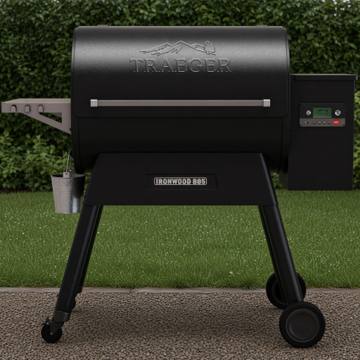
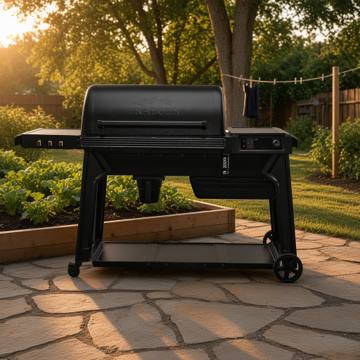
No single winner. Here is how to choose.
The Ironwood 885 is the better smoker; the Woodridge Pro is the safer purchase. The Ironwood opens Super Smoke at 165 F behind insulated walls and sells around $1,008. But Traeger files it under Legacy and gives it three years, the brand's shortest term. The Woodridge Pro cooks on 970 sq in across two racks, engages Super Smoke only between 185 and 225 F, and carries ten years against rust-through with load-rated shelves and all-terrain wheels. Our scores land 8.22 and 8.24, which is as close as this corpus gets.
What actually differs
-
Where Super Smoke starts
165 F on the Ironwood against a 185 to 225 F band on the Woodridge Pro. Heavy smoke lives at the bottom of the dial, so a lower floor is the one capability that genuinely favours the older grill.
-
Legacy against current
Traeger's own site files the Ironwood 885 under Legacy. That is what the $140 discount is, and it is also what you accept: parts, firmware attention and resale all follow the current line.
-
Ten years of rust cover against three
The Woodridge Pro headline is rust-through on sheet metal for ten years, with three on the controller, auger and fan. The Ironwood is three years all in, by its product page and its owner's manual.
How they score, category by category
The Traeger Ironwood 885 scores higher in 1 category, the Woodridge Pro in 4 categories. One is level.
Level overall: within a tenth of each other.
-
Heat Performance
Counts for 25% of the scoreTraeger Ironwood 885 9.0 Better by 1.0Woodridge Pro 8.0Why the Traeger Ironwood 885 scores 9.0Super Smoke opens at 165 F where the current $1,399.99 Woodridge Pro Plus waits until 185 F, behind insulated side walls.
Why the Woodridge Pro scores 8.0
Super Smoke and a two-rack 970 sq in barrel, though the published ceiling stops at 500 F and there is no sear station.
-
Long-term Reliability
Counts for 20% of the scoreTraeger Ironwood 885 6.5Woodridge Pro 7.0 Better by 0.5Why the Woodridge Pro scores 7.0Ten years covers rust-through only; the controller, auger and fan carry three years, and the hot rod and cord one.
Why the Traeger Ironwood 885 scores 6.5
Three years is Traeger's shortest term, it needs an Authorized Seller on the receipt, and resale kills it outright.
-
Build Quality
Counts for 18% of the scoreTraeger Ironwood 885 8.5Woodridge Pro 8.5Level: within a tenth of each other.
Why the Traeger Ironwood 885 scores 8.5Porcelain coated steel grates, a stainless shelf and double-walled construction, on a barrel whose steel Traeger still declines to name.
Why the Woodridge Pro scores 8.5Load-rated shelves, casters and staging hooks at 174 lbs, but Traeger publishes nothing at all about the steel.
-
Ease of Use
Counts for 15% of the scoreTraeger Ironwood 885 9.0Woodridge Pro 9.5 Better by 0.5Why the Woodridge Pro scores 9.5WiFIRE control, a pellet sensor reporting in 5% steps with app alerts, and one-touch Super Smoke and Keep Warm.
Why the Traeger Ironwood 885 scores 9.0
A pellet sensor, a cleanout trapdoor and 5 F steps from a phone remove the two chores cheaper Traegers keep.
-
Value
Counts for 12% of the scoreTraeger Ironwood 885 8.7Woodridge Pro 9.0 Better by 0.3Why the Woodridge Pro scores 9.0$250 over the base Woodridge buys the flavor feature, two shelves and 110 sq in; the next step buys a cabinet.
Why the Traeger Ironwood 885 scores 8.7
Around $1,008 buys insulation and Super Smoke from 165 F, where Traeger's $1,399.99 Woodridge Pro Plus lists neither, at the same 500 F ceiling.
-
Maintenance
Counts for 10% of the scoreTraeger Ironwood 885 7.5Woodridge Pro 8.0 Better by 0.5Why the Woodridge Pro scores 8.0Grease and ash share a single keg, but the manual still asks for a firepot vacuum after about 20 hours of cooking.
Why the Traeger Ironwood 885 scores 7.5
The hopper empties without tools, but Traeger's own chart marks it absent for the EZ-Clean grease and ash keg.
See all six scores in one table
| Category | Traeger Ironwood 885 | Woodridge Pro |
|---|---|---|
| Heat Performance (25%) | 9.0 Better | 8.0 |
| Long-term Reliability (20%) | 6.5 | 7.0 Better |
| Build Quality (18%) | 8.5 | 8.5 |
| Ease of Use (15%) | 9.0 | 9.5 Better |
| Value (12%) | 8.7 | 9.0 Better |
| Maintenance (10%) | 7.5 | 8.0 Better |
| Avid Griller Score | 8.2 | 8.2 |
Both reviews are scored on the same six weighted categories, on the same 0 to 10 scale, and each reason is the one that review gave. A category is marked better only where the two differ by a tenth or more. How we score →
Where the spec sheets differ
Quoted from each maker's own specifications, as each review records them. Figures the two products publish identically are left out, so only the differences are listed.
Which one is for you
You smoke heavily, want insulation and the 165 F floor, and accept a discontinued model.
You want the current grill, more grate, load-rated shelves and the longer rust cover.
Check price →More head-to-heads
Every score and figure on this page comes from our own reviews of these two products, linked above. We have not tested them side by side in one place; the comparison is between two full reviews, each built from the maker's published specifications and documentation. Prices move, and the ones quoted are the ones each review checked on its own date.