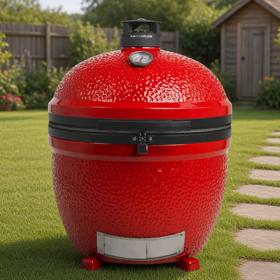
Every kamado sells the same promise: heat that holds steady for hours. Almost all of them keep it the same way. A thick ceramic shell banks heat and gives it back slowly.
The Summit Kamado E6, model 18201001, contains no ceramic at all. Weber built the shell from two steel walls with air trapped between them. Insulation, not mass. It priced the result at $1,399.00, which is ceramic money.
That swap raises one question, and the rest of this page answers it. A barrier holds the heat in; a body would bank it. What changes for the cook?
452 sq inCooking area, all of it on one grate
24 inGrate diameter, edge to edge
14.5 inExtra headroom the lid needs to swing open
$1,399.00Weber's list price, before an $84.99 cover
First Impressions of the Weber Summit Kamado E6
The box is a freight problem before it is a grilling one. The stand arrives flat, and the bowl and lid arrive as one heavy unit. Weber will not help here. It advertises a $99 Angi booking, then excludes Summit models from it.
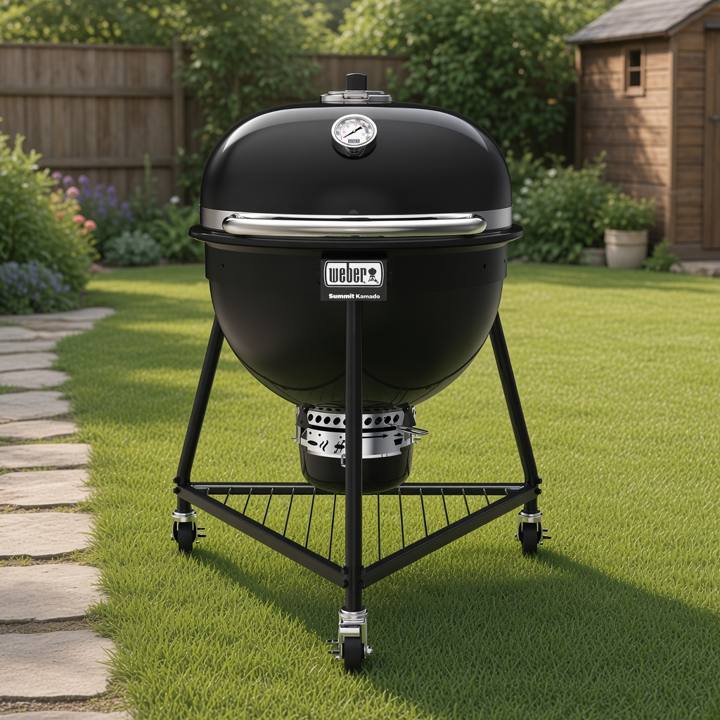
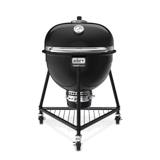
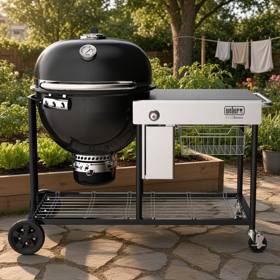
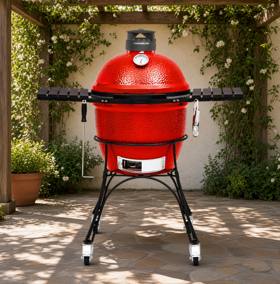
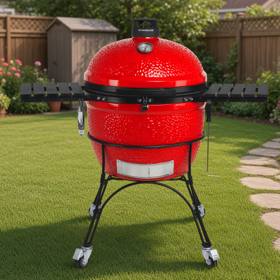
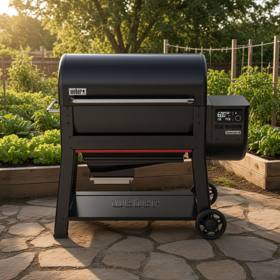
Built, it looks less like a kettle than the parts list suggests. A black tripod frame holds the bowl clear of the ground. A wire rack hangs beneath it. Three swivel casters sit under the frame, and all three lock.
Gloss is what you notice before anything else. Both bowl and lid wear porcelain enamel, hard and glassy under the fingers. A full-width chrome handle spans the front of the lid, and the dial sits above it.
First cook: light a bed in the two Char-Baskets, set the Rapidfire damper open, wait. The lid drops onto its gasket with a soft thud. That sound tells you something, because this is sealed in a way a kettle never is. Steaks come off it with a hard crust and no acrid edge.
Key Features of the Weber Summit Kamado E6
Strip away the shape and this is a kettle’s toolkit fitted to a kamado’s body. Weber reused what it already builds well. Two pieces are new, and they are the ones that matter.
- Dual-walled insulation: Two steel walls with air between them make up the lid and bowl. The air gap does what a ceramic wall does, without the mass behind it. Weber’s own claim for it is speed of change, not steadiness.
- Two-position fuel grate: The charcoal grate lifts to a high setting or drops to a low one. High brings the fire close for searing. Low pulls it away for smoking, and the food never moves.
- Stainless steel diffuser plate: A plate sits between coals and food to break up direct heat. Weber includes it, rather than selling it alongside.
- Gourmet BBQ System cooking grate: Stainless, hinged, with a removable centre. Pizza stone, griddle, sear grate and poultry roaster all drop into that hole, sold separately.
- Rapidfire lid damper: The top vent is hinged, so it swings fully clear rather than cracking open. Wide open, it sets up a hard draw straight through the fuel bed.
- Multiple vents and dampers: Air is the only throttle on this grill. Nothing here is electric, and the one fan port Weber built in ships without a fan.
- Stainless steel One-Touch cleaning system: Three blades sweep the bowl floor and drop ash into a removable aluminium catcher. The lever is outside the bowl, so nothing hot gets handled.
- Three swivel locking casters: The tripod stand rolls and then locks. A ceramic kamado of this diameter stays where two people put it.
- Built-in lid thermometer: One dial, set into the lid above the handle. What it reports is the air under the dome.
Insulation and mass are not the same tool, and the difference shows up as timing. A ceramic body absorbs heat on the way up, then releases it on the way down. The E6 has less to absorb, so more of the fire reaches the food sooner.
That cuts both ways, honestly. Getting to searing heat takes less fuel and less waiting. Coming back down takes a hand on the dampers, not a wait for cooling stone.
Weber leans into this. Its own description reaches for quick rather than steady. That is an unusual pitch for a kamado, and worth reading as a claim about response.
The two-position fuel grate turns that response into two different cookers. Raised, the coals sit close under a 24 inch grate and sear. Dropped, with the stainless diffuser in place, the same load runs low and long.
Where either end actually sits is not something Weber prints. No ceiling, no floor, no charcoal capacity, no hours from a load. The dial on the lid is the only instrument, and it reports the dome.
Build, handling and durability
Materials talk on this page is thin, so read the warranty instead. Three tiers sit in it, split by material. 10 years of rust and burn through cover goes to the porcelain shell. Stainless ash hardware gets five years, and every remaining part gets two.
Read the gap. That shell means the bowl, the lid and the centre ring. Weber backs it five times longer than the hinge, gasket and casters. A lid that seals works its gasket and hinge harder than a kettle’s.
Steel changes what the object is to live with. There is nothing here to crack if a wet lid meets a hot fire. No gauge is published for the walls, the grate or the air gap between them.
Handling is where the steel pays off twice. Three locking casters under a tripod frame mean the grill can move at all. Rolling it off the deck for winter is a decision, not an event.
Running costs, upkeep and value
Charcoal is the running cost, and the dual walls are meant to reduce it. Less heat escaping means less fuel burned to replace it. Weber says as much, then publishes nothing you could check it against.
That is the pattern across this grill’s paperwork. No capacity for the bowl or the two Char-Baskets, no hours from a load. Buy it and you will learn both by burning through bags.
Cleaning is the opposite story. The One-Touch lever sweeps the bowl floor with three blades. A removable aluminium catcher takes whatever the blades push down. Wipe the enamel, brush the grates, and that is the whole routine.
Now the price. Weber lists the E6 at $1,399.00, which puts it among ceramic kamados rather than below them. For that you get casters, a diffuser plate and a 10 year shell.
You do not get a cover. The matching Premium Grill Cover is $84.99 on the same page. Assembly is not on offer either. Weber sells a $99 Angi booking above $399 and names Summit as an exception.
One more omission sits on the spec sheet itself. A fan port is built into the bowl and no fan comes with it. Weber fitted the socket and left the automation to somebody else.
Possible Weber Summit Kamado E6 Complaints
- The instruments have not kept up with the price: One dial in the lid is all Weber fits. It reads dome air, which is not the air around your food. At $1,399.00 a probe thermometer should not be the first thing you buy. The built-in fan port makes the omission stranger, since it anticipates gear Weber does not sell.
- You build it yourself, whatever you would rather pay: The $99 Angi booking Weber advertises stops short of Summit models. So the exclusion lands on the grill most likely to need help. Clear a morning, and find someone to help lift the bowl into the stand.