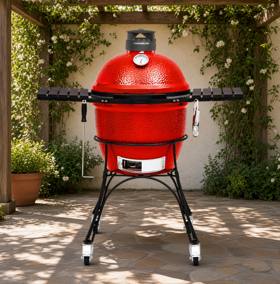
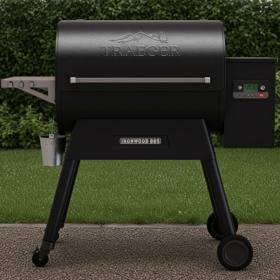
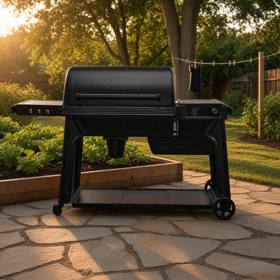
Most kamados are clay. You buy a thick ceramic wall, and the wall does the work. It soaks up heat and hands it back slowly.
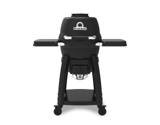
The Broil King Keg Kamado Charcoal, model 420150, keeps that shape and drops the clay. Its shell is double-walled metal. The ceramic sits inside, as bricks around the fire and as a diffuser above it. Street price is around $1,256, which is kamado money.
Everything else about the Keg follows from that swap. Can a metal shell do a clay one’s job? And what does it buy back?
First Impressions of the Broil King Keg Kamado Charcoal
Nothing about the delivery is light. The published weight is 140.4 lb, and nearly all of it is body. The cart assembles first, then the shell drops into it. Get a second pair of hands, or lose an afternoon.
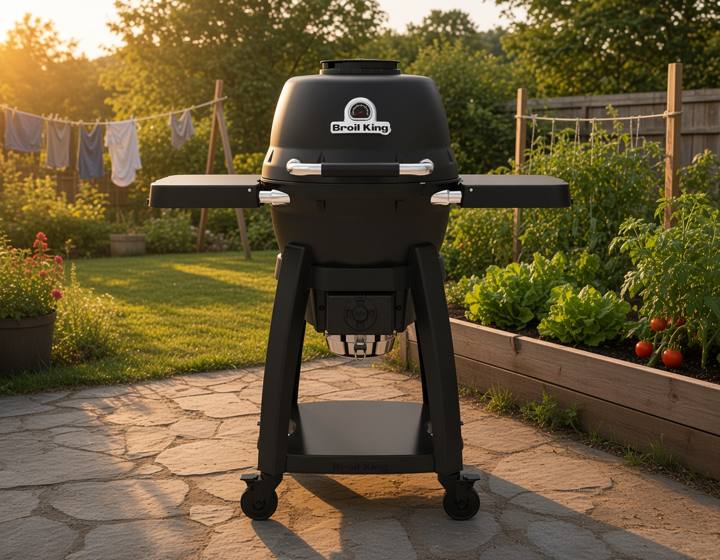
Standing up, it has more presence than the pictures suggest. At 48.5 inches to the top of the damper, it reads tall rather than squat. The finish is flat black everywhere. Chrome shows up only at the handles.
Two details land straight away. The lid latches shut with a clunk. The cast damper on top turns with real weight behind it. Cheap vents rattle, and this one does not.
First fire behaves the way a kamado should. The body takes its time coming up. Then the needle simply stops moving. Chicken thighs off the lower grid came out with dark, even bars and no dried edges.
Key Features of the Broil King Keg Kamado Charcoal
The feature list here is unusually physical. There is no app, no probe port and no fan. Almost every dollar went into metal you can put a hand on. The cleverest part is a grid you turn over.
- Reversible cast iron grid: one face leaves a 1/4 in gap between the bars, the other 3/4 in. Flip it tight for searing. Flip it open when fat needs somewhere to fall.
- Ceramic where the fire is: heat-retaining bricks line the firebox, and a ceramic diffuser turns the cooker indirect.
- Two dampers, nothing electric: the cast iron damper on top and a bottom vent are the whole control system.
- Dual-level stainless charcoal grates: fuel can sit high and close for steak, or low for pork.
- Elevated stainless rack: the second of the two levels, and where the 405 sq in total comes from.
- Quick-release ash collector: a pan pulls out beneath the firebox, rather than being scraped out from above.
- Stainless steel at the contact points: the lid handle, the charcoal grates and the upper rack.
- Latch-and-lock lid: it seals rather than resting, which is what makes damper control mean anything.
- PelletReady body: the shell accepts a separately sold pellet module with Bluetooth and wi-fi.
- Rotisserie: offered as a Premium Rotisserie Kit alongside the grill, not supplied in the box.
- Removable resin shelves: both lift off with their tool hooks attached. Each handle carries a bottle opener.
Read the list and the shape of the product is clear. Broil King built a charcoal cooker that expects to be used often and moved. The smart parts were all left as options.
The case for this grill is that it reaches kamado behaviour by another route. Mass in the walls is only one way to hold a fire steady. A sealed double-wall body, ceramic packed around the coals and two dampers is another.
In use, that distinction disappears. Once the bricks are hot, the body stops leaking. The latch holds the lid down, and small damper moves change something real. Fire management stops being a fight and becomes a setting.
The grid is what you notice most. On the 1/4 in face, the bars carry heat straight into the meat. Turn it over and the 3/4 in gaps let drippings fall clear. Two cooking characters, one casting, no tools.
Underneath, the dual-level charcoal grates give a second axis. Fuel set high puts the fire close for steak. Dropped to the lower position, the same load reads as gentle. Most kamados make you settle that argument with the dampers alone.
One honest gap. Not one number in degrees appears on anything Broil King publishes here. Neither page we read states a ceiling, a floor or a recovery time. What the specification does establish is the machinery, and it is the sort low-and-slow cooks trust.
Build, handling and durability
Something odd turns up in the maker’s own pages. The product description calls the firebox and lid cast aluminum. The same page then closes by calling the grill durable steel. The listing gallery heads its construction card “Double-Wall Steel Construction”.
Three statements, one grill, and they do not agree. That matters, because metal against ceramic is the choice a kamado buyer is actually making. A shopper deserves to know which metal.
The height is loose too. The gallery card gives 48.5 inches, the product page 48.8. Small, but it is the same measurement from the same company.
The rest is not in doubt. Grids are cast iron and the top damper is cast. Charcoal grates, upper rack and lid handle are stainless. The cart carries four large locking castors, and they are why this kamado moves at all.
The weak note is resin. Shelves and handles both use it, and at this price a buyer could reasonably expect otherwise. Neither part sits in the fire, so this is cost, not risk.
Running costs, upkeep and value
Fuel costs little here, because a latched kamado wastes almost none of it. The latch and two dampers let the fire burn at the rate you set. The wind does not get a vote.
Shutting both vents at the end smothers the coals. What survives goes into the next cook. Over a season that habit matters more to running costs than the price of the bag.
Cleaning is where the design quietly wins. The ash collector pulls out from below. Emptying is short work, with no reaching down through the cooking grid. Cast iron grids want oiling rather than scrubbing, which suits a cooker used every week.
The accessory list repays a careful read. Broil King’s own description sells a ceramic diffuser cooking system. The same page also sells a Keg Diffuser Kit at $64.99 Canadian. Ask the retailer which parts are in your carton before ordering.
The rest of the catalogue is cheerful enough. A griddle is $49.99 and a pizza stone $59.99. The pellet module that makes this a hybrid carries no published price at all.
Against a maker’s list of $1,699 Canadian, around $1,256 reads well. The cooking hardware is all present for that figure. But the grill in the gallery is not quite the grill that arrives.
Possible Broil King Keg Kamado Charcoal Complaints
- The warranty is written two ways: the product page grants 15 years on the cook box, lid and grids. Remaining parts and paint get 2 years. The badge in the listing gallery instead says 15 years top to bottom. Owners find out which version applies at the moment they claim.
- The hybrid on the listing is a separate purchase: pellet cooking needs a module that is not in the box. It is absent from the brand’s own Keg accessory list, and unpriced. Budget for a charcoal grill and treat pellets as a maybe.