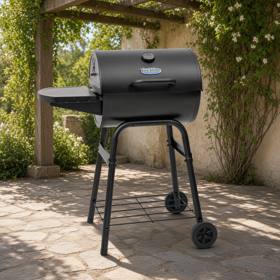
Most grill buying is a choice between fuels. Gas is fast and controllable. Charcoal tastes better and takes longer. Almost everyone picks one and quietly misses the other.
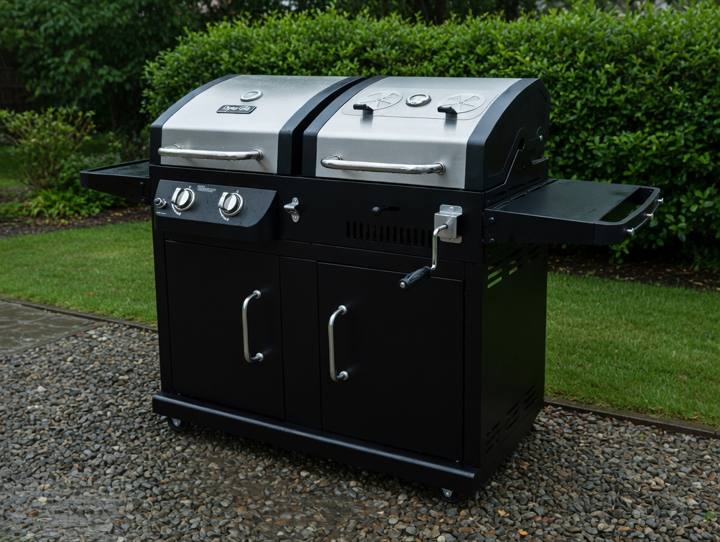
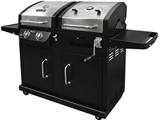
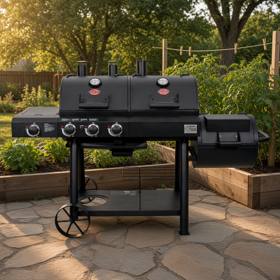
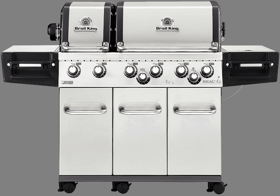
The Dyna-Glo DGB730SNB-D refuses the choice. It puts a two-burner gas grill beside a charcoal grill, on one cart. Each half keeps its own lid line. Each side has its own firebox and its own grate.
So the question is not whether dual fuel is appealing. It obviously is. The question is what you give up to get both, and where that cost actually lands.
First Impressions of the Dyna-Glo DGB730SNB-D
The first thing this grill communicates is width. Two full cooking chambers sit next to each other, with a double-door cabinet underneath. It reads as a piece of outdoor furniture rather than an appliance.
The finish is stainless and black, and the grates are the good news. Porcelain-enamelled cast iron is the material you would want. Both sides get it.
It holds heat and needs no seasoning. It will not rust while the enamel stays intact.
Then the two halves start to feel different. The gas side lights on a button and is ready in minutes. The charcoal side needs fuel, a chimney and patience, exactly as it would on its own.
That difference is the whole product. One machine, two temperaments, and the cook decides which one the evening calls for. Nothing about the design tries to blend them.
Key Features of the Dyna-Glo DGB730SNB-D
The feature list matters more than usual here. Two cooking systems mean twice as many things to get right. Dyna-Glo publishes a clear set for the gas side and a thinner one for charcoal.
- Two 12,000 BTU gas burners: They serve the gas side only, which is 365 square inches. That works out at roughly 66 BTU per square inch. For comparison, that is genuine searing heat rather than a token gas option.
- Charcoal adjustment crank: The charcoal side raises and lowers its fuel bed. Moving coals closer to the food is how a charcoal cook controls heat. It is the charcoal equivalent of a burner knob.
- Porcelain-enamelled cast iron grates: Both sides get the same material. Cast iron holds heat through a cold steak, and the enamel keeps it from rusting. This is a better grate than the price band usually buys.
- Electro pulse ignition: The gas side lights on a button rather than a match. Dyna-Glo names it and does not explain it. The charcoal side, of course, still needs lighting the old way.
- Two collapsible side tables: Each is powder-coated steel and rated to hold 25 pounds. They fold down when the grill has to fit through a gate or against a wall.
- Two lid temperature gauges: Each lid carries its own readout. Two fireboxes running at once need two numbers. Sharing one gauge would have made the dual-fuel claim thinner than it is.
- Aluminized steel inner lid wall: The lid liner sees the most heat and the most moisture. Aluminized steel is there to slow that down.
- Double-door cabinet: The base encloses the tank and whatever else lives with the grill. On a cooker this wide, the storage is not incidental.
- Secondary cooking racks: 111 square inches per side sit above the main grates. They take buns, vegetables and anything finished early.
The gas side is more serious than dual-fuel grills usually manage. Two 12,000 BTU burners over 365 square inches gives about 66 BTU per square inch. That is enough to sear rather than merely cook.
The charcoal side is where the published record thins out. Dyna-Glo describes the adjustment crank but gives no temperature range and no output figure. That silence is worth respecting. Charcoal heat depends on fuel and airflow, not on a rating.
Running both at once is the real capability. A crowd cook can put burgers over gas and something slower over charcoal, with no juggling. Very few grills at any price let one person do that.
What you cannot do is use the whole machine for one cook. Each side is its own sealed chamber with its own fire. You buy the width of two grills and cook on half of it at a time.
That shapes how you plan a cook. A large party means lighting both sides early. A quiet weeknight means one side and a cover over the other. The machine rewards deciding before you start.
Build, handling and durability
The materials are better than the category average, and they are specific rather than vague. Cast iron grates with porcelain enamel on both sides. An aluminized steel inner lid wall. Side tables in powder-coated steel with a stated 25 pound rating.
Storage deserves a mention too. The cabinet doors hide the tank and the charcoal bag together. Both fuels live in one place, which matters on a grill this wide.
Handling is a two-person job on delivery day. The cabinet and twin chambers make this heavy and awkward to place. Once sited, it is not a grill you move often.
A published load rating is a small thing that signals a real one. Most manufacturers say “sturdy side shelves” and stop. Dyna-Glo says what they hold. A claim that can be wrong is a claim that means something.
The gap is the warranty, and it is a real one. Dyna-Glo publishes no warranty terms for this model on its own product page. Not a length, not a component breakdown, nothing.
That absence matters more on a dual fuel grill than on a simple one. There are two fireboxes and two sets of hot metal. The charcoal side runs uncontrolled by design. Get the terms from the seller in writing before buying.
Running costs, upkeep and value
Two cooking systems mean two running costs, and they behave differently. The gas side burns propane at a predictable rate. The charcoal side burns money by the bag and time by the hour.
Habits matter more than either fuel bill. A cook who lights charcoal weekly spends more than one who saves it for Saturdays. The grill does not push you either way.
Upkeep is the honest weak point. Cast iron grates want oiling if the enamel ever chips. The charcoal side produces ash after every cook. There are two fireboxes to clean here, not one, and neither cleans the other.
Set against that is what the cart replaces. Buying a decent gas grill and a decent charcoal grill separately costs more. It also takes more space. For a cook who genuinely wants both, that is the argument.
The specification sheet does complicate the value case. Dyna-Glo’s own page states 952 total square inches and 730 primary. Its comparison table prints 467. Three numbers for one grill is not a rounding difference.
Possible Dyna-Glo DGB730SNB-D Complaints
- The spec sheet argues with itself: The same page gives 952, 730 and 467 square inches for the same cooker. It also tags the fuel type as charcoal on a grill named dual fuel. None of it is fatal, but it makes every figure worth checking twice.
- No published warranty at all: Most makers publish a term even when it is short. Finding nothing is different from finding something disappointing. On a grill with two fireboxes, that is the specification a careful buyer would most want.