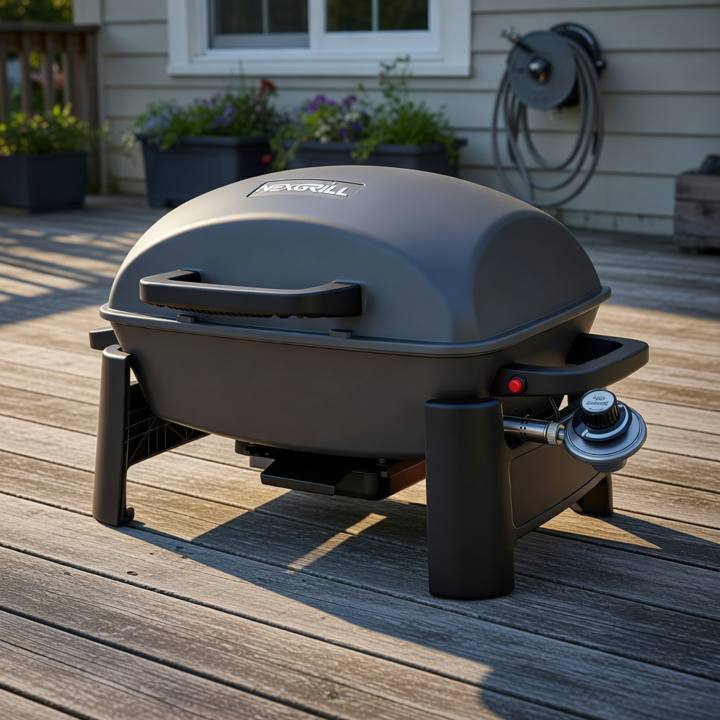
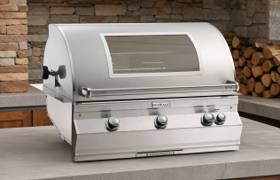
Nexgrill built the Fortress 1-Burner out of castings rather than folded sheet steel. Model 820-BC002 has a cast aluminum lid sitting on a cast aluminum firebox. That is the material you normally meet a tier or two further up.
Underneath sits one burner, rated at 10,000 BTUs, feeding 203 square inches of grid. Hold those two numbers next to each other and the flame looks thin. Heavy metal costs money. So does a bigger burner, and Nexgrill picked the metal.
The question is whether that trade works. Can a thick aluminum box make a small flame cook like a larger one? The answer shapes everything else about living with this grill.
10,000 BTUsOutput from its single burner
203 sq. in.Cooking surface, per Nexgrill
49 BTUsHeat per square inch it has to cover
NoneGauges fitted to read that heat
First Impressions of the Nexgrill Fortress 1-Burner
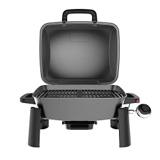
Unboxing takes about as long as reading this paragraph. Body, lid and legs turn up already married to each other. The only job left is dropping in two grid halves.
Lifting it out of the carton tells you most of what you need to know. The finish is a flat gunmetal. Black handles sit at each end, and a single knob sits on the right. Four stubby legs stand the firebox clear of whatever it rests on.
One press of the red button and the piezo cracks. The burner catches with a soft thump and then disappears behind its flame tamers. Shut the lid a few minutes. The warmth spreads through the whole casting, handles included.
First cook was burgers and sausages, four patties across the middle with room around them. The sear came off the grid bars rather than from any roar underneath. Bars this heavy stripe the meat instead of just browning it.
Sausages took their time and were better for it. Food tasted the way food does off hot iron, which is to say properly. Nothing about the first hour felt like a hundred-dollar grill.
Key Features of the Nexgrill Fortress 1-Burner
The specification for this model is short and almost entirely about metal. One thing worth knowing before the list: two cooking areas are in circulation for it. Nexgrill’s own page gives 203 square inches. The retail listings for the same model say 183.
We use the maker’s number here, and flag the gap rather than quietly picking a side.
- Cast aluminum lid and firebox: The lid is a 2.55mm die-casting. Aluminum cannot rust, and metal this thick stores heat instead of shedding it.
- Cast-iron cooking grids: Two porcelain-coated pieces, 7mm through the bar. Each half lifts out alone, which helps on a grid this shallow.
- Stainless steel where the fire is: The single burner is 304-grade, and so are the 0.8mm flame tamers above it. Both parts live in the flame, and both got the good alloy.
- Push-button igniter: A piezo system, so there is no battery to go flat between seasons.
- One knob, and nothing to read: Heat is set by hand and judged by eye. No gauge sits in the lid.
- Nothing hung off the sides: No side shelves, no side burner, no tank enclosure, no casters. The outline stays as narrow as the firebox itself.
That last bullet is not a complaint so much as a description of the tier. The maker’s own spec table says N/A more often than anything else. A buyer is better served by that than by a page of hedged claims.
The whole case for this grill lives in one ratio. One burner makes 10,000 BTUs, and 203 square inches wait to be warmed. Do that division and each square inch is allotted about 49 BTUs. It is a modest allowance, and the castings are what make up the difference.
The flame tamers matter more here than they would on a four-burner grill. One stainless tube cannot cover a grid this wide on its own. The 0.8mm plates above it catch that flame and push it outward. Drippings landing on them make the smoke that does the seasoning.
Preheat with the lid down and the box turns into a heat store. Food then cooks off hot metal as much as off burning gas. Burgers, chops, sausages and skin-on thighs all suit that rhythm. Thin fillets and anything wanting a short violent blast suit it less.
The bill arrives the moment the lid comes up. A small burner refills a big cold space slowly. Peek often and the grill spends the session climbing back. It holds heat better than it makes it, and cooking to that is the skill.
Build, handling and durability
Across a table it takes 23.3 inches, and 16.25 inches front to back. Height comes to 13.5 inches with the lid down. That is picnic-table sized rather than rucksack sized. Nexgrill gives the lid thickness to two decimal places and the weight nowhere at all.
Corrosion is how most cheap portables end, and castings sidestep it. Aluminum oxidises at the surface and then stops. Two parts actually sit in the fire: the burner and the tamers. Both are 304-grade stainless rather than aluminised steel.
Moving it is a two-handed job. The end handles sit low on the firebox, which keeps the load close to your body. Nothing detaches except the two grid halves.
Little can be left behind at a campsite, and nothing rattles loose in a car boot. Legs, body and lid travel as one object. For a grill meant to move, that counts for more than a low weight would.
Running costs, upkeep and value
Nexgrill asks $109.97, and the retail listing on our record matches that figure. Little else on that shelf is put together from castings. Porcelain cast-iron grids, stainless in both hot parts, aluminum everywhere else. Those are the materials of a grill two tiers up.
Upkeep is mostly a grid job. Metal scrapers and porcelain do not get along. A brass brush and a cloth are the right tools. The halves come out one at a time, which makes them manageable at a sink.
The aluminum body wipes down cold and shows almost nothing. Castings have no seams to trap fat and no paint to blister off. That is worth as much over five seasons as any coating claim.
The warranty is five years on the main burner. That is the component most likely to need it. Five years of cover at this price is not a token gesture. No term is published for the firebox, the lid or the grids.
An aluminum casting failing is unlikely, but silence is not the same as cover.
Fuel costs behave as they do on any small propane grill. One modest burner is a modest draw, and much of a cook is idling. Nothing here burns hard enough to surprise anyone at the refill counter.
Possible Nexgrill Fortress 1-Burner Complaints
- No way to read the heat it works so hard to keep: The entire design argument is thermal mass. Nothing on the lid reports how much of it is in there. You cook by clock and by instinct instead. A separate probe fixes that, but this grill should not need one.
- One burner means one heat, everywhere: A single tube sits under the full grid, so every inch sees the same setting. A thick chop that wants a gentle finish has nowhere to go. Cooking in smaller loads is the workaround, no great hardship on 203 square inches.