Kamado Joe sells three versions of one 18-inch ceramic body. Its page prices them at $999.99, $1,499.99 and $2,199.99. The Classic II, model KJ23RHC, is the middle rung.
Its cooking numbers are the body’s numbers. The grate is a circle 18 inches across, 250 square inches in all. Kamado Joe publishes a band of 225 to 750 degrees. So where does the extra money go?
Kamado Joe answers that on its own page. The Classic II has everything the $999.99 Classic has, plus more. The “more” is a hinge and a top vent. Neither one touches the fire, and both live on the lid.
First Impressions of the Kamado Joe Classic II
Getting it into place is the first real job. The assembled grill weighs 227.7 lbs. That is not something one person walks up a step. Plan for two people and a clear path to the spot.
Assembly is mostly the cart. The ceramic body settles into a steel frame on locking wheels. The folding shelves bolt on either side of the band.
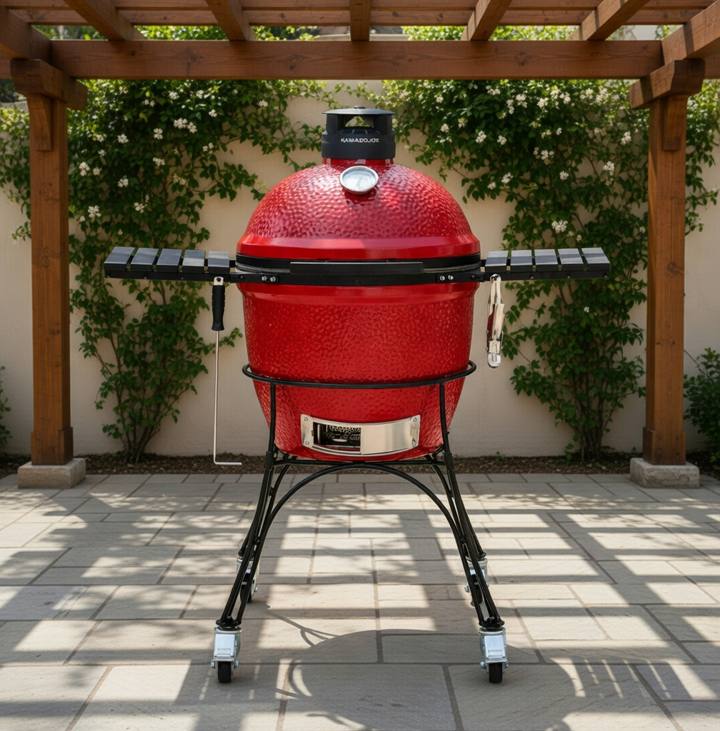
Standing finished, it reads expensive. The red glaze has a dimpled, almost pebbled surface to it. The top vent is a squat black tower, and it looks like hardware rather than trim.
Then most people lift the lid, which is exactly the pitch. The dome rises easily and stops wherever it is let go. On a cooker this heavy, that is a stranger feeling than it sounds.
Site it once and mean it. Allow 46.2 inches of width, and 47.6 inches of headroom above.
Key Features of the Kamado Joe Classic II
Most of this list is the standard Kamado Joe ceramic package. The page says the $999.99 Classic carries it too. Only two entries are the reason this one costs more. Reading the list that way is the fastest route to a decision.
- Two tiers, cut into half-moons. The Divide & Conquer system splits the grate into halves across more than one level. Different foods, different heights, one fire.
- Kontrol Tower top vent. Powder coated cast aluminum, with two adjustments on it. Kamado Joe credits this vent with the 225 to 750 degree range.
- The air setting survives the lid. Open the dome, close it again, and the vent sits where it was left. The tower exists for that one behaviour.
- Air Lift hinge. The dome counterbalances so it can be raised with very little effort. Kamado Joe says “significantly reduces dome weight” and publishes no figure for it.
- Patented ash drawer. Ash falls through and pulls out on a tray. An ash tool comes in the box alongside it.
- Double-thick wire mesh fiberglass gasket. The seal is what lets a ceramic cooker sit on a low fire for hours.
- Stainless steel where hands go. Two parts get it: the grates, and the latch that holds the dome shut.
- Multiple vents, top and bottom. A kamado meters oxygen rather than fuel, so the vents are the controls.
- Built-in thermometer. A dial set into the dome, readable without opening anything.
- Folding HDPE side shelves. They swing down flat against the body, and the handle is part of the same assembly.
- Cart with locking wheels. Included at $1,499.99. The standalone version is $1,399.99 and arrives without any of it.
- AMP Firebox. Kamado Joe names it in the feature list and describes it no further.
A ceramic cooker is a heat store more than a heat source. Charcoal under a sealed dome behaves differently from charcoal under thin steel. The walls give back what the fire has already put into them.
Kamado Joe publishes one band for this grill: 225 to 750 degrees. That covers a pork shoulder left overnight and a pizza floor in the same week. The page then does something unusual with the credit.
It attributes that band to the Kontrol Tower vent rather than to the ceramic. On a kamado the air setting is the throttle, so the claim is fair. The body stores the heat and the vent decides how much fire there is.
This is where the Classic II earns its money, if it earns it anywhere. The throttle stays set. Lift the dome to turn ribs and the vent opening does not move with it. Drop the lid back down and the fire returns to the setting it had.
Anyone who has cooked on a kamado with a loose cap knows the alternative. The cap shifts and the reading drifts. The rest of the cook goes on hunting for the number again.
What none of this buys is a second zone. One fire sits under one round grate. The Divide & Conquer tiers change height, and height changes distance from the coals. That is a gradient, not two fires.
Build, handling and durability
Weight is the honest signal here. At 227.7 lbs this is furniture rather than equipment, and it behaves accordingly. The locking wheels matter more than the wheels do.
The materials show where the money went. Cast aluminum on the vent, stainless on the grates and the latch, ceramic everywhere else. The one exception is the shelves, which are HDPE. That is plastic, folded against the side of a grill listed at $1,499.99.
Then the gap. Search the product page for a warranty and nothing comes back. Ceramic, metal, gasket: no term is attached to any of them.
The grill is not worse for that omission. A buyer in this bracket still deserves the answer before paying. Ask the seller, and keep what they send you.
Running costs, upkeep and value
Running a kamado costs charcoal and very little else. There is no gas bottle to swap, no hopper to fill, no power lead to reach. The sealed body is frugal with fuel. That is most of why people accept the weight.
What Kamado Joe does not publish is how much charcoal the firebox takes. Nor how long a load lasts. Planning a long cook means learning your own grill first.
Upkeep splits into the ash and the seal. Ash drops below the grate and comes out on a drawer. That is about as close to painless as charcoal gets.
The gasket is the part that ages. That seal is what holds a low fire steady for hours. Kamado Joe calls it double-thick wire mesh fiberglass, which is the durable end of the choices.
Value is the harder conversation. At $1,499.99 this grill sits $500 above the $999.99 Classic. That cheaper one already carries the ceramic, the grates, the gasket and the drawer. So the $500 is a hinge and a vent.
Whether that lands depends entirely on how often you open the lid. The cart is a separate $100 inside that same price. Skipping it leaves 227.7 lbs of ceramic sitting on the ground.
Street pricing changes the arithmetic. A check in July 2026 put Amazon around $1,199 and Walmart around $1,359.32. The Kamado Joe page itself was showing the grill out of stock at $1,499.99. At around $1,199 the list price stops being the number that decides anything.
Possible Kamado Joe Classic II Complaints
- The upgrade is the one thing left unmeasured. The Air Lift hinge is what separates this grill from the cheaper one. Kamado Joe calls it a significant reduction in dome weight and stops there. Lifting one in a showroom is the only check available before paying $500.
- No warranty appears on the product page. Cracked ceramic is the failure every kamado owner quietly worries about. The page commits to nothing on it, or on anything else. That is a gap in what got published rather than a bad policy.