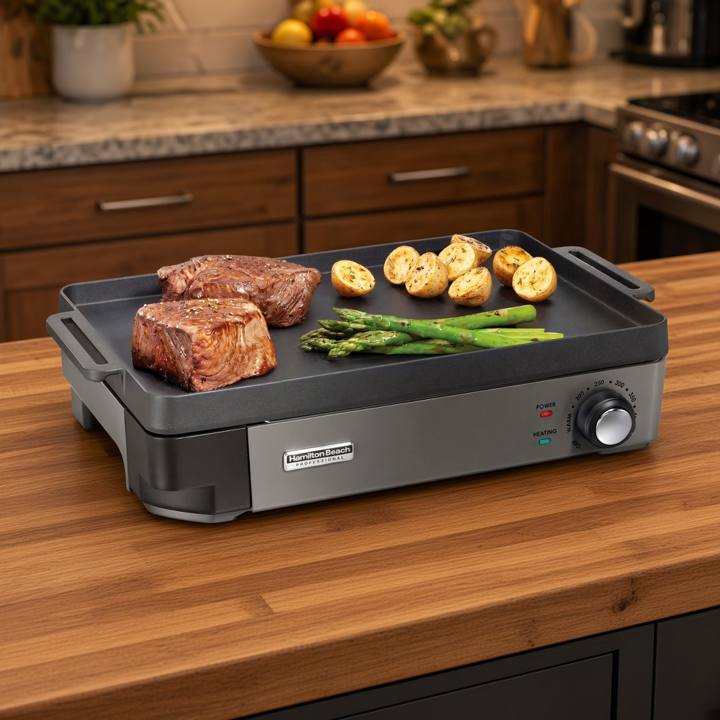
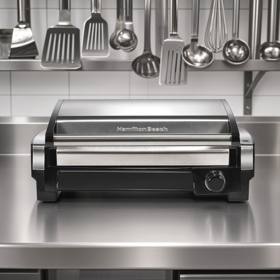
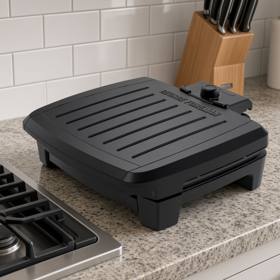
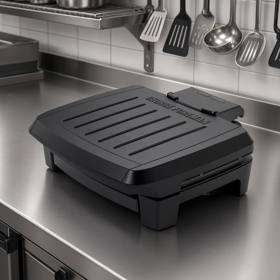
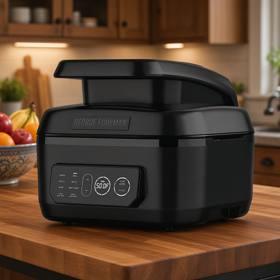
Hamilton Beach calls model 38560 a grill. Look closely at the cooktop and there is not a ridge on it.
What is there instead is cast iron. Flat, preseasoned at the factory, and heavy enough to need two hands. The iron is the entire argument for spending more than a coated plate costs.
Iron does not wear out. It rusts. A worn-through nonstick plate is finished. A rusted one is an afternoon and some oil.
Whether the 38560 cooks well turns out to be the easy half. The harder half is whether you keep that one part alive.
First Impressions of the Hamilton Beach 38560
Nothing needs building. Slide the drip tray in, drop the cooktop on, find a socket.
The shape surprises you first. At 18.9 inches across and 4.3 tall, it reads as a long tray. A brushed stainless facia runs the front, carrying one dial and two small lamps.
Then you pick the plate up. A raised lip runs all the way round. Two loops are cast into the short ends. One corner is cut away into a drain that sits over the tray below.
Underneath is the part nobody photographs for the box. A folded tube element lies exposed in a shallow stainless pan. The plate merely rests above it.
Hamilton Beach asks for a wash before the first cook. Then a lint-free cloth and a little oil. It also warns that the first heat will smell. Run the dial to its top mark with the windows open and that passes.
First proper cook, a sirloin and a tray of halved new potatoes. Browning arrives steadily rather than instantly. It keeps arriving when the cold potatoes land beside the steak.
Key Features of the Hamilton Beach 38560
The feature list is unusually short here, and almost none of it is electronics. Two decisions carry the whole product. What the surface is made of, and that it comes off. Everything else on the machine exists to serve one or the other.
- Preseasoned cast iron cooking surface: Ten by sixteen inches of it, seasoned before it ships. Hamilton Beach rates it for metal, wooden or plastic utensils up to 450°F (232°C).
- A cooktop that lifts off: Two cast handles, and the plate clears the base completely. What that buys is a base you clean with a damp cloth rather than around.
- 1800 W on a 120 V, 60 Hz supply: A 15 A draw, which is most of a kitchen circuit. The manual asks you not to run another hungry appliance alongside it.
- A dial marked in numbers: Eight positions, from OFF and WARM through every fifty degrees between 200 and 450. You choose a figure rather than a vague position.
- Red POWER and green HEATING lamps: The red one is lit whenever the plug is in. The green one cycles as the thermostat works.
- Grease drain and removable drip tray: The drain is cast through the plate. The tray slides out beneath it, carrying a MAX fill line. Running the grill without it is forbidden.
- Stainless steel: The front face of the base, where the dial, the lamps and the Professional badge sit.
- Moulded cord wrap: On the back of the base. The flex stores with the machine, not beside it.
What is absent shapes the cooking just as much. There is no lid, and nothing reports what the surface is doing. Food has nowhere cooler to go, and nothing here is rated for outdoors.
The electrical rating is the figure that stands out in this class. 1800 W is a great deal of power to put under 160 square inches.
That power is only half the story though. What cast iron contributes is not speed, it is refusal to be cooled down. Lay six cold burgers across the plate and the surface underneath them does not collapse.
The ceiling is where the ambition stops. The dial’s last mark is 450. Hamilton Beach’s own food guide places searing at 375° to 400°F. Above that, 400° to 450°F is labelled browning and blackening.
Grilling sits lower still, at 325° to 375°F. Those are a griddle’s bands, written by the company that named this a grill.
Two things limit what you can attempt. Flat iron browns across the whole face of the food, so bars never appear. With no lid, heat only ever arrives from below. A thick cut has to be turned and waited out.
There is also a question over evenness, and it is Hamilton Beach’s own. The plate rests on the element rather than being bonded to it. The manual carries a listed condition headed “Cooking performance is uneven”. Its remedy is to wait for the green lamp, which is where the documentation falls apart.
Build, handling and durability
The pleasure of this machine is that its materials are named. Cast iron above, stainless across the front. Both are stated plainly, rather than hidden behind the word nonstick.
The handles are the one design cost. They are cast into the plate, so they run as hot as it does. The manual requires oven mitts every time. A plate you lift in mitts is a plate you lift carefully.
The rest handles well. The base is a shallow stainless pan, with nothing under the plate to trap grease. At 4.3 inches tall, it never feels tippy when you lean on a chop.
Failure here looks different from failure in a coated grill. Rust is the thing that goes wrong. Hamilton Beach prints the cure in its troubleshooting pages. Hot soapy water and steel wool.
Running costs, upkeep and value
Electricity barely enters into it, even at 1800 W, because these cooks are short. The real running cost of the 38560 is paid in discipline.
The manual is strict and worth reading before the first wash. Never the dishwasher. Never left to soak, never left to air dry, never stored anywhere damp. Every wash finishes with a thorough dry and a wipe of oil.
Then there is the seasoning routine, the sentence most buyers will never see. Oil the top face, then turn the plate upside down onto the oven’s top rack. Lay foil on the rack below to catch drips.
Bake at 450°F (232°C) for 1 hour and cool it in the oven. An hour of your oven, to maintain a countertop grill. No coated plate in this class asks that.
Hamilton Beach also documents a neat trick for baked-on residue. Bring the plate to 300°F (149°C) with the tray in place. Pour about 1/4 cup of water across it.
Scrape the loosened matter into the drain. You are deglazing your grill.
All of which matters because of what the spares panel looks like. It holds two entries. A drip tray at $5.99, and a replacement cast iron cooktop at $191.99.
The grill lists at $164.99 direct, and Amazon undercut that at roughly $139.99 in September. So the seasoning routine is not optional housekeeping. It is what keeps you off that parts page.
Possible Hamilton Beach 38560 Complaints
- The upkeep is a routine rather than a rinse: Cast iron asks for drying and oiling after every wash. Add an oven hour when the seasoning thins. Buyers who chose an indoor grill to escape scrubbing will feel it in week one. A cloth and a bottle of oil in the cupboard fixes it, unmentioned on the box.
- It is a griddle carrying a grill’s name: No ridges means no bars, and no lid means heat from one side only. Hamilton Beach’s own description slips into calling the same surface a griddle. Judge it as a large seasoned flat-top and it is excellent. Expect steakhouse markings and it disappoints every time.