Two grills in Weber’s Genesis line share a cookbox and a cart. The E-315 and the E-330 both run 39,000 BTU across three burners. Both put that heat onto 513 square inches. Every published dimension matches.
Model 1500576, the E-330, adds a fourth burner Weber counts separately. It sits under a stretch of grate called an extra-large sear zone. Weber rates that burner at 13,000 BTU on its own. The cart also gains doors.
That costs $200 more than the E-315, read the same day from the same site. So the question is narrow. Does the extra burner change how this grill cooks? Or does it only put a name on what three burners already did?
First Impressions of the Weber Genesis E-330
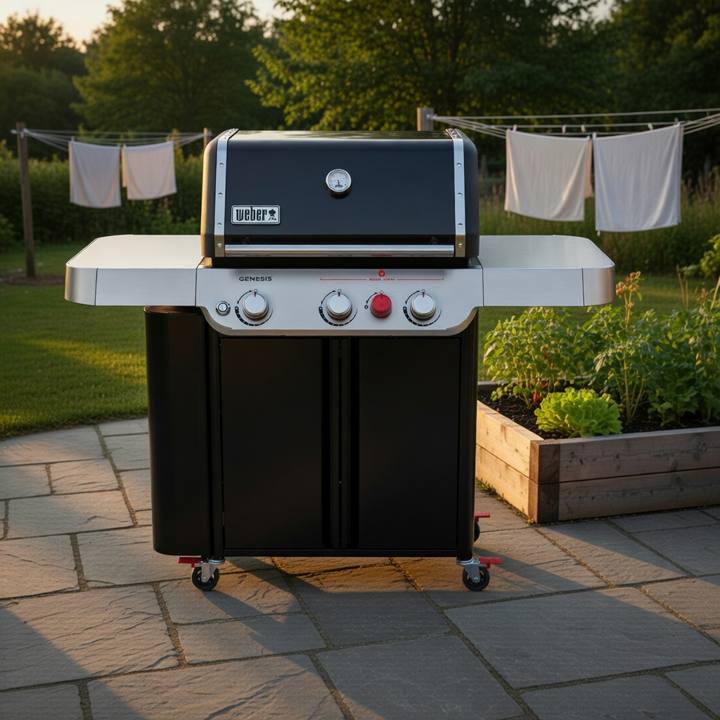
Standing on flagstones, the E-330 reads as a cabinet with a grill on top. The doors are what your eye lands on first. Black, full height, and they swallow the cylinder completely. Its cheaper sibling leaves that job to open air.
Getting there takes an afternoon. The finished grill weighs 168 pounds and most of that mass is cart. Weber will send someone to assemble it for a fixed $99. That offer is a fair signal of the work involved.
The control panel is where the difference announces itself. Three knobs sit in a row for the main burners. A fourth, marked in red, belongs to the sear zone. Nothing else up there has changed.
One evening of cooking said more than the specification page had. Two ribeyes went over the sear zone while asparagus held on the far burner. The cast iron took cold meat without sulking. The crust came out dark and dry at the edges, which is the whole ambition.
Key Features of the Weber Genesis E-330
Most of this grill is shared hardware. The features worth naming are the ones that separate it. That means one burner, one cabinet, and the grate they act on. Everything else is Genesis furniture.
- Sear Zone burner: A dedicated burner rated at 13,000 BTU, listed apart from the mains. It heats one designated stretch of the same grate. That gives you a hard corner without turning three knobs up.
- Three PureBlu main burners: Weber rates them together at 39,000 BTU. The tapered tubes are built to spread heat evenly rather than in stripes. Even across the grate is the baseline the sear zone plays against.
- Cast-iron cooking grates: Porcelain-enameled cast iron over the whole surface. Their mass is the point, because a thin grate cools the moment food lands. They also carry a 10 year warranty of their own.
- Grill locker: Doors close over the cart, so the cylinder and long tools live inside. Weber sizes it for bulky grillware, not just a scraper. This is the half of the upgrade you touch every cook.
- Stainless steel: Weber puts it over the burners as Flavorizer bars, and again in both side tables. What falls off the food lands on those bars and returns as smoke. Stainless there resists the wet, greasy corner of the cookbox.
- Electric Igniter: One AA battery drives the electronic ignition. No cord to run, and no worn piezo to coax. Keep a spare cell somewhere near the tool hooks.
- Grease Management System: Rendered fat collects in a tray you pull forward and empty. Nothing needs to be lifted or unbolted. Emptying it is a job you finish standing up.
- Four casters and six tool hooks: Two casters swivel and two swivel and lock. The grill rolls off the patio edge and then stays put. Six hooks hold more tools than most cooks own.
Weber prints two output figures on this page and never adds them. Main burners read 39,000 BTU. The Sear Zone burner reads 13,000 BTU on a row of its own. Refusing to sum them is unusual honesty from a marketing page.
Weber also describes the grill correctly. Nothing here adds cooking surface. The zone is a designated part of the same 513 square inches. It simply runs hotter than the rest.
So the honest framing is this. You are not buying more grill. You are buying disagreement inside the grill you already had. That matters, because zoning is a skill most gas owners never finish learning.
On three even burners you make a cool side by turning one off. That costs you a third of the grate. Here the hot end is engineered instead of improvised. The cool end stays fully lit and useful.
The grate material carries the rest of the load. Enameled cast iron holds a reserve that thinner grates simply do not have. Stainless Flavorizer bars sit over the burners and turn spillage into flavor. Sear marks and flavor both come out of that combination, not out of raw output.
Build, handling and durability
Build quality on the E-330 is easiest to read at the cabinet. Doors, hinges and a full-height shell add six pounds over the open-cart E-315. They add rigidity too. At 168 pounds it does not shift when you lean on a side table.
Two locking casters hold it against a sloped patio. The other two swivel, so it turns in a tight corner.
Durability, on a Genesis, is mostly an argument about the warranty. Twelve years covers the cookbox and lid against rust-through and burn-through. The stainless burner tubes get ten years. So do the grates, and everything else runs five.
Read that alongside the sibling model and something useful falls out. The cover is identical in shape on both grills. The sear burner is not sold as a longevity upgrade. It is a cooking feature wearing the same guarantee as the rest.
Running costs, upkeep and value
Weber lists the E-330 at $999.00 today, cut from $1,099.00. The E-315 sits at $799.00 on the same site, cut from $899.00. So the gap is $200 at both the old figures and the new ones. It has not moved with the discount.
What that $200 buys is precise, and worth stating plainly. One burner. One set of doors. Zero extra cooking area, because primary area is 513 square inches on both.
There is no side burner either. At this price that reads as a real absence rather than a quibble.
Running the grill is cheap in effort. The cylinder sits inside the cabinet. Swapping it means opening a door rather than unhooking a frame. The grease tray needs no tools to empty.
Cast iron asks for a wipe of oil now and then. The enamel resents a wire brush used in anger. Neither job takes longer than clearing the table.
The value question turns on how you cook, not on what you spend. A cook who works in zones uses the sear burner most weeks. A cook who runs everything at one setting has paid $200 for doors.
Possible Weber Genesis E-330 Complaints
- The upgrade adds heat, not room: The sear zone takes its space out of the 513 square inches already there. Cook for a crowd and you feel it. The hot corner is grate you were using anyway. Nothing mitigates that except planning your batches around it.
- A $999 grill that will not light without an AA cell: The electronic ignition runs on one battery and nothing else. A dead cell turns a one-knob start into a hunt for matches. Keep spares on a tool hook, because that failure always arrives at dinner time.