DCS sells two thirty-inch griddle modules. Both drop into the same hole.
The Series 7 unit lists at $3,999. This one, the Series 9 Evolution GDE1-30-L, lists at $5,299. Both want a cutout 28 1/2 inches wide and 22 3/4 deep. A mason cannot tell them apart.
So the gap between those two prices buys nothing structural. It buys whatever sits in the opening.
This is the propane build, and DCS publishes it on its own LPG page. Every figure below comes from there. What separates it from the natural gas GDE1-30-N turns out to be very small.
First Impressions of the DCS GDE1-30-L
Nothing here arrives ready to cook on. It is a module, sized for an opening somebody else builds first.
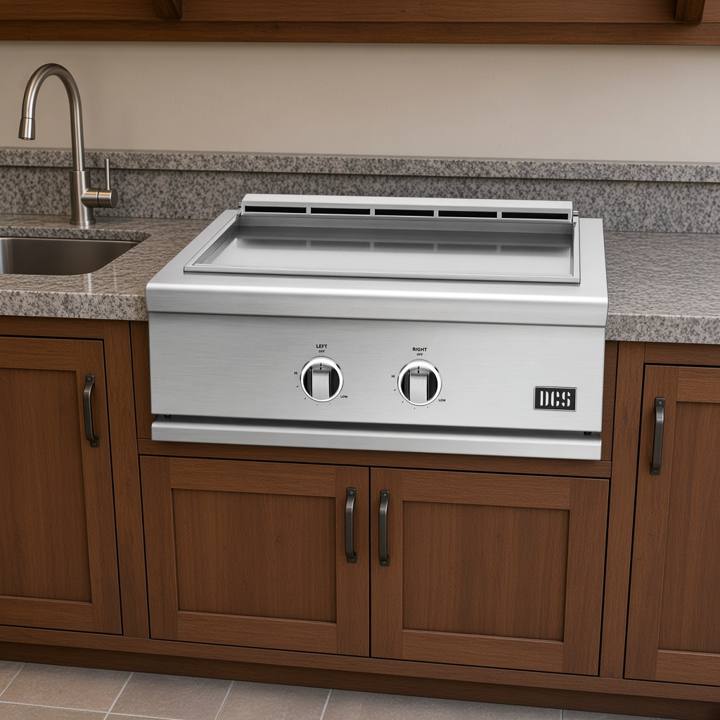
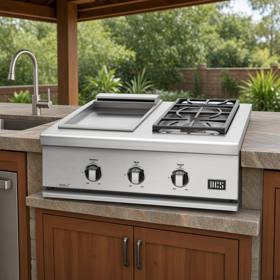
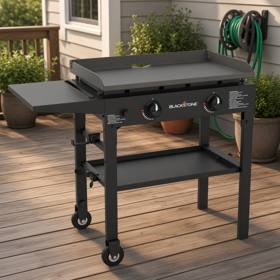
Face on, it is close to austere. Two dials, marked LEFT and RIGHT. OFF sits above each one, with HI and LOW to either side. At the far right sits a small DCS badge, and nothing else.
The lid slides back rather than hinging up. Slide it and the whole cooker is visible at once. One flat sheet of stainless, 8 mm thick, 500 square inches of it.
A vent runs the back edge, and a drip tray pulls out below the dials. Nothing else is on show. Restraint of that order is deliberate at this price.
The plate is the heavy part of the machine. DCS asks for two people to move the unit or handle that plate. It also has to come out before the griddle is carried anywhere.
First cook is not really the first cook. A new plate gets seasoned. DCS wants hot soapy water, then a rinse of water cut with white vinegar. Dry it thoroughly.
Pour two teaspoons of vegetable oil into the middle and heat until it smokes. Turn it off, let it cool, and repeat as the steel asks.
Key Features of the DCS GDE1-30-L
Count the features on a griddle and you run out quickly. There is no rotisserie to describe and no second tier. What there is comes down to burner, plate and the metalwork around them.
- Two 20,000 BTU U-burners. Both on HI draws 40,000 Btu/hr, and that is the entire appliance. Each burner owns half the plate.
- An 8 mm 304 stainless griddle plate. DCS prints the alloy and the thickness together. That plate is the only cooking surface on the unit.
- Surface ignition, running on mains power. Two seconds of push, a turn to HI, then ten seconds held. A flash tube accepts a match if the spark ever fails.
- Illuminated dials that talk to each other. A dial in use glows orange. Turn it off while the other still runs and its halo goes white. All of them dim once everything is off.
- A flame failure device. Gas stops if a burner goes out. On a cooker this expensive it is worth confirming rather than assuming.
- A slide-out drip tray and grease cup. Both live at the front under the dials, reachable without moving anything else.
- A sliding lid. Its job is keeping weather off a cold plate. It is not a hood, and you do not cook beneath it.
- A chassis that carries itself. Into masonry, the unit drops in and hangs from its own side flanges. DCS says no deck is needed underneath.
- Stainless steel throughout. The body is 304 grade, and DCS rates the finish weather resistant.
- Cabinetry sized to the same opening. Access doors are ADN1-30 and access drawers ADR2-30, for the space below.
- An optional cart, under three different names. The product description calls it CAD1-30E, the accessories table CAD1-3E, the installation guide CAD1-30. Whichever code is right, it arrives on its own invoice.
This is where the money went, and it is easy to check. The Series 7 griddle runs one 12,000 BTU U-burner under 244 square inches. This one runs two at 20,000 under 500.
Read that twice. The cheaper unit is a double side burner with a griddle attached to it. The Series 9 is a griddle. That single difference is most of the price gap.
The plate divides down the middle, one dial to each half. Bacon left, pancakes right, and thick steel keeps that boundary from smearing. Heavy steel is slow to warm and slow to give heat up. DCS asks fifteen minutes of preheat, which is the toll that mass charges.
What DCS never publishes is a temperature. The dials read OFF, HI and LOW with nothing marked between them. The copy promises thermostatic control, but no figure anywhere backs a number. You cook by the plate, not by a dial position.
Two zones is also the ceiling here. There is no third setting and no fourth burner to borrow.
Build, handling and durability
Griddles fail by warping. A thin plate bows in the middle. Oil gathers at the low point. You chase it uphill for years.
Eight millimetres of 304 stainless is the answer DCS chose. That thickness is what makes the lift a two-person job. It is also much of why the module costs this.
The chassis follows the same logic. Drop it into a masonry opening and it hangs from its own side flanges. DCS states that no deck is needed below to carry it. The grade is a number, 304, rather than the bare word stainless.
Handling happens once and then stops. Two people lower the module into the cutout, and there it stays. It will not move again unless the plate comes out.
Running costs, upkeep and value
The $5,299 buys the griddle module. After that the list begins, and some of it is trade work rather than shopping.
Built in, this griddle wants an outdoor 120VAC 15A GFI outlet. A 12V transformer comes with it and must sit somewhere dry and serviceable. That transformer runs both the ignition and the glowing dials. The Series 7 griddle lights from a 9V battery and needs no outlet at all.
Propane makes the plumbing harder rather than easier. DCS attaches a regulator and hose intended for a cart. Build the unit in and that assembly has to be removed again.
The installer then supplies flex hose, fixed pipe and a flare adapter. A retention device holds the cylinder, and that cylinder is not included. It has to live inside the island, restrained, with the enclosure vented.
A natural gas buyer skips every part of this. Gas is genuinely the only place the two models part company. Operating pressure is 11 inches W.C. here against 4 on the natural gas build.
Supply runs 12 to 14 inches against 6 to 9. Burner power, cooking area, plate, cutout, voltage, warranty and price are identical on both. One installation guide covers the pair, and a single checklist line forks them.
Day to day the running costs are close to nothing. A flat plate scrapes clean while it is still warm. Grease runs to the tray, the tray pulls out, the cup empties.
Timber framing is the expensive surprise. A combustible enclosure needs the DCS insulated jacket, which widens the cutout to 34 7/8 inches. Clearance above the counter goes from 3 and 6 inches to 12 all round.
Cover also stops at the installation. Faults traced to fitting are not DCS’s to pay for. A trade plumbs, wires and sets this module. That exclusion is worth reading twice.
Possible DCS GDE1-30-L Complaints
- Two years of cover, and a warranty table with no griddle in it. DCS warrants the whole product for two years, parts and labour. Its outdoor booklet then promises lifetime material cover on grill burners, grates and racks. The only Griddle Plate in that table sits under accessories, at one year.
- Propane and built-in is the awkward pairing. The hose DCS fits at the factory has to come straight back off. A 20 lb cylinder then needs a restrained home inside the cabinet. Natural gas buyers plumb in and are finished.
- Reaching a burner means lifting the cooker. The vent assembly comes off, then the plate, and the plate is a two-person job. Adjusting an air shutter is therefore never a five-minute task.