Broil King Regal Pellet 400 vs 500
The 500 adds 125 sq in of grid and 30 lb of steel — on the 400's burn pot and the 400's 22 lb hopper. Why the smaller one scores higher.
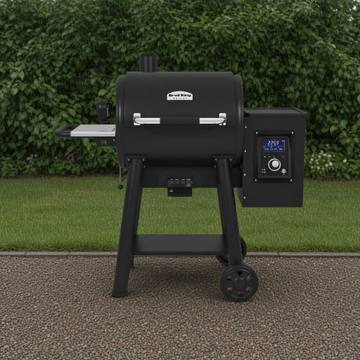
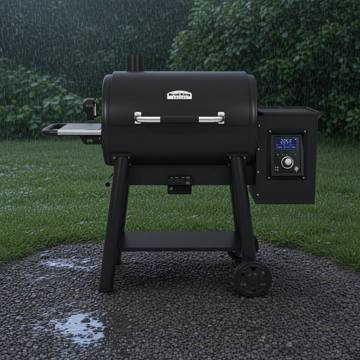
We pick the Broil King Regal Pellet 400
The 400 is the better buy, and the reason is that the 500 grows the box without growing the fire. Both are built like gas cabinets: 2 mm steel, cast iron grids, a double-wall gasketed lid, a rotisserie with spit, forks and motor in the box, two meat probes and app control. The 400 puts that over 500 sq in of primary grid at around $826. The 500 stretches it to 625 sq in and 865 sq in all told — using the same burn pot and the same 22 lb hopper — at around $1,399 US, and gains 30 pounds and six inches of width.
What actually differs
-
The same burn pot under a bigger box
Our reviews score heat performance 8.7 on the 400 and 8.2 on the 500 for exactly this reason: the larger chamber is fed by the smaller grill's burn pot, so the fire has more steel and more air to heat.
-
One hopper, two grills
22 lbs on both. On the 500 that is the same fuel load serving 125 more square inches, which means more refills on a long cook, not fewer.
-
250 pounds and 58.75 inches
The 500 rolls on two wheels at 250 pounds and needs nearly five feet of width. Our review drops its ease-of-use score to 7.4 against the 400's 8.3 on placement and refilling alone.
The scorecard, side by side
Both reviews are scored on the same six weighted categories, each bar on the same 0–10 scale, and every cell carries the reason that review gave. A row is marked won only where the two differ by a tenth or more. How we score →
Mass, a gasketed double-wall lid and cast iron grids suit long cooks, but no operating band backs up the Grill preset.
Two mm walls, a gasketed double-wall lid and cast iron hold heat well, but the burn pot is the 400's, under more grid.
Heavy steel and rated paint last well, yet auger, fan and controller carry the risk, and no warranty term is published.
A stainless burn pot and 2 mm painted steel outlast the category norm; auger, fan and controller carry the wear.
Gas-cabinet material on a pellet cooker: 2 mm steel body, cast iron grids, double-wall lid closing on an oven-grade gasket.
Gas-cabinet material throughout: 2 mm steel chamber, cast iron grids, double-wall gasketed lid, stainless at every hand and grease point.
One dial with Smoke, Roast and Grill presets reads easily, but 220 lbs across two wheels makes placement a two-person job.
The dial and presets read instantly, but 250 lbs and 58.75 in of width make placement and refilling real work.
Around $826 buys the rotisserie spit, forks and motor in the box, plus two meat probes and app control.
Broil King asks $1,499 CAD for 625 sq in against $1,299 for the 400's 500, rotisserie and probes included.
Four mechanisms for one chore: burn pot agitator, removable ash collector, lined hidden grease tray, removable stainless drip tray.
Agitator, removable ash collector, lined hidden grease tray and stainless drip tray; only the cast iron asks for a habit.
Published figures that differ
Quoted from each maker's own specifications, as each review records them. Figures the two products publish identically are left out — only the differences are listed.
Which one is for you
You want the better-fed cooker, the lower price and a cart you can actually move.
Check price →You routinely cook for a crowd and need the 625 sq in badly enough to accept the same burn pot and hopper.
Check price →Every score and figure on this page comes from our own reviews of these two products, linked above. We have not tested them side by side in one place; the comparison is between two full reviews, each built from the maker's published specifications and documentation. Prices move, and the ones quoted are the ones each review checked on its own date.