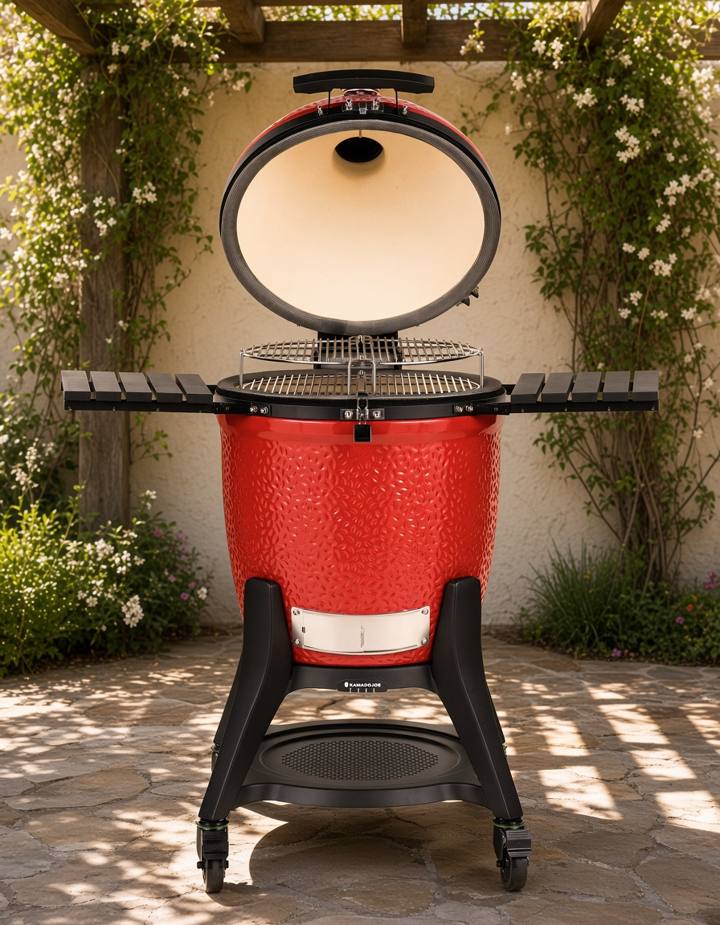
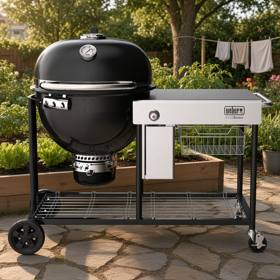
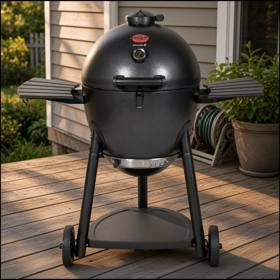
Kamado Joe sells its 18-inch ceramic grill on three rungs. At $2,199.99, model KJ23RHCI sits highest of the three, sold as the Classic III. The Series II below it costs $1,499.99.
Both cook inside the same 18-inch ceramic shell. Both offer 250 square inches of grate and a band of 225 to 750 degrees. Both lids carry the Kontrol Tower vent and the Air Lift hinge.
So the fire does not change between the two rungs. The $700 buys a SlōRoller insert, a third tier, a steel cart and aluminum shelves. Which of those ever reaches the food is the question this grill review answers.
First Impressions of the Kamado Joe Classic III
The scale registers before anything else. On the maker’s scale it comes to 280.6 lbs. Its own sheet gives the Series II 52.9 lbs less, at the same ceramic diameter. Most likely the gap lives in the hardware around the egg.
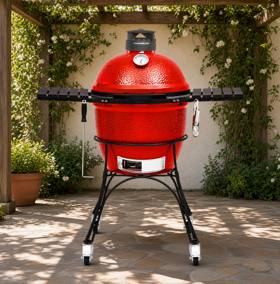
The cart is the obvious suspect. It is powder coated steel, with a storage shelf low down and locking wheels. Amazon’s listing calls the same cart galvanized steel, and the two descriptions never get reconciled.
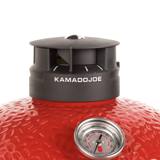
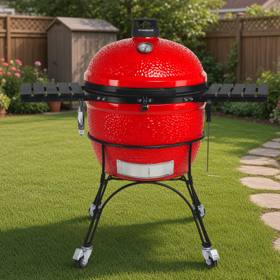
Kamado Joe’s sheet gives 43.1 inches of width and 49.5 of height. The red glaze is pebbled, and the side shelves are dark finished slats. A squat black vent tower crowns the dome.
Open the dome and there is more hardware in there than on a Series II. Half-moon grates stack on a frame at different heights. The SlōRoller sits below them. It is a curved insert, shaped to roll smoke around the chamber.
The case for its price gets argued over a pork shoulder. A quick steak tells you nothing a Series II could not.
Key Features of the Kamado Joe Classic III
Read this list in two halves. Kamado Joe says the Series III carries every feature of the two cheaper rungs. The new items are the ones worth the $700. Everything else already sits on the cheaper grill.
What the Classic III adds:
- SlōRoller hyperbolic insert. Kamado Joe says it turns the grill into a smoker instantly. Amazon copy describes smoke and heat moving in rolling, recirculating waves.
- 3-Tier Divide & Conquer system. Half-moon pieces on three levels instead of two. One fire, three distances from the coals.
- Stainless steel charcoal basket. Lift it out and the spent ash drops away. Unburned lumps stay put for the next fire.
- Finished aluminum side shelves. They fold, and they double as handles. The Series II uses HDPE for the same job.
- Heavy-duty steel cart. Powder coated, with locking wheels and a lower storage shelf.
What it keeps from the cheaper rungs:
- Kontrol Tower top vent. Cast aluminum, adjusted two ways, and credited with the full 225 to 750 degree band. Its setting holds when the dome opens.
- Air Lift hinge. It offsets most of the dome’s weight. The maker’s page calls the reduction significant and gives no figure.
- Double-thick wire mesh fiberglass gasket. Without a tight seal, an overnight fire creeps hotter as air leaks in.
- Stainless steel where hands go. The cooking grates and the latch both get it.
- Multiple vents and dampers. Two openings, one at each end, do the throttling. That is how a kamado gets throttled.
- Built-in thermometer. Its needle answers the oven question while the dome stays shut.
- AMP Firebox and an ash tool. The firebox is named, never described. The listing adds a grill gripper too.
Every heat figure here is a ceramic figure. The same dome holds the same coals and reaches the same 225 to 750 degrees. On searing, roasting or pizza, a Series II cooks the identical meal.
The SlōRoller is where the cooking really diverges. A kamado’s weakness on long smokes is a hot column straight above the fire. The insert is shaped to break that column up and push smoke around the meat. Kamado Joe publishes no number for how well it works.
So the honest claim is narrow. This grill should smoke more evenly than its sibling, and that is the whole cooking upgrade. The third tier helps with crowding rather than with heat. It gives you another height, still above one fire.
That third level earns its keep on a crowded cook. Picture a brisket low, a tray of beans above it, and wings on top. Each piece sits at a different distance from the coals. The dome holds them all, but one vent still sets the fire for every tier.
Searing is the case to think hardest about. A hot direct cook wants the grate close to bare coals. The insert and tiers add nothing there. A Series II sears just as hard.
Build, handling and durability
Run a hand over the parts and the upgrades are easy to find. The shelves are aluminum, not plastic. The grates, latch and charcoal basket are stainless. The vent is cast aluminum, the body ceramic, the cart steel.
The warranty is published in full, and it is layered by part. Kamado Joe backs the ceramic parts for life, if the first buyer keeps the grill. Five years applies to the steel and iron, with deflectors on a three-year clock.
The gasket and the thermometer sit on the shortest term, at two years. Those are the parts that wear first. Registration is required, and buying from an unauthorized seller voids the lot.
Handling is better than the weight suggests. Air Lift springs take the dome’s heft, so a heavy lid feels light. The locking wheels let the cart roll across a level patio. Steps, gravel and lawns are another matter at 280.6 lbs.
Running costs, upkeep and value
Day to day, a kamado runs on lump charcoal and patience. The sealed dome is frugal with fuel. Kamado Joe does not say how much the firebox holds, or for how long.
The basket is the upkeep upgrade that matters most. After a cook, lift it, shake it, and the half-burned lumps stay ready for next time. Ash falls through to the drawer below. Cleanout stops being a scoop-and-sift job.
Gasket wear is the recurring job. The seal compresses with time, and a tired one leaks air on a long smoke. Plan on replacing it eventually, and check the two-year term first.
Now the price, which is where this grill struggles. At $2,199.99 it sits $700 above the Series II and $1,200 above the $999.99 entry rung. Take the cart away and the standalone still asks $1,999.99. That alone outprices a complete Series II, cart included.
Street pricing offers no rescue. Amazon was asking around $2,199 on 16 October 2026, close to list. The discounts that soften a Series II simply were not there that day.
A note on shopping comparisons, too. Amazon’s listing quotes 510 square inches, which counts the tiers stacked together. It also lists 316 pounds against the maker’s 280.6. Compare grills on the maker’s figures, or the arithmetic stops being like for like.
Possible Kamado Joe Classic III Complaints
- Most of the premium never touches the food. Cart, shelves and a third tier are comfort, not cooking. Only the SlōRoller changes a meal, and only a slow one. A searing household pays $700 for a nicer stand.
- Two listings, two different grills on paper. Kamado Joe’s own page lists 250 square inches, at 280.6 lbs. Amazon prints 510 and 316. Neither number is wrong in its own terms, but they cannot be compared directly.