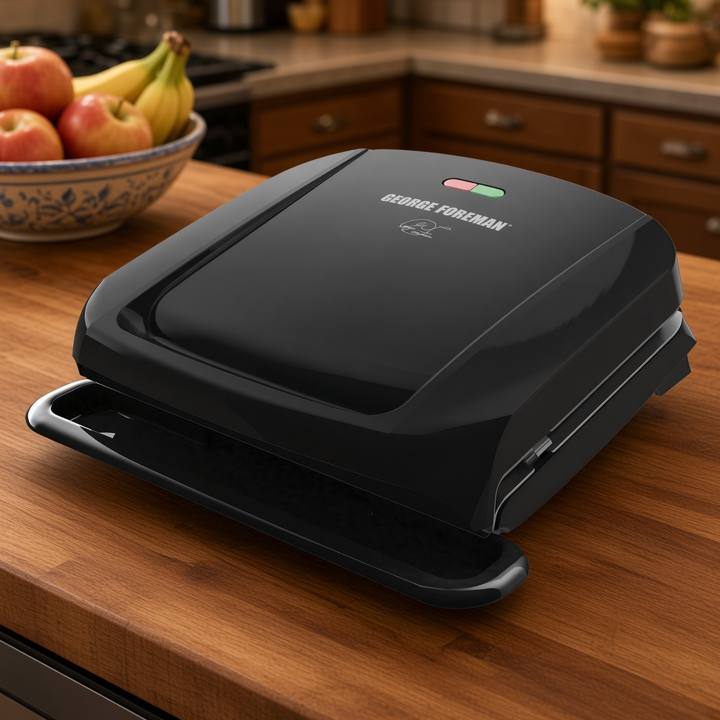
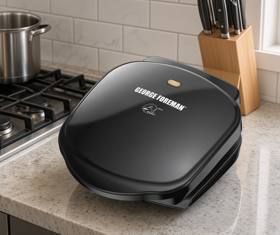
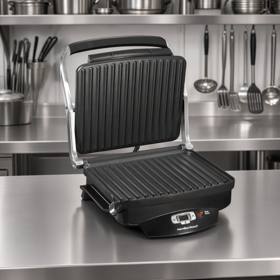
Every George Foreman grill drains fat down a slope into a tray. That part never changes. The plates are where the family splits.
On the GRP1060B, both plates unclip. They go in the dishwasher, and each one carries its own part number. The fixed-plate Foremans leave you scrubbing ribs in place, and their plates die with the body.
So the question is narrow, and it decides whether this model earns its shelf space. What do removable plates and a floating hinge actually buy you? And what does a 60 square inch, one-heat grill give back for them?
First Impressions of the George Foreman Removable Plate Grill
The box opens onto something smaller than a chopping board. The maker’s drawing puts the footprint at 12 inches by 12 inches. The plates arrive already seated, ribbed and dark, with a release tab on each side.
Setup is mostly unwrapping. A plastic band circles the plug, and stickers need peeling. The manual then asks for one empty 15 minute run to cure the elements. Expect a little smoke and smell, so open a window first.
Then comes the routine you will repeat. Shut the lid and plug in. A red light means power, and a green light means the plates are ready. That takes roughly 4½ minutes.
The first cook should be burgers, since the manual’s chart is built around them. Four ounce patties need 5 to 7 minutes for medium. Close the lid on them and the slope does its work, sending grease to the tray.
Grill marks land on both sides at once. That is the whole charm of a contact grill.
Key Features of the George Foreman Removable Plate Grill
This grill is mostly a standard Foreman with one structural change. The plates detach. That one decision ripples through the cleaning, the warranty and the parts list. Read the features through that lens.
- Plates that unclip and wash: Press the tabs on both sides and each plate lifts away. Both are dishwasher safe, as is the drip tray on the top rack. The hinged body itself only ever gets a damp sponge.
- Plates you can buy again: The manual marks the top plate, bottom plate and drip tray as consumer replaceable. Black plates are parts GRP1060-01 and GRP1060-02. A separate parts number, 1-800-738-0245, sits in the warranty section.
- Adjustable-Height Cooking Grates: The floating hinge lets the upper plate rise to the thickness of the food. That is what turns a burger grill into a panini press. The manual asks for pieces of similar thickness, or browning goes uneven.
- Elements embedded in the body: The specification block lists embedded heating elements. The plates sit on top and draw their heat through contact. That is why both must be fitted before power goes on.
- One heat and two lamps: There is no dial, and George Foreman’s own spec block says so. Red shows power and green shows readiness. The cooking chart takes the place of a control.
- A slope that sheds fat: The plates tilt toward the front so grease runs off. From a quarter pound of 80/20 chuck, the maker claims up to 42% drains. The tray catches what drains.
- An Advanced George Tough coating: The nonstick is branded, but its description shifts between sellers. Amazon says 3x more durable, Walmart says 2x, and the current maker page says 8x. We would not buy on any of those multiples.
Wattage matters less when the food is sandwiched between two hot plates. The manual’s rating line gives 1,150 watts at 120 volts. Both Amazon and Walmart print 1,800 watts, a figure the paperwork does not support. Trust the manual.
That power is spread over 60 square inches, and the space is the real limit. Four 4 ounce burgers fit if they are flat and evenly shaped. Four 6 ounce chicken breasts are another matter. The manual gives breast 9 minutes, so a second round adds real time.
For burgers and steak, the fixed heat matters less than it sounds. A rare 7 ounce steak gets 4 to 6 minutes on the chart. Well done takes 6 to 8. Salmon gets 4 minutes and no say in the heat.
A cheap instant-read thermometer turns the chart into something closer to control.
The floating hinge earns its keep on sandwiches. On a rigid pivot, a thick sandwich ends up squashed at one end only. This lid lifts on its pivot and lands flat on the bread.
Two paninis of matching height brown evenly, top and bottom. One tall and one thin will not, and the manual says as much.
Build, handling and durability
The removable plates change the durability picture more than any other detail. Nonstick wears out before the elements do, on any contact grill. On a fixed-plate Foreman, a tired coating means a new grill. Here it means a new plate, ordered by its number.
The rest of the build is less published. George Foreman gives no weight and no shell material. Past the plates, it is a sealed appliance: a special screw keeps owners out. A short cord is fitted on purpose, so plan the counter spot near an outlet.
The clip-in plates bring their own rules. Fit them only when the grill is cool, and never switch on without both locked. Those are small habits, but a hurried cook could break them. Swapping plates on a warm grill is exactly the shortcut the manual forbids.
Running costs, upkeep and value
Running costs barely register on a power bill. The grill draws 1,150 watts for a few minutes at a time. The manual bans outdoor use and wants the lid closed while it runs. This is strictly a kitchen tool.
Upkeep is where the money goes, and it is mostly behaviour. Cooking spray from a can is out, because its residue clings to the coating. No metal tongs, forks, knives or skewers, and no steel wool or scouring pads.
The plates themselves are the easy part. Unclip them once the grill is cold and load them into the dishwasher. Wet tabs and slots are worth drying before reassembly. The drip tray gets washed after every use, once it has cooled.
The price makes the case cleanly. Our check on 20 October 2026 found it at around $41.99, sold by Amazon itself. Walmart showed $55.99 the same day, and the maker charged $49.99 direct in 2019.
Cover runs three years from purchase, with the receipt as proof. The remedy is a similar replacement unit, new or refurbished, not a repair. Liability stops at what you paid. Past those three years, the plate part numbers are what keep the grill going.
Possible George Foreman Removable Plate Grill Complaints
- Four servings is a generous count: Sixty square inches holds four thin patties comfortably and four thick breasts barely. You notice it on a family night when half the plates wait. The fix is cooking in two rounds, which the short times make bearable.
- The listings overstate the power: Retail pages print 1,800 watts while the manual’s rating line says 1,150. A buyer comparing wattage across grills could pick this one for power it does not have. Read the cooking chart for speed, not the box.