Traeger has stopped treating the Ironwood 885 as a current grill. Its own site files this one under Legacy Grills. The brand link on our record opens with the year it launched.
The money moved too. Traeger lists model TFB89BLEC at $1,399.99. On 2026-09-17 the Amazon listing was sitting at around $1,008. Two prices for one grill, with a long way between them.
That gap is the whole review. A superseded flagship always sells for less than it did, and the saving is never free. What does this one actually cost you?
885 sq inGrate area, two tiers of porcelain coated steel
165 FBottom of the dial, and where Super Smoke opens
$1,008Amazon price on 2026-09-17, against a $1,399.99 list
LegacyHow Traeger's own site files this grill today
First Impressions of the Traeger Ironwood 885
Pick the spot first, because this thing is not moving once built. Allow 54 in of run, 27 in of depth, 47 in of height. Then allow a little more.
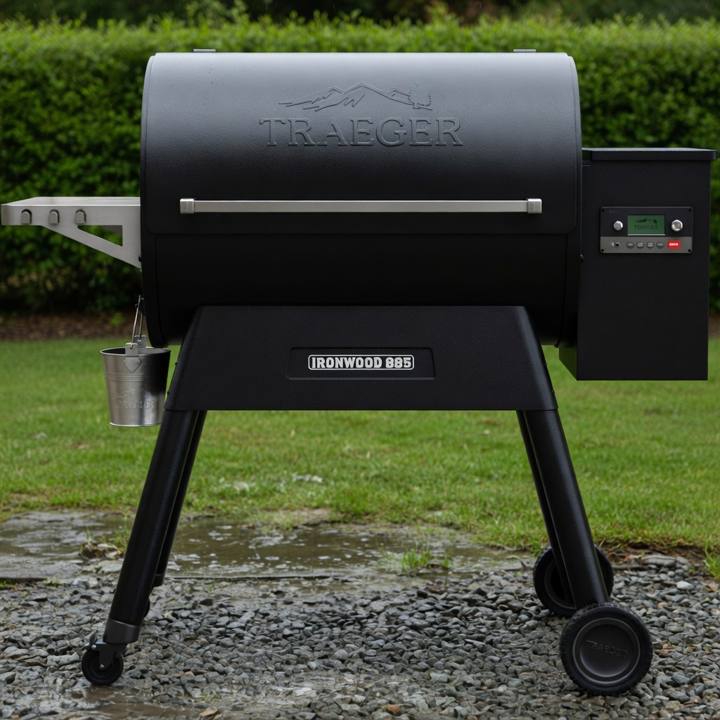
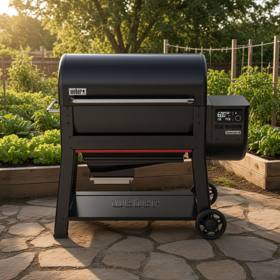
Assembled, it reads as a squat black drum standing on splayed tube legs. The hopper box hangs off one end, the grease bucket off the other. All-terrain wheels are sized for gravel, and they behave on it.
The controller face is where the money shows. A small screen, a dial, an ignite button, and hooks for tongs alongside. Temperature moves in 5 F steps.
First cook should be a slow one. Set 165 F, press Super Smoke, and leave it. The plume thickens, then thins, then turns almost blue.
Pull ribs off the upper tier and the smoke reads sweet, never sooty. That is the case for an insulated pellet barrel in a sentence. Against a stick burner the flavor is mild. It is also far harder to ruin.
Key Features of the Traeger Ironwood 885
This was Traeger’s mid-flagship when the D2 generation launched. The feature list still reads that way. Several rows below have since been trimmed out of the cheaper current line. Two of them are the reason to read on.
- Double side-wall insulation: Traeger builds a second skin into the barrel to steady the internal temperature. Cold mornings and long cooks are where a thin-walled pellet grill wanders. Traeger lists no insulation at all on the Woodridge Pro Plus.
- Super Smoke Mode: A dedicated mode that runs from 165 F to 225 F. Fan control is what does the work, pushing more hardwood smoke across the food. The window here opens lower than on Traeger’s current mid-range.
- WiFIRE and the D2 controller: Put it on the house Wi-Fi once and your phone becomes the dial. Set a number, read it back, answer the probe alarm from the sofa. Adjustment runs in 5 F steps.
- Integrated pellet sensor: A sensor watches the 20 lbs in the hopper and warns you when it thins out. Since no consumption rate exists on paper, that notification is your entire fuel plan.
- Hopper cleanout trapdoor: Unlatch it and the hopper empties into whatever you hold underneath. Swapping hickory for apple stops being a job with a scoop and a bucket.
- Adjustable dual-position smoke/sear grate: The upper grate moves between two heights. Lower for heat, higher for smoke, decided per cook rather than per grill.
- Porcelain coated steel grates: Two tiers, 570 sq in below and 315 above. Traeger names the material here. It does not on the Woodridge Pro Plus or either Westwood.
- Downdraft Exhaust and TRU Convection: Traeger’s names for how air moves through the barrel. Smoke is pulled down across the food instead of straight out of a chimney.
- Electric Igniter: Hold ignite and an element lights the pellets. No match, no lighter fluid, no chimney standing on the paving.
- Keep Warm on the controller face: A button holds the grill at 165 F once the cook is done. Traeger’s own key describes it as keeping food warm without overcooking it.
- TurboTemp and a meat probe: TurboTemp is Traeger’s faster route up to the set point and back after the lid opens. One wired probe comes in the box.
Pellet grills are judged at the bottom of the dial. This one is strongest there.
165 F sits at one end of the dial and 500 F at the other. Super Smoke covers 165 F to 225 F. That is the entire low band, not a slice.
Compare that to what Traeger sells new at the same list price. The Woodridge Pro Plus starts its Super Smoke at 185 F and publishes no insulation. The Ironwood opens the window 20 degrees lower and wraps insulated walls around it.
The top of the dial is the ordinary pellet story. 500 F bakes a good pizza and will not build a steakhouse crust. A heavy pan on the grate is still the answer to steak. Nothing about the D2 generation changed that.
What the insulation buys is steadiness rather than power. A barrel that loses less heat asks its auger for fewer corrections. Over a twelve hour cook that matters more than the ceiling does.
Build, handling and durability
175 lbs is substantial for a barrel this size. Traeger fits all-terrain wheels, and the difference shows on anything softer than paving. Getting it down a step is still a two-person job.
Traeger names the grate material, which is rarer from this brand than it should be. Porcelain coated steel, two tiers. The auger runs on a brushless motor. Brushless is the version of that part you want under a decade of heat.
Traeger does publish the size, just not as text. The figures live in a picture in the listing gallery, not on the spec page. The same picture puts the grill at 170 lbs. The product page says 175.
Running costs, upkeep and value
Start with the arithmetic a buyer actually faces. Traeger’s list is $1,399.99. Amazon was asking around $1,008 on 2026-09-17.
The Woodridge Pro Plus, brand new today, still carries the $1,399.99 ticket. The Westwood XL asks $799.99, with a 450 F ceiling and an 18 lb hopper.
Set those columns beside each other and the Legacy grill wins most rows. Only this one publishes insulation and names a grate material. Only this one runs Super Smoke down at 165 F. The Woodridge Pro Plus offers more grate and less of everything else.
Traeger also ships the argument against this grill inside the listing. One gallery image is its own comparison chart. The Ironwood 885 sits beside the Ironwood and the Ironwood XL. It takes a cross on five rows.
Those five are a touch screen, a wireless probe and the EZ-Clean grease and ash keg. Traeger’s Pop-N-Lock accessory rail and Smart Combustion make up the rest. None of them cook, and all of them are things you would notice weekly.
Then read the paperwork, because it moves the other way. The term is 3 years. It runs against faults in the materials and the making.
Labor and freight are at your expense. Cover requires an Authorized Seller, and it dies if the grill is ever resold.
Here is the part worth sitting with. On the newer Traegers that long headline number buys sheet metal against rusting through. The igniter and the temperature probe drop to a single year.
So three years covering the whole machine is not obviously the worse deal. It is simply the honest one.
Upkeep is light and mostly toolless. Grates and internals lift out, the bucket unclips, the hopper empties through its own door. Before the first flare-up, read what the cover leaves out.
A heat baffle that goes out of shape is your problem. So is a drip tray. So is paint the fire has burned.
Possible Traeger Ironwood 885 Complaints
- Traeger states this grill’s warranty two ways: The product page says three years. The service page lists Ironwood Gen 1 under a seven year schedule. It then gives three years to grills built before October 2021. A claim is a bad moment to learn which rule governs.
- The clauses narrow it further: No Authorized Seller on the receipt, no cover at all. Confirming that gets harder once a brand retires a model. Resale voids it completely. Anyone buying this grill secondhand is buying it with nothing behind it.