First Impressions of the Char-Broil Versa-Tile 28
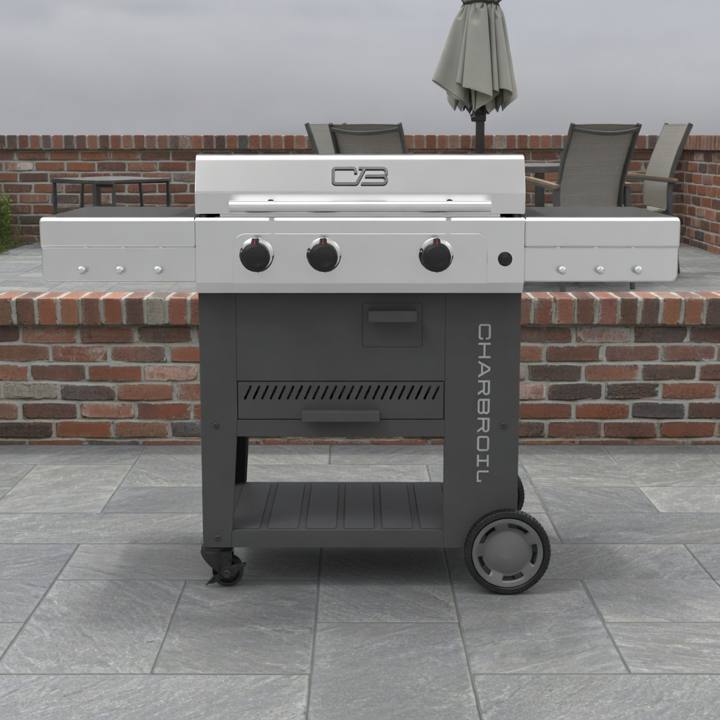
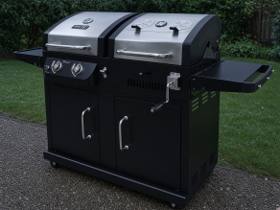
The proportions read as griddle rather than grill. A stainless lid folds down over a flat top. Three knobs sit below it, on a stainless panel.
Both side shelves are stainless and they fold out wide. Fully extended, the station runs 56 inches across. Depth is a more modest 26 inches.
Underneath sits a dark cart with a pull-out drawer. There is a louvred panel, a bottom shelf and six tool hooks. Somewhere for every tile to live is part of the design.
The wheels are worth a second look. Char-Broil lists two locking casters, and the photographs bear that out. This is a cooker that parks rather than one that travels.
At 131 pounds it is substantial without being immovable. Assembly is required, and Char-Broil is upfront about it.
Weight on a griddle is not a drawback. A light flat top rocks when a spatula presses down on it. This one will not.
What the panel lacks is any dial that reads back. There is no temperature gauge anywhere on this station, which becomes the story later.
Key Features of the Char-Broil Versa-Tile 28
- Five cooking modes from one body. Grill, griddle, pizza oven, wok and stockpot, using what Char-Broil calls a patent-pending tile system.
- All the tiles included. The searing plate, the grill grate and the two accessory rings ship with the cooker. None of it follows later as an upsell.
- A hinged, aluminium-lined lid. Char-Broil calls it a cooking dome. It is sold on melted cheese and steamed vegetables as much as pizza.
- 36,000 BTU across three burners. The burners are stainless steel. No per-burner figure is published.
- An anti-warping griddle top. Char-Broil states the surface will not warp under frozen food. Wind blockers run around it.
- Full-length grease management. A patented drip tray runs the length of the cooker and feeds a front-access slide-out cup.
- Integrated storage. A pull-out drawer, two spacious side shelves and six tool hooks keep the tiles somewhere findable.
- Electronic ignition. Char-Broil states it is designed to last the lifetime of the flat top. It runs on a single AA battery, which the box does not include.
- Two locking casters. The cart stays put once positioned, which matters with a lid this wide.
The fire is adequate rather than abundant. Some 36,000 BTU spread across three burners, over roughly 550 square inches of plate.
Three separate burners matter more than the total here. A griddle cooks by zone, and three knobs give three zones across the plate.
That is what makes the tile system work at all. A wok ring wants concentrated heat under it. A pizza dome wants steadier heat around it.
One burner could not serve both. Three can, provided the cook learns which knob does what.
The wind blockers are a real feature rather than trim. Flat tops lose heat sideways, and blocking that is how fuel lasts.
They also make the plate behave predictably. A gust across an unprotected griddle drops one end without warning.
Then comes the gap. Char-Broil lists the temperature gauge as N/A. No heat range appears anywhere on the page.
That is awkward on a cooker sold on pizza. A pizza oven is a temperature argument more than a hardware one. This one asks the cook to judge by eye.
The anti-warp claim is the other half of the performance story. A plate that stays flat keeps its contact with the food. Contact is everything on a griddle.
So the heat is competent and the instrumentation is absent. Experienced flat-top cooks will not mind. Anyone arriving from an oven will.
The practical answer is an infrared thermometer. It is not an expensive tool. It is simply one Char-Broil left for the buyer to work out.
Build, handling and durability
The materials are better than the warranty suggests. Stainless burners, a stainless lid and stainless shelves sit over hot rolled steel.
At 131 pounds the station feels settled rather than portable. Two locking casters carry it, and locking them is the point.
The drawer and the tool hooks are ordinary hardware done properly. Tiles are awkward objects, and this cart was designed with somewhere to put them.
That matters more than it sounds. A modular cooker whose modules end up in the garage stops being modular. Storage at the point of use is what keeps five modes in play.
Where it gets uncomfortable is the paperwork. Every component carries two years: burners, grates, lid, firebox and everything else.
Char-Broil publishes a comparison table lower on the same page. It gives the Medallion Vista ten years of burner coverage. The Pro Series 3-Burner gets ten years too.
Both of those are Char-Broil products, and the table is Char-Broil’s own. The feature copy meanwhile sells these two years as twice what leading griddle brands offer.
Running costs, upkeep and value
Fuel means a propane cylinder, bought separately. That is normal for the category and still worth budgeting.
The AA battery is the first real surprise. An ignition built to last the grill’s lifetime depends on a cell the carton omits.
Upkeep is better handled than on most flat tops. The full-length drip tray feeds a cup you pull from the front. Emptying it means no crouching.
Against that, five cooking modes mean five things to clean. A pizza ring, a wok ring, a plate and a grate all need storing dry.
The hot rolled steel top wants the usual attention. Steel that cooks bare is steel that rusts when neglected.
Value is a real argument at $599.99. Every tile is included, which is the opposite of how most modular cookers are sold.
Compare that against the warranty and the case softens. Two years across the board is short at this price. Char-Broil picked the comparison itself.
Three published cooking areas do not help either. A buyer sizing a family cook cannot tell whether the number is 550 or 543.
The gap is only seven square inches, so nothing turns on it practically. What it costs is confidence. A page that cannot add up its own surface invites doubt about the rest.
None of that undoes the tile argument. It does mean reading the specification twice.
Possible Char-Broil Versa-Tile 28 Complaints
The warranty is the first and the clearest. Char-Broil’s own stack-up table makes the argument better than any reviewer could.
The missing gauge is the second. A cooker sold on pizza that publishes no temperature leaves its headline mode unmeasured.
Third is the arithmetic. One page gives 550 as the total, 550 as the primary, and 543 as the total. Those cannot all be true.