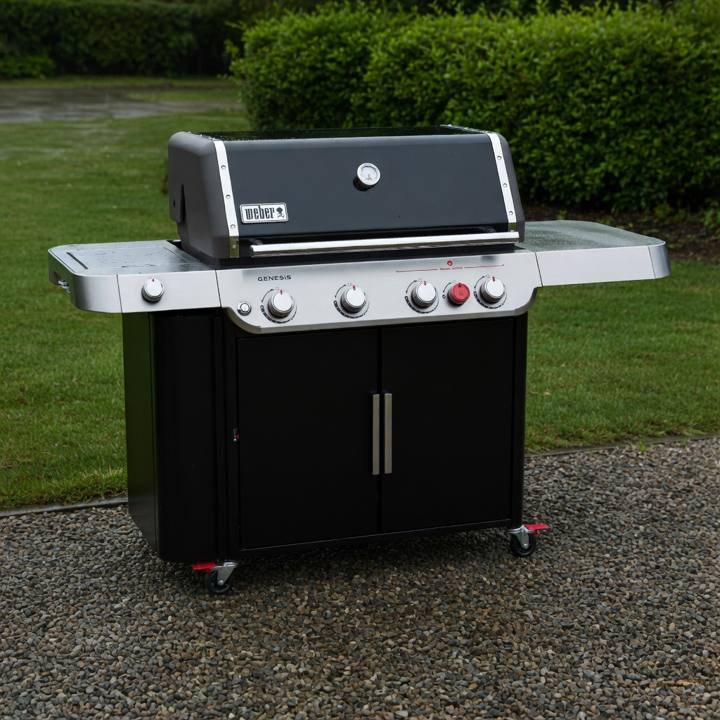
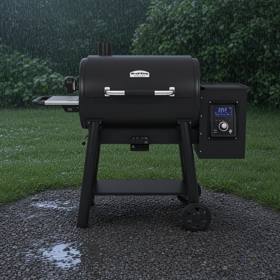
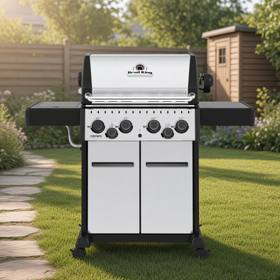
Weber sells the Genesis E-435 for around $1,499. One rung down its own range, the E-415 sells for $1,199. Each gives you 646 square inches to cook on. Both run four stainless steel burners at a combined 48,000 BTU-per-hour.
So the extra three hundred dollars buys no more main grate. It does not buy hotter main burners either. What it buys, and whether that is worth it, is the whole of this review.
The answer turns out to be consistent. Everything on the invoice sits beside the main grate, above it, or underneath it. Model 36410001 is the propane build, and it is the one Amazon sells.
48,000 BTU/hrFour main burners, combined input
994 sq inTotal area across both cooking grates
646 sq inPrimary grate, the same as the $1,199 E-415
68.5 inCart width, four inches past the E-415
First Impressions of the Weber Genesis E-435
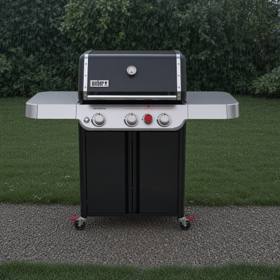
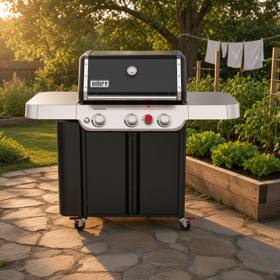
The cart is wide. At 68.5 inches lid closed, it reads less like a grill. More like an outdoor counter. A brushed stainless fascia runs the full width between two side tables.
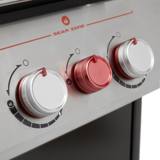
Five knobs sit on that fascia. Four are silver. The fifth is red, set between the third and fourth.
Above that red knob the panel reads Sear Zone, printed in matching red. Color is the only labelling the sear control gets. A sixth knob lives out on the left table, for the side burner.
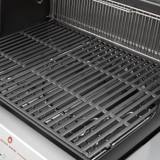
Under the lid, three levels stack up. Enameled cast iron below, a hinged stainless grate above it, and a wire rack above that. The middle one folds, so half swings out of the way. A dial thermometer faces the cook from the lid.
Open the left door and the propane cylinder is not standing on the cabinet floor. It hangs from a cradle. That is how the front-facing fuel gauge takes its reading. It also means a tank swap is a lift, not a slide.
Lighting instructions are printed onto the panel itself, in English, Spanish and French. They point you at the inside of the left door. It is a small thing. It also assumes the person lighting it never kept the manual.
Key Features of the Weber Genesis E-435
Read the feature list in the order the heat travels and the logic gets clearer. Four burners heat the main grate. A fifth heats one end of it harder. A sixth sits off the cookbox entirely.
- Side Burner. A 12,000 BTU-per-hour ring on the left table, with its own knob. This is the feature that separates the E-435 from the cheaper E-415, which has none.
- Sear Zone burner. Another 12,000 BTU-per-hour burner, under part of the 646 square inch grate. The red knob is the only colored control on the panel, which is deliberate.
- Cast-iron. The grate you use most is cast iron, in a porcelain skin. Nothing to season, and a wet week leaves no rust bloom.
- Stainless steel. Look for it on the Flavorizer bars, the tubes and the tables. Doors and lid get paint instead.
- Second-level grate. 348 square inches of hinged stainless above the main grate, carrying a circular frame. The E-415’s upper shelf is 174.
- Electric Igniter. Electronic ignition running off a single AA battery. Keep a spare, because one dead cell puts you back on a long match.
- Fuel Gauge. Front-facing, reading the cylinder as it hangs. You check the level by opening a door, not by lifting the tank.
- Storage locker. A slotted steel rail runs inside the cabinet, carrying a clip-on bin. Six tool hooks sit outside. Storage here is arranged rather than piled.
- Weber Crafted frame. The grate system takes Weber’s Crafted grillware, so a griddle or a pizza surface drops in.
Six gas zones, five of them on the cookbox. That is a lot of decisions for one dinner. You are not managing one fire here. You are running several small ones at once.
The main four at 48,000 BTU-per-hour across 646 square inches is conventional and competent. Weber’s tapered PureBlu tubes are built to hold an even flame down their length. Nothing about the main grate is unusual for this money.
The Sear Zone burner is the departure, and it needs stating precisely. It does not add cooking surface. It heats grate you already had.
That burner drives one end hard while the rest stays moderate. Fill the grate with chicken and there is nowhere left to put a steak.
Of the six zones, the side burner alters the routine most. A pan of sauce or a pot of corn never touches the grate.
The upper level does more than warm. At 348 square inches it is nearly double the E-415’s shelf. Weber calls it a top grate, not a warming rack.
It is hinged stainless with a circular frame set into it. Use it to hold cooked pieces while the sear end keeps going.
Build, handling and durability
Materials follow the range, and they hold up. Cast iron takes the food, wearing porcelain enamel. Stainless takes the flame, in the bars and tubes beneath. Paint takes the weather, on the cabinet and lid.
Width comes from the two tables, both stainless. The left one carries the side burner and its knob. The right one is clear space, rarer on a grill cart than it sounds.
Two of the four casters lock down. On a level patio that is enough. The red locking pedals are easy to find with a foot. On grass or gravel, 68.5 inches of cart does not move gracefully.
Weber’s warranty reads as a hierarchy. Steel first, at twelve years against rust or burn. Paint last, at two.
Running costs, upkeep and value
Grease takes two steps out of this grill, and both are quick. A sloped porcelain pan slides out from under the cookbox. Below it sits a second tray. That one holds a disposable foil pan.
Easy to empty, and also a small standing cost. Foil pans are a consumable. Grill weekly and you buy them in packs, then keep a stack in the locker.
The fuel gauge answers a related nuisance. A 20 lb cylinder gives no warning of its own. Reading the level through an open door beats discovering it with guests waiting.
Ignition draws on a single AA cell. Keep a spare beside the foil pans. Neither item costs anything worth noticing. Both are the kind you remember once.
So back to that price gap. Against the E-415 at $1,199 you gain a sear burner and a side burner. The upper grate doubles, 174 to 348. The cart grows four inches wider.
You gain no primary area and no extra main burner output. Value here is a question about your cooking, not about the grill. If sauces and sides genuinely come outside with you, the side burner alone can justify it. Cook steaks and burgers on the main grate and the money buys equipment you walk past.
Possible Weber Genesis E-435 Complaints
- The extra heat lands on old ground. This grill and the E-415 share a 646 square inch grate and 48,000 BTU-per-hour. The sear burner makes one end hotter, not larger. The price gap invites an expectation the specification never made.
- The finish falls out of warranty first. The cookbox gets twelve years against rust. Its paint gets two, fading excluded. Cover ends at resale, labor is never included, and a fitted cover stops being optional.