
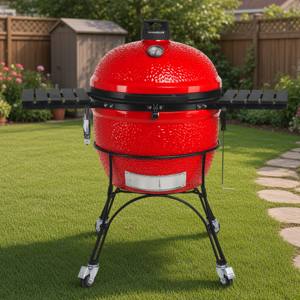
A kamado is a thick walled egg of ceramic, or insulated steel, that burns lump charcoal. Air comes in through a vent at the bottom and leaves through a vent on top, and those two vents set the temperature. The thick walls hold the heat, so a small fire stays steady for hours, low enough to smoke or hot enough for pizza.
Inside a kamado
- Top vent
- Dome
- Thermometer
- Cooking grate
- Heat deflector
- Gasket
- Fire ring
- Charcoal
- Charcoal grate
- Bottom vent
- Ash
- Thick ceramic walls
Follow the air from the bottom left. It comes in through the bottom vent, rises through the lump charcoal sitting on the charcoal grate in the firebox, and feeds the fire. The hot air and smoke flow up around the heat deflector, over the food on the cooking grate, and out through the top vent in the dome. A felt gasket seals the lid, so no air gets in anywhere else.
That seal is the whole trick. Because the only air the fire gets is the air you let in, the vents control the fire precisely. And because the thick walls soak up heat and give it back, the temperature barely moves when the wind blows or the sun goes down.
Setting the temperature with two vents
More air means a hotter fire. Open both vents to raise the heat and close them down to lower it. These are good starting points on any kamado; give it 10 to 15 minutes to settle after each change.
Low and slow smoking225 to 275 F
Roasting a chicken325 to 375 F
Searing and pizza500 F and up
Creep up on a low temperature and never overshoot it. A kamado holds heat so well that bringing it back down from 400 F to 250 F can take an hour.
Grill, smoker or oven: the heat deflector
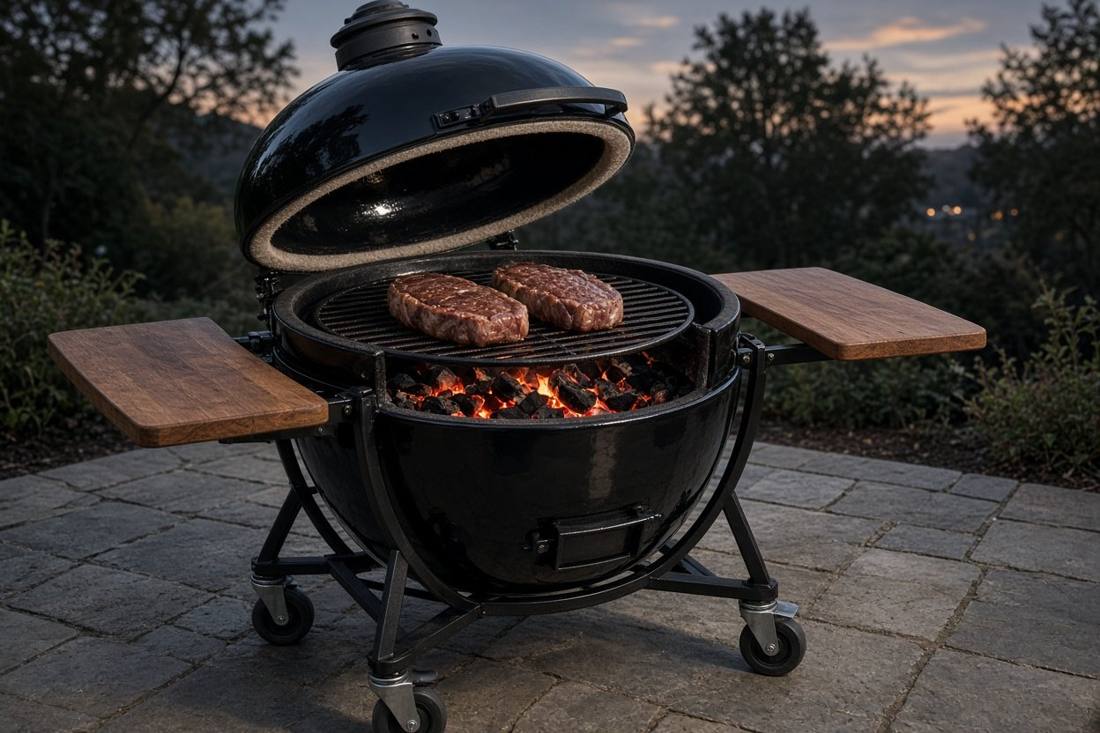
Without the deflector, the food sits right over the coals. That is grilling: steaks, burgers, chops and vegetables, seared hot and fast.
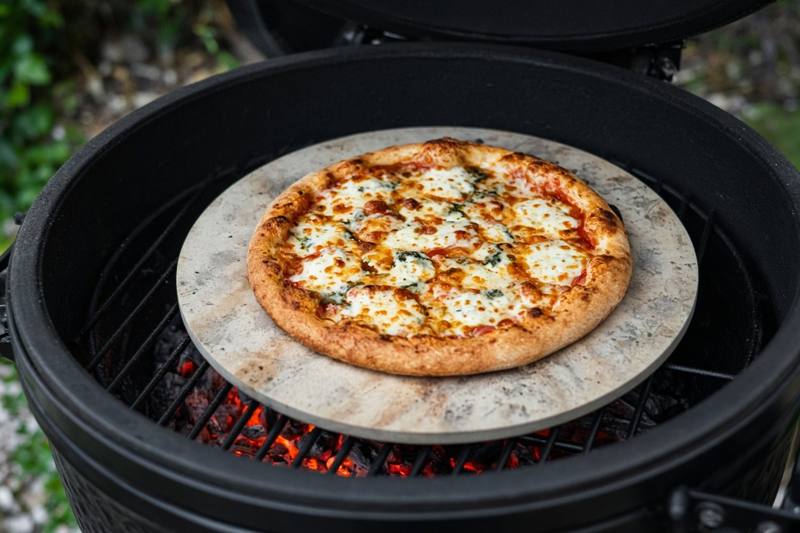
With the deflector, a thick ceramic plate sits between the fire and the food and blocks the direct heat. Now the kamado cooks like an oven: smoke a brisket at 250 F, roast a turkey at 350 F, or set a pizza stone on top and bake at 600 F or more.
Many kamados use split deflectors, so you can cover half the fire and grill over the other half in the same cook.
Ceramic or steel?
Most kamados are ceramic. A few are steel, either coated steel walls with insulation between them, like the AKORN, or heavier insulated steel, like the Weber Summit Kamado. Here is how the 7 ceramic and 5 steel kamados we have scored compare.
CeramicSteel
Ceramic holds heat best, and it shows in Heat Performance (9.1 against 8.7). Steel is lighter, usually comes on wheels, and does not crack if it takes a knock, so it scores higher for Ease of Use (8.8 against 8.0). Overall, the two land level.
Is a kamado grill worth it?
On our scores, yes, if you will use what it does best. The 12 kamados we have scored average 8.41 out of 10, against 8.02 for every grill we have scored. Here is each category, with the all grills average under each name.
Kamados score best on Heat Performance (8.9 against 8.2 for all grills), the reason to buy one. They score lowest on Value (7.7 against 8.0), because a good ceramic kamado costs more than a gas grill of the same size.
- Worth it if you want one cooker that grills, smokes and bakes, you cook through cold weather, or you like to cook with charcoal and want it to sip fuel.
- Not worth it if you mostly cook quick weeknight dinners for a crowd, want to light up and cook in ten minutes, or need to move the grill often. A gas grill fits that better.
The best kamados we have scored
See every pick in our best kamado grills.
Questions people ask
- What is a kamado grill?
- A round, egg shaped charcoal cooker with thick walls and a heavy domed lid. The name comes from the Japanese word for a stove, and the design goes back to clay cooking pots used in Asia for thousands of years.
- What is a kamado grill used for?
- Almost everything cooked outdoors: searing steaks, smoking brisket and pork shoulder, roasting whole chickens and turkeys, and baking pizza and bread. It is one of the few cookers that does all of them well.
- Should I use lump charcoal or briquettes?
- Lump charcoal (see lump vs briquettes). It makes much less ash, so it does not clog the small vents and charcoal grate, and it lights faster. Most makers say to use lump, and some say briquettes void the warranty.
- How long does a load of charcoal last?
- A full firebox can smoke for 12 hours or more at 225 to 250 F, because the sealed lid and thick walls waste so little heat. At searing heat it burns much faster.
- Can a ceramic kamado crack?
- Yes, if it is dropped, knocked or heated too fast from cold. Bring it up to temperature gently, keep it dry and covered, and check the warranty: many ceramic kamados cover the ceramic for life. Our guide to how long grills last has the figures.
- Can you use a kamado in winter?
- Yes, and it is one of the best grills for it. The thick walls keep the cold out, so it holds temperature with little more charcoal than in summer.