First Impressions of the Cuisinart Venture
Setting up is unclipping rather than building. Side clasps release the body from the base, and both go on level ground. A retaining loop flips out, and the cylinder screws on and drops into it. Five parts leave the packaging in total, and none of them needs a tool.
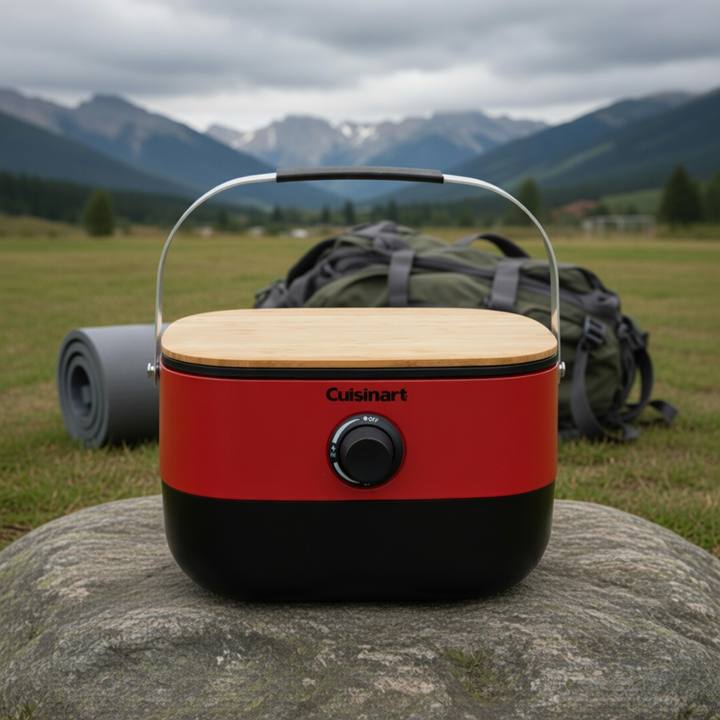
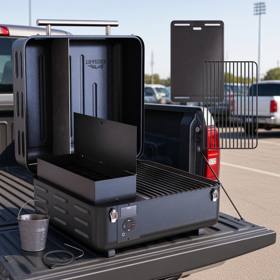
Then the board does its trick. You lift it clear of the grill top and set it on the base. What was a roof thirty seconds ago is now a table beside the fire. That is the stack ‘n go idea, and it works.
The finish is louder than most camping kit. Red, black and real wood, instead of the usual anonymous black box. It is built to be left out on a bench, not hidden away.
The first cook settles whether the grate is worth carrying. Enameled iron banks heat and then spends it slowly. A cold sausage hitting the bars barely dents the surface. What you get is color and crust, not the gray steaming that thin portables produce.
Key Features of the Cuisinart Venture
Strip the Venture back and there are three ideas in it. A heavy grate, and a small burner sized to match it. Then a wooden board that changes job twice a day. Everything else exists to hold one of those in place.
- Cast-iron: The grate is porcelain enameled cast iron, in one piece. Mass is what keeps the surface hot when food lands. The glaze means no seasoning and no wire brush.
- Stainless steel: Stainless shows up in exactly one place here, the burner. Cuisinart rates it at 9,000 BTU per hour. That figure is the whole heat budget, spent under one grate.
- Multi-function board: The wooden lid is a cutting board, a serving surface and the grill’s only cover. It sits on the base while you cook and back on top when you do not.
- Electric Igniter: Twist the control and it sparks. The manual also documents match lighting, which means the cooking grate comes out first. Worth reading once at home rather than at dusk in a parking lot.
- Pullout Tray for Propane Tank: A flip-out rack holds the cylinder upright, and clips stow the hose. When the grill is packed, the 1 lb tank travels inside the base.
- Cover: Cuisinart supplies no fabric cover, and does not think one is needed. The manual asks you to keep the wooden board on top whenever the grill is idle.
- Small-cylinder fuel path: It runs on 14.1 oz or 16.4 oz cylinders through a CGA No. 600 connection. No cylinder is included with the grill.
- Removable grease tray: The tray slides into the rear of the body. Cuisinart is blunt about it: never cook without the tray in position.
Nine thousand BTU sounds modest until you see what it has to heat. It sits under 154 square inches and nothing else. Plenty of small grills spread less fire over more metal, and cook slowly for it. This one is the other way round.
Cast iron then decides what that fire is worth. Cuisinart asks for 3 to 5 minutes of preheat, and the grate earns every second. Enameled iron loads slowly and gives heat back steadily. That is the difference between a sear and a gray stripe.
What you never get is a roof over the food. The board has to be off before the burner lights. So the moment you light the Venture, it stops having a lid. Every cook happens over open flame, in open air.
Plan the menu around that and nothing is lost. Chops, burgers, sausages, shrimp and vegetables all want direct heat and speed. A whole chicken, a rack of ribs or a slice of melting cheese wants trapped heat. There is nowhere on this grill to trap any.
Build, handling and durability
Twenty pounds and change is a genuine one-handed carry. Cuisinart prints 20.57 in its specification table, and the Amazon listing says 20.6 pounds. Packed, it stands 16.25 by 13 by 10.75 inches.
Multiply the first two out: about 211 square inches of table. It cooks on 154 of them. Very little of what you carry is packaging.
Most of that weight is grate, which is the right place for it. Cast iron is why the heat holds and also why your arm knows about it. Thin steel would save a few pounds and cost the cooking. Cuisinart made that trade in the right direction.
The wooden board is the part that ages first. It lives outdoors, takes a knife edge, and then goes back on a hot grill’s roof. Keep it dry between trips and out of the weather in winter. Nothing else on the grill has a comparable soft spot.
Warranty cover runs 3 years on parts and workmanship, which is respectable here. One clause deserves attention: enamel damage has to be claimed within 30 days of purchase. Inspect the grate the day it arrives, not at the first cook.
The paperwork also disagrees with itself, so match numbers carefully when ordering. Cuisinart’s product page and its manual file say CGG-750P. The cover of that same manual, and the Amazon listing, both say CGG-750.
Running costs, upkeep and value
Fuel is where this grill sets its own terms. It takes 14.1 oz or 16.4 oz cylinders, and Cuisinart answers the obvious question directly. A 20 lb tank is not permitted, and no adapter makes it acceptable. Nobody publishes how long a canister lasts, so travel with a spare rather than a plan.
Upkeep is close to effortless, with one standing instruction. Cuisinart wants the burner run on high for five minutes after each session to clear residue. Enamel then wipes down cold, and the grease tray pulls out of the back. Nothing needs seasoning, and there is no ash to deal with.
Money is the part that needs thought. On 2026-08-25 the Amazon listing sat in stock at around $229.99, matching Cuisinart’s own list. Buy direct and shipping is free over $35, with 30 days to return it.
What that buys is real. Cast iron, a stainless burner, a wooden board, and a base that hides the cylinder. What it does not buy is a working lid or any fuel. Cheaper tabletop grills give you thin steel and a hood, and this is the opposite bargain.
Possible Cuisinart Venture Complaints
- The lid is unavailable exactly when a lid is useful: It has to be off before ignition and stays off until the grill is cold. So there is no covered cooking, no roasting and no quick melt. The mitigation is menu choice rather than equipment, since nothing here traps heat.
- The fuel rule is absolute, and easy to miss when buying: Only 14.1 oz or 16.4 oz cylinders may be used. The manual forbids the 20 lb tank outright. Anyone who already owns a big tank gains nothing from it here. Buy small canisters in quantity and keep one in the base.