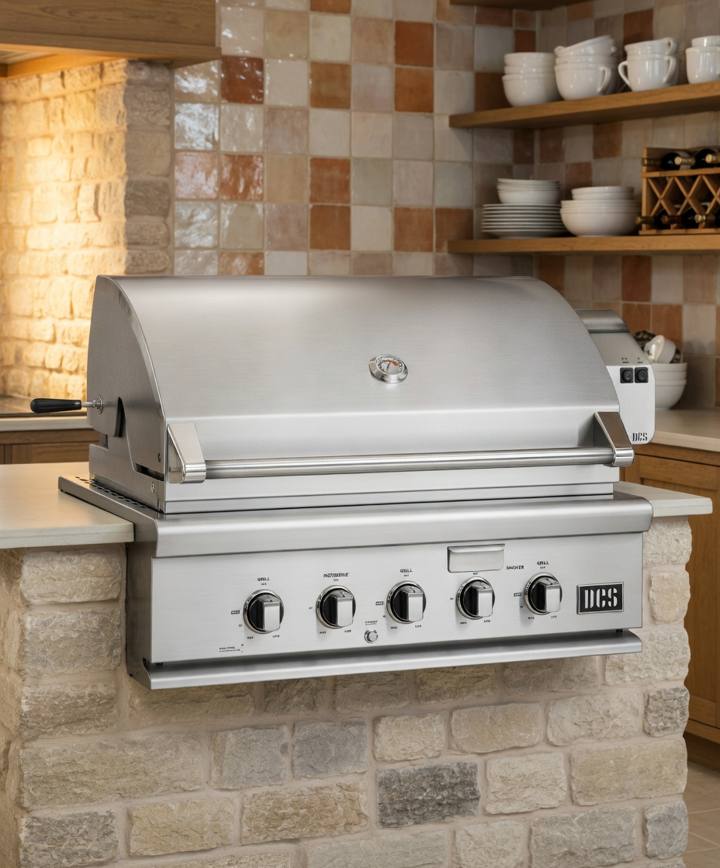
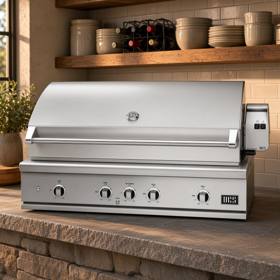
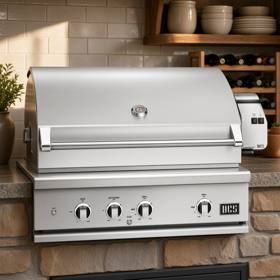
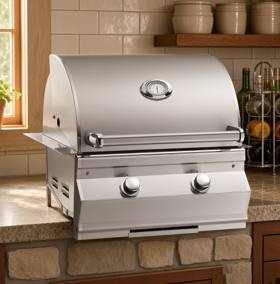
DCS asks about $5,599 for the BH1-36R-N. It is the natural gas build of its 36” Series 7 grill.
Open the hood and you find three U-burners. Each is rated 25,000 BTU. That is simply the DCS grill burner. A larger DCS is mostly a cabinet holding more of them.
Raw heat is not what the premium buys. What surrounds those burners is. A rotisserie with its own flame and its own controls. A smoker tray with a burner beneath it.
Then there is 304 grade stainless, and a warranty measured in decades. There is also a cabinet built to receive it all. That last item is the one buyers underestimate.
92,500 BTUEverything lit, grill burners and the two specialists
871 sq in630 of it grate, the rest a warming rack
45 5/16 inWhat a 36-inch DCS actually spans, motor included
18 inHow far wood has to stay from the burner box
First Impressions of the DCS BH1-36R-N
Nothing here arrives ready to cook. This is a grill head. DCS states that two or more people must move and install it. Gas arrives through a 1/2” NPT male fitting with a 3/8” flare adapter.
The opening for that gas line sits 18 1/2” back from the cabinet front. It is a plumber’s measurement, not a griller’s.
Face on, the control panel explains the machine in one glance. Five dials run left to right: GRILL, ROTISSERIE, GRILL, SMOKER, GRILL. A small rotisserie safety valve button sits below the second dial. The smoker tray slides out through the panel between two of them.
Buyers get caught by the width. The spec sheet says 35 7/8”. The DCS planning guide gives an overall width of 45 5/16”, motor included. That housing is 5 13/16” deep and hangs outside the cabinet.
A 36-inch DCS is a 45-inch job for whoever builds the counter. At $5,599 the metalwork had better look the part, and it does. Brushed 304 grade stainless steel, weighty metal dials, a temperature gauge set into the hood.
Key Features of the DCS BH1-36R-N
Feature lists on premium grills tend to blur together. This one splits cleanly into three groups. Three burners you actually grill on, two specialists, and the metalwork holding all of it.
- Three 25,000 BTU U-burners. With the other two they total 92,500 BTU. Each gets its own dial. The grate splits into three zones, not one wall of heat.
- A SEAR position on every grill dial. The sequence runs OFF, SEAR, HI, MED, LOW. SEAR is also the ignition position. You pass through maximum heat on the way down.
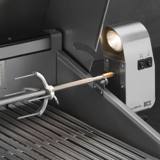
- A rotisserie that is really a second cooker. Behind it sit a 14,000 BTU burner and a 120V 60Hz motor. Lighting it means holding a safety valve for ten seconds. Rated load is 50 lb.
- A 3,500 BTU smoker burner. It heats a sealed tray of woodchips. Run it alongside the rotisserie and DCS asks you to keep it on LOW.
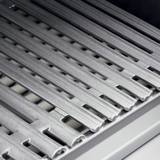
- Double-sided cast stainless grates. One face is W-shaped for sear lines and drains grease away. Flip it for a gentle radius that suits scallops and salmon.
- Illuminated cooking surface. The Smart Beam halogen light throws across the grate for night cooking. DCS specifies a 50W maximum narrow halogen bulb for the rotisserie light.
- 304 grade stainless steel. The alloy is printed in the spec table rather than left as “stainless”. At this money that distinction matters.
- Electric igniter on a 9V battery. Lighting means pressing a dial, not pushing a separate button. The spark clicks, and the remaining grill burners cross light from the first.
- A BBQ cover, and most other things, sold separately. The built-in cover is ACBI-36 and the cart CAD1-36. The griddle plate is BGC-GP, the storage unit ASH6-36.
The interesting claim here is not the 92,500 BTU total. It is that DCS spread the searing across the whole grate. Every grill dial carries SEAR above HI, which DCS calls full surface searing.
In practice, 630 sq in of grate becomes three independent zones. Overhead, the warming rack adds another 241 sq in. Sear on the left, hold on the right, swap at will. Ceramic rods in the radiant trays sit between flame and food.
Ten minutes of preheat, hood down, is what DCS asks for. Aim at a low setting and it takes longer. DCS also prints a range of 300 up to an intense 1100 for its grills. Read that carefully, because the same paragraph serves a whole line.
Before any of that, the grates need seasoning. DCS wants them oiled, then heated on SEAR for fifteen minutes. Repeat it after a deep clean or a long idle spell.
The rotisserie is where the design turns strict. Its 14,000 BTU burner runs alone. DCS instructs owners to keep the grill burners off while it burns.
Build, handling and durability
Where a company draws its warranty lines tells you what it expects to wear. DCS draws them twice. Radiant trays, their side rails and the drip pan get five years of material cover.
Burners, burner box, cooking grates and grill racks are covered for life, to the original owner. Everything else follows from the alloy. 304 grade stainless carries the finish. The grates are cast stainless rather than coated iron, and the dials are metal.
Handling is a one-time event. Two people lift it in and it never moves again. Defects traced to bad installation are excluded from cover. That clause quietly makes your installer part of the purchase.
Running costs, upkeep and value
The $5,599 buys a grill head. The cart mount, both covers, the griddle plate and the side storage unit are extra. So is the insulated jacket. DCS is straightforward about it: the cart in the photographs is sold separately.
Then the cabinet. A non-combustible cavity measures 34 1/2” wide, 10 1/8” high and 22 3/4” deep. Build in wood and the BGA36-IJS jacket becomes mandatory.
Combustible construction otherwise stays 18” clear, non-combustible 3”. The open hood stands 24 5/16” above the countertop. It then wants 24” of air above that.
Upkeep, by contrast, costs almost nothing. The rotisserie burner cleans itself if you run it ten to twenty minutes. Heavily soiled radiant trays get the same treatment. Their ceramic rods rotate, so a fresh face burns clean.
The drip tray insert is dishwasher safe. Grill burners lift out once a flathead screwdriver loosens their clamps. The ignition battery lives behind that drip tray, and pulls downwards to come out.
Running costs after year two are where the maths bites. A lifetime burner is covered for material only, and fitting it is billable.
Two smaller costs are easy to miss. Switching this grill to propane later needs a factory conversion kit, not a nozzle swap. In Massachusetts, a licensed plumber or gas fitter has to do the installation. DCS does at least staff its customer care line around the clock.
Possible DCS BH1-36R-N Complaints
- The rotisserie locks out the grill. DCS is explicit that grill burners stay off while the rotisserie burner is lit. A spit-roasted shoulder takes the whole grill for its entire cook. The vegetables go indoors, though the smoker tray can still run on LOW.
- The cabinet is the real invoice. A gas fitting sits deep inside the enclosure, and the motor wants a GFI outlet. Clearances rule out a timber island unless the jacket goes in. Price the island first, then the grill.