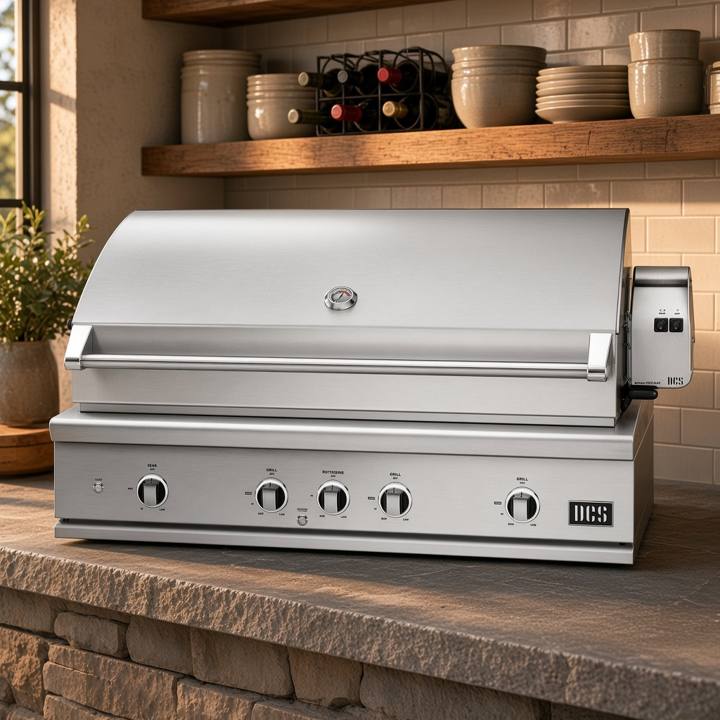
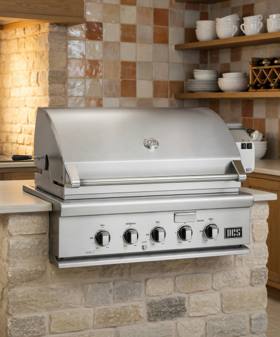
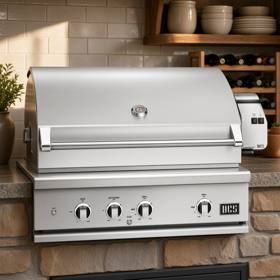
DCS calls this a 48-inch grill. The number sits on the badge and almost nowhere else.
The head itself measures 47 15/16 in across. The hole it drops into is 45 3/4 in. Bolt the rotisserie motor on and the counter has to span 53 1/4 in. Build the island from timber and the cavity opens out to 51 7/8 in.
This is the BE1-48RCI-L, the propane build, and $9,799 buys the head alone. The cylinder has to live somewhere too.
Whether the cooker is any good barely settles the matter. What a buyer needs to know is how much of this is cooker.
117,000 BTUThree grill burners, the infrared bay and the rotisserie
855 sq inPrimary grate, with another 738 sq in stacked above it
53 1/4 inCounter the grill spans once the motor is bolted on
20 sq inVent area the propane cylinder's cupboard needs up top
First Impressions of the DCS BE1-48RCI-L
Nothing here arrives ready to cook, and DCS never suggests otherwise. Moving and installing it is explicitly a job for more than one person. The installation guide adds a warning worth repeating. Never rest the grill on the ground, because its own load will damage the regulator assembly.
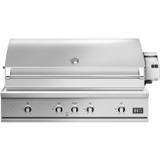
The panel is the whole user interface, and it hides nothing. A light button sits at the far left. Then SEAR, GRILL, ROTISSERIE, GRILL and GRILL, in that order. Under the centre dial, a separate safety valve button serves the rotisserie.
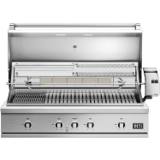
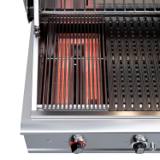
Raise the hood and the cookbox divides into four jobs. A rod-style sear grate occupies the left end. A ceramic rotisserie panel runs the length of the back wall. Two levels of rack and a tray hang above, spit rod and forks already fitted.
Whichever end you picked, the motor housing ends up outboard of the cabinet. It runs 5 5/16 in deep. The counter arithmetic never matches the badge because of it.
To light a burner, push its dial in two seconds and turn to SEAR. No click follows, because the ignition is hot surface rather than spark. It takes a cook or two to stop waiting for one.
Key Features of the DCS BE1-48RCI-L
Premium feature lists blur together, so it helps to sort this one by role. Two of the five burners are specialists. The other three do the grilling, and the cabinet exists to hold all of them.
- Three U-burners rated 25,000 BTU each. Every grill dial carries SEAR above HI. Browning is not confined to one strip of grate.
- A 24,000 BTU infrared sear burner in its own bay. MAX, not SEAR, is where its dial ends. Only the sear grate may sit over it, never the griddle plate or a charcoal insert.
- An 18,000 BTU rotisserie burner behind a ceramic panel. The safety valve button has to be held down for ten seconds. Rated load on the spit is 50 lb.
- A motor that mounts on either end. Either end will take the mount and the motor. A wall at one side stops being a problem.
- 855 sq in of grate, 1,593 sq in in total. The difference is racks on two levels and a tray, rated to 20 lb.
- Double-sided cast grates. A W profile on one face lays down bar marks. Turn them over for the rounded face, which suits scallops and salmon. A low bar lays them flat, a high bar angles them.
- A charcoal insert supplied in the box. It replaces a radiant tray over a grill burner. Two of them fit at this width, because DCS wants a burner space between them.
- Lights in the hood, and dials that light with them. White light rings the bezels with the hood lights on. Gas flowing turns them orange.
- Hot surface electric ignition. Nothing sparks, nothing clicks, and no battery ever needs changing. No mains power, no flame either.
- 304 grade stainless steel. Naming the grade is a choice, and DCS made it in its own spec table.
- A propane hose, regulator and Type 1 connector. All three come with this build. The 20 lb cylinder does not.
- A cover and a cart, neither included. ACBI-48E covers it built in, CAD-48E turns it into a cart grill.
Four burners can be alight at once, and they are doing genuinely different jobs. Three U-burners cover most of the 855 sq in of grate. Each carries SEAR above HI. The infrared bay adds its own 24,000 BTU at the left end.
The interesting part is what the extra width bought. The 36-inch version of this grill totals 88,000 BTU. This one totals 117,000. The sear burner is the same 24,000 BTU on both.
Every additional BTU the bigger cookbox brings is grilling and roasting heat. So the width buys spread, not intensity. What it also buys is room to give something up. Give the charcoal insert a burner bay and two gas zones survive.
The U-burners are the burners DCS attaches a temperature range to, 300°F up to 1100°F. For the sear burner it publishes a BTU rating and no temperature. We will not invent one.
Build, handling and durability
The metalwork is not in doubt. The finish is 304 grade stainless. Dials are metal, and a temperature gauge sits in the hood.
DCS publishes no weight for the head. That is a gap in the paperwork, not a fault in the grill. The counter is where buyers actually get caught out.
A masonry cavity measures 45 3/4 in wide and 10 1/8 in high. Depth is 22 3/4 in. Build in timber and the BGA48-IJS jacket pushes that opening to 51 7/8 in.
Clearances follow the same pattern. Unprotected combustible construction stays 18 in clear, protected construction 12 in. Non-combustible surfaces want 6 in at the sides. Above an open hood, the planning guide’s clearances page asks for 24 in.
One caution on that last figure. DCS’s own 48-inch data sheet prints a far smaller number on that row. The two disagree inside one document. Take the 24 in from the clearances page, and confirm it with your installer.
Running costs, upkeep and value
Propane is the decision that shapes the whole island. On the natural gas twin, BE1-48RCI-N, the fuel arrives through a pipe. Here it has to live in the cabinet, and DCS is specific about the cupboard.
A 20 lb cylinder needs 20 sq in of free vent area up top. Another 10 sq in goes near the bottom. Every opening has to be wide enough to pass a 3/16 in rod. The restraint holding the cylinder is supplied by the installer, not by DCS.
The gas figures here come off the LP product page. That side is what genuinely differs between the two builds.
Operating pressure on this build is 11 in W.C. On the natural gas page it is 4 in. Supply wants 12 to 14 in W.C.
Electricity is not optional either. A qualified electrician fits a 120VAC 15A GFI outlet. The transformer then sits within 63 in of the grill. Make that 31 1/2 in from the motor.
After that come the extras, and nothing in the accessory list is bundled. That means the cart mount, two covers, side storage, the griddle plate and either jacket. Each carries its own model code and its own invoice. In Massachusetts the installation itself needs a licensed plumber or gas fitter.
Warranty is two years on everything, material and labor. Lifetime material cover then picks up the grill burners, burner box, grates and racks. Labor on those is billable. Five years is all the sear burner gets, and its mesh gets none.
Possible DCS BE1-48RCI-L Complaints
- A propane island is a bigger island. The cylinder needs its own vented cupboard and a restraint the installer buys. None of that applies to the natural gas version of the same cooker. The cabinet is the part to cost out first.
- Nearly half the headline area never meets flame. DCS advertises 1,593 sq in, of which 855 is grate. The rest is racks and a tray holding 20 lb apiece. Useful space, but not cooking space.