
A pellet grill burns wood pellets in a small firepot. A screw called an auger feeds pellets from the hopper, a hot igniter lights them, a fan feeds the fire air, and a controller reads the temperature and runs the auger and fan to hold the heat you set, much like an oven.
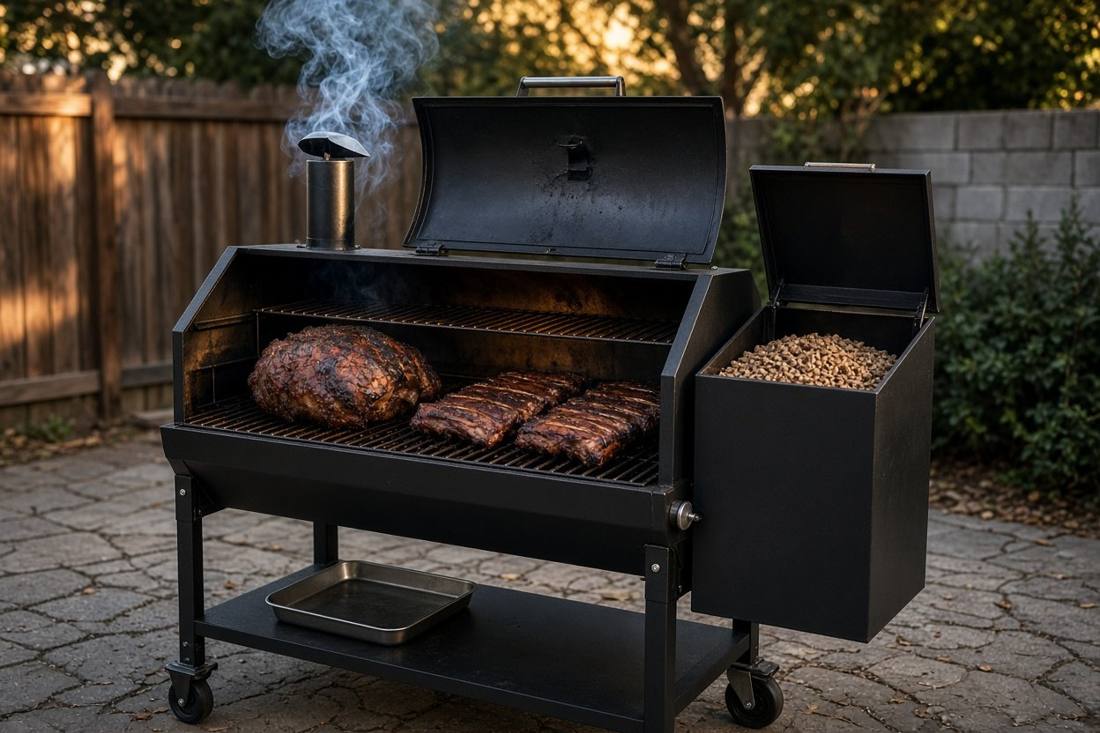
Inside a pellet grill
- Chimney
- Grates
- Drip tray
- Heat baffle
- Igniter
- Fan
- Firepot
- Auger
- Hopper
- Controller
Follow the pellets from right to left. They wait in the hopper, drop onto the auger, and are carried a few at a time into the firepot. Under the firepot, the fan blows in air, and beside it a rod called the igniter glows red to light the first pellets. Above the fire, the heat baffle and the sloped drip tray spread the heat and smoke evenly under the grates, and catch the grease. The smoke leaves through the chimney.
What happens during a cook
- Start up. You turn it on and set a temperature. The igniter heats up and the auger feeds the first pellets into the firepot. You leave the lid open until the fire catches, about five to ten minutes on most grills.
- Hold. The igniter switches off. A probe inside the grill reads the temperature, and the controller speeds up or slows the auger and fan to hold the heat you set. Better controllers make many small corrections and hold within a few degrees.
- Smoke. Smoke comes from the pellets smoldering, so there is more of it at low temperatures, around 180 to 250 F, and less when the grill runs hot.
- Shut down. You press off and the auger stops, but the fan keeps running for several minutes to burn off the pellets left in the firepot. Do not unplug it during this cycle.
The fuel: wood pellets
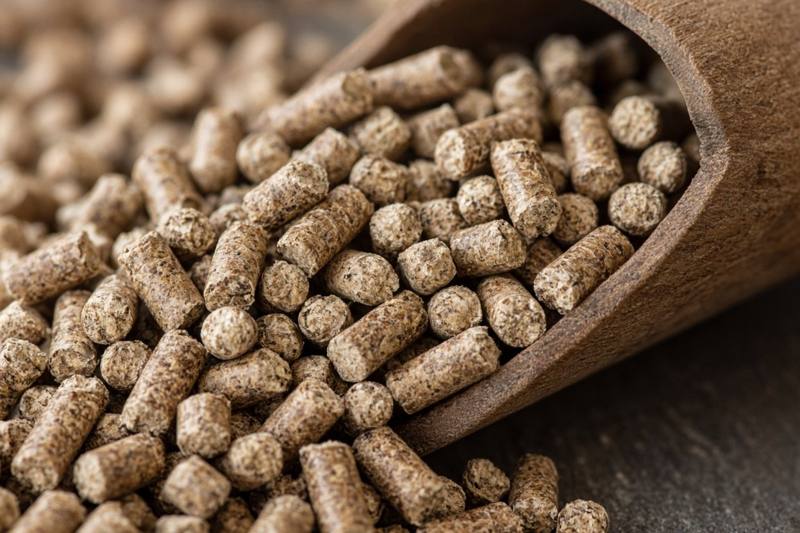
Our wood pellet guide covers types and storage. Cooking pellets are sawdust pressed into small rods, with no glue: the wood's own lignin holds them together. Hickory, oak, apple, cherry and mesquite each give their own smoke, and blends are common.
Keep them dry. Damp pellets swell into mush that can jam the auger. Hoppers on the pellet grills we have scored hold 4 to 32 lb, and most hold around 20 lb, close to one standard bag.
What pellet grills do well, and where they fall short
Here is how the 20 pellet grills we have scored average on each of our six categories. The figure under each name is the average across every grill we have scored, for comparison.
Pellet grills score best on Ease of Use (8.7), the reason people buy them. They score lowest on Long-term Reliability (7.0 against 7.4 for all grills), because an auger motor, a fan, an igniter and a control board are each a part that can fail. All four can be replaced.
The best pellet grills we have scored
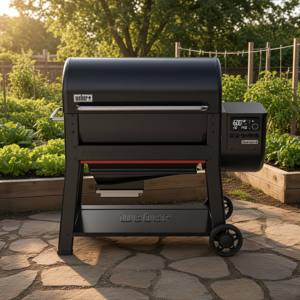
See every pick in our best pellet grills.
Questions people ask
- Do pellet grills need electricity?
- Yes. The auger, the fan, the igniter and the controller all run on power, so a pellet grill needs an outlet or a portable power station. If the power cuts out, the fire goes out too.
- Is a pellet grill a smoker or a grill?
- Both. It smokes best at low temperatures and grills at higher ones, and many reach 450 to 500 F. Few sear as hard as gas or charcoal, which is why some add a sear zone or a direct flame option.
- What is a pellet grill good for?
- Long, steady cooks with real wood smoke and little effort: brisket, pork shoulder, ribs, whole chickens and turkeys. Our types of smokers guide compares it with the other ways to smoke.
- What is a smoke tube?
- A perforated metal tube you fill with pellets and light, then set on the grates. It adds extra smoke, mostly used when a pellet grill runs hot and gives off less of its own.
- How long does a pellet grill last?
- Their warranties are shorter than gas grills', and they score lower for reliability, because of the electronics. Our guide to how long grills last has the figures.