Most pellet cookers sell themselves on range, from low smoke to a hard sear. Weber’s Smoque, model 1500770, barely tries. Its published ceiling is 500, and the word on the lid is Smoque.
Weber already builds pellet grills that chase fire. This one spends its whole feature list somewhere else. SmokeBoost holds things low so smoke has time to land. SmoqueVent moves that smoke around the food.
Sear is the wrong question to bring to this cooker. Ask instead what a pellet smoker gains by giving it up. Weber has built the whole machine around that trade.
500 maxPublished ceiling, in Fahrenheit
44.50 x 38.75 x 22.50 inSize with the lid down
209 of 594 sq inIs warming rack, not primary grate
60.0 inHeadroom needed to open the lid
First Impressions of the Weber Smoque Pellet Smoker
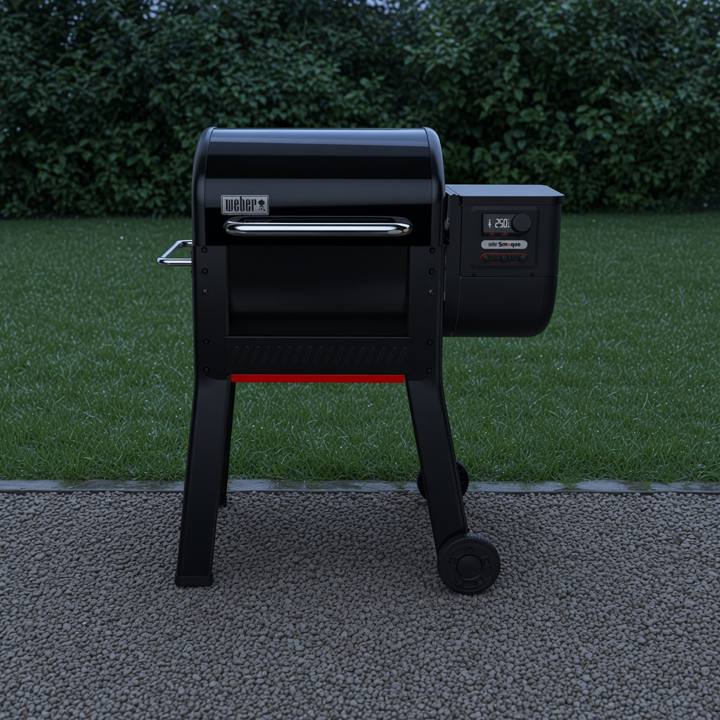
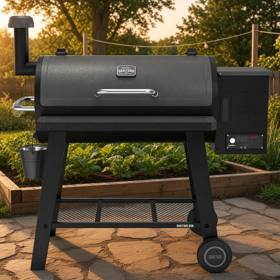
Standing on its two wheels, the Smoque reads as a black cabinet wearing a kettle lid. The hopper hangs off one side at waist height. A single side table sits on the other. It looks like a machine that expects to stay put.
What comes with it is short and sensible. Weber lists the smoker and cabinet, the manual, two food probes and a cookbox scraper. A QR code takes you to the digital guide instead of a second booklet. If building it holds no appeal, Weber sells a booked professional assembly for a fixed $99.
The first thing it does is not cooking. Weber’s guide asks you to run the empty smoker up to 450°F. Hold it there at least 30 minutes.
Getting up there takes roughly a quarter of an hour. Burning off the factory is a pellet ritual worth doing properly. Skipping it puts factory oil into the first brisket.
Then the first real cook does the talking. Pellet smoke is politer than a stick burner’s. At the low settings it still arrives thick and sweet. The smell reaches the neighbors long before the food reaches the table.
Key Features of the Weber Smoque Pellet Smoker
Almost everything Weber has named on this smoker is about smoke or about control. There is no sear station, no side burner and no searing kit in the box. The list below is what the money actually buys.
- SmokeBoost setting: Weber describes it as holding the cooker low so food absorbs more smoke. No figure is published for it. Treat it as a mode for the first hours of a long cook.
- SmoqueVent system: This circulates smoke around the food rather than letting it stream past. Weber credits it with browning as well as flavor. Bark is partly an airflow problem. Spending design effort there is reasonable.
- Rapid React PID controller: Weber claims the smoker heats up in 15 minutes or less. The footnote conditions that on 77°F lab air and Weber’s own pellets. The same PID is what pulls the heat back after you open the lid.
- Weber Connect LCD controller: The screen on the smoker shows cooker and food readings together. Wi-Fi or Bluetooth pushes the same thing to a phone. You can change the setting from indoors.
- Two food probes, two ports: Both probes are in the box and both ports are built in. Most pellet cookers at any price charge for the second probe. Two joints, or a joint and the pit, can be watched at once.
- Plated steel cooking grates, on two levels: The primary grate is 385 square inches and the warming rack adds 209. Plated steel suits patient heat better than it suits fire.
- Enclosed grease and ash management: Weber’s claim is cleanup with less mess and no vacuum. Ash is the standing chore on every pellet cooker. A system built to answer it is worth more than another feature name.
- Side-loading pellet hopper: It takes a standard 20-pound bag, poured in from the side rather than over the top. No stepping back to judge the level from above.
- Weber Crafted compatibility: A frame kit lets griddle, sear and pizza inserts drop in. Each of those is $99.99 and none is included.
Start with the number everyone will fixate on. Weber publishes a maximum of 500 and does not publish a minimum at all. Read that first figure as a decision rather than a shortfall. Every named feature on this cooker points downward in heat.
That reading holds up against the hardware. Plated steel grates are a fine bed for hours of low heat. They are a poor one for hard, dry searing. A warming rack sits above the grate, where a sear zone might have gone.
Nothing here was designed to leave marks on a ribeye. What it was designed to do is hold still. A PID controller trims the auger continuously instead of swinging on and off. Weber also makes a specific recovery claim for lid openings.
The 15-minute heat-up claim carries a lab caveat, so treat it as a manufacturer figure. Nothing published tells you how low the cooker will go. Weber prints a ceiling and no floor, which is an odd gap on a smoker.
The capacity story needs the same care. The headline is 594 square inches, but 209 of that is the rack above. Plan the brisket, the pork butt or the rib racks against 385. Use the rest for sides.
Build, handling and durability
The cabinet is the reassuring part. At 102.00 pounds it is heavy for its size. Mass is what keeps a smoker steady through a long cook.
The retail listing names the outer material as porcelain enameled steel. None of Weber’s own pages name a body material at all. That gap is the retailer’s word standing in for the manufacturer’s.
Mobility means two all-weather wheels and a short push across a patio. It does not mean lifting. Measure upward as well as across before choosing a spot. The lid wants 60.0 inches of clear height, against 44.50 inches closed.
The warranty is the most honest document Weber publishes here. It is a map of expected trouble. The cook box carries 5 years, the electrical components 3. So do the grates, pellet slide, burn pot, heat baffle, pellet grate and bezel.
One small oddity is telling. Weber’s own ownership panel on this page still greets you as a Searwood owner. That is a copy slip rather than a defect. It does hint at how new the line is.
Running costs, upkeep and value
Amazon had it in stock at around $799 when we checked on 2026-08-25. At that number the probes, the ports and the connectivity are included. On a pellet cooker, that bundle is usually where a second invoice starts.
The extras are where the budget moves. Weber’s bottom shelf for the Smoque is $69.99, and the premium cover another $69.99. A Weber Works side table is $124.99.
Weber’s own hardwood pellets are $19.99 a bag, across five flavors. No published figure tells you how quickly a bag goes. Buy two bags before the first long cook and learn your own rate.
Upkeep is the quiet argument in this smoker’s favor. The enclosed grease and ash system is sold on cleaning up without a vacuum. That is the job most owners resent. Weber claims it rather than proving it, but the aim is right.
The retail listing showed 4.8 stars from 21 ratings when we looked. That is far too small a sample to lean on. It is worth naming only because a launch product has no record yet.
Possible Weber Smoque Pellet Smoker Complaints
- The ceiling is the whole ceiling: Weber publishes 500 as the maximum and nothing about searing. Steaks, chops and anything needing a hard crust will disappoint. Crafted grillware bolts on, but Weber publishes nothing about what a sear insert changes. Buyers who want one cooker for everything will feel this on week one.
- The working half carries the shorter cover: The burn pot, pellet slide, heat baffle, pellet grate and bezel all sit on 3 years. So do the electrical components. Those parts are what actually runs a pellet smoker. The 5-year headline covers the box around them.