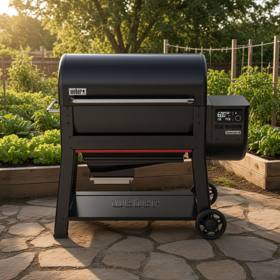
Traeger’s own grill menu now files the Pro 22 and Pro 34 under Legacy Grills. The Woodridge, part number TFB86MLH, stands where they used to stand.
Everything you can measure went up. 860 square inches, a 24 Lbs. hopper, a 10-year limited warranty. Traeger also replaced the thermocouple with an RTD.
One thing went the other way. Super Smoke Mode is not on this grill. It begins on the Woodridge Pro, at $1,149.99.
Bigger is not the interesting question here. Ask instead what a Traeger is worth without its flavor button.
First Impressions of the Traeger Woodridge
Setting it up starts on a phone. Traeger puts the assembly steps in its app rather than in a booklet. The claim is 60 minutes, shown one instruction at a time. Nothing on paper tells you which bolt goes where.
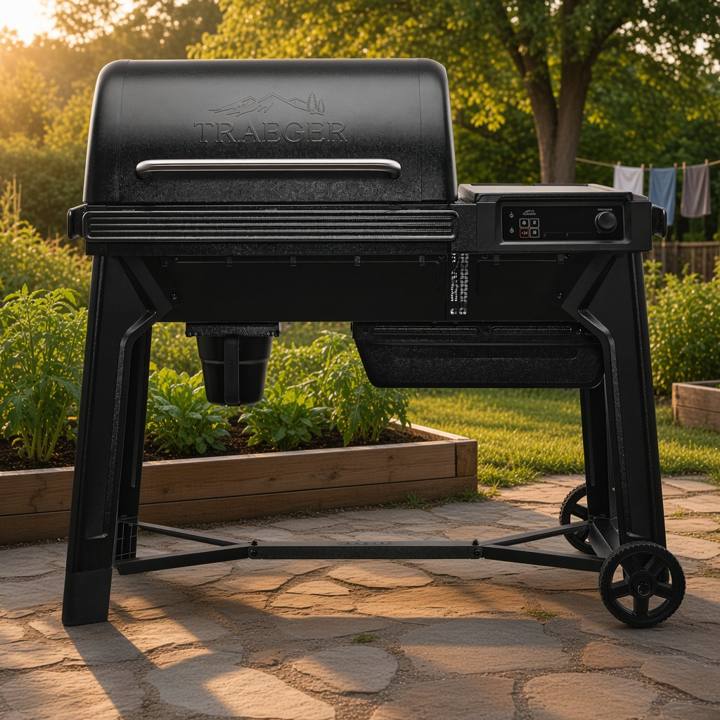
Built and standing, the Woodridge reads as one long black barrel on legs. The controller panel sits to the right of the lid, above the hopper. The grease and ash keg hangs underneath, in plain sight rather than tucked away.
A pellet grill has its own opening ritual. Fill the hopper, run the start-up cycle, and let the fan find its rhythm. The first smoke smells sweeter than charcoal and far less sharp than gas.
Food settles the argument faster than a spec panel does. Run it low and the smoke lands properly on pork. Run it hot and the flavor thins out, exactly as Traeger’s own guidance warns.
Key Features of the Traeger Woodridge
Most of what Traeger changed here sits in the controller or in the cleanup. The cook box itself is a conventional pellet barrel with two racks. Everything named below comes fitted, not bought later.
- Full-color digital controller: Traeger describes a full-color, easy-to-use display on the Woodridge. You set a number and the auger works to hold it. No dampers or vents need balancing.
- RTD sensing: Traeger names an RTD in place of a thermocouple, for better accuracy. On a set-and-forget cooker, what the grill believes is what you eat. It is the most concrete engineering claim Traeger makes here.
- WiFIRE connectivity: The Traeger App watches and adjusts the cook from anywhere. Software updates then arrive over the air. The grill runs unconnected, but Traeger plainly prefers that you connect it.
- One wired meat probe: A single wired probe comes with the grill. Traeger also lists Bluetooth Meat Thermometer compatibility for cutting the cord. Watching two joints at once means buying something extra.
- 860 square inches on two racks: Traeger splits the area 520 below and 340 above. The rating is 6 chickens, 8 rib racks or 6 pork butts. The headline number is not one flat surface.
- EZ-Clean Grease & Ash Keg: Drippings and pellet ash collect in one container below the barrel. Ash is the chore that puts people off pellet grills. Traeger aimed a part at it rather than a paragraph.
- Hopper clean-out: A door lets you empty the hopper and change pellet flavors quickly. Going from a fruit wood to hickory needs no scooping. Anyone who cooks different meats will use it weekly.
- Staging hooks: Built-in hooks hold the grates while you clean underneath them. It is a small thing that solves a genuinely awkward moment. Wet grates otherwise end up on the lawn.
- P.A.L. Pop-And-Lock rails: Traeger’s rail system takes shelves, hooks and ModiFIRE accessories. The grill can be added to rather than replaced. None of those accessories arrives in the box.
Traeger publishes one heat figure for the Woodridge, a maximum of 500 F. No minimum appears anywhere on the page. That is an odd gap on a cooker sold for low and slow work.
What Traeger prints instead is an instruction. Higher heat makes less smoke, and food cooked between 165° and 225° carries more of it. On this grill, smoke is a setting you cook at, not a button you press.
That matters because the button exists one model up. The FreeFlow firepot and Super Smoke Mode belong to the Woodridge Pro and the Elite. The base grill gets the range and the sensor, and you supply the judgment.
Read 500 F as roasting heat rather than steakhouse heat. Skin crisps and pizza bases set at that number. A thick ribeye asks for more than this grill advertises.
The sensor is the real upgrade. An RTD reads heat more closely than the thermocouple Traeger fitted before. A set-and-forget cooker is only as honest as its sensor. Every hour of an overnight cook depends on that one part.
Searing is where Traeger’s own copy wobbles. Its FAQ answers the searing question with an unqualified yes, citing high heat at the grates. The same answer then recommends the upper racks for searing. Those are two different places, and Traeger does not reconcile them.
Build, handling and durability
Traeger publishes 138 lbs as the total weight, and the mass reads as reassurance. A pellet grill that shifts under a full hopper helps nobody. Two people should place it, and after that it stays put.
Moving it is a tilt rather than a lift. Two wheels carry one end, while the far end stands on fixed feet. You tip the grill onto those wheels and push, which needs a flat run.
The published record carries one wrinkle worth knowing about. The same product page also holds a 165 figure in its underlying data, unlabeled. It is almost certainly a shipping weight, but Traeger never says so.
More awkward is what Traeger does not print at all. No width, depth or height appears in text anywhere on the Woodridge page. If it must fit an alcove or a gap in fencing, measure at a dealer.
Traeger also names no material for the grates or for the body. The page leads with a 10-year limited warranty. The manual is narrower: those ten years cover sheet metal against rusting through. The controller, auger and fan get three years, the igniter and probe one.
Running costs, upkeep and value
Traeger listed the Woodridge at $899.99 on its own site on 2026-08-25, in stock. That buys 860 square inches, WiFIRE, a wired probe and ten years against rust-through. The same page showed 4.26 stars from 120 owner reviews.
The interesting comparison sits inside the family. The Woodridge Pro is $1,149.99 and brings Super Smoke, a side shelf and 970 square inches. It weighs 174 lbs, with racks of 585 and 385 square inches.
Pellets are the running cost, and Traeger stays quiet about them. The hopper takes 24 Lbs., and no published figure says how long that lasts. Stock up generously for the first month and track what you go through.
The cleanup story is the best-designed thing on the Woodridge. Drippings and ash land in one keg. The hopper empties through a door, and the grates hang on hooks. Three chores owners genuinely resent each have a part assigned to them.
One ownership note belongs here rather than in a footnote. Traeger takes back an unopened grill within 45 days, with return shipping possibly charged. Once it is built, that window has closed.
Possible Traeger Woodridge Complaints
- The flavor feature starts one model up: Traeger sells this brand on wood-fired taste. Super Smoke Mode is then reserved for the Pro and the Elite. A base Woodridge owner reaches the same territory by cooking low and waiting. It works, it is slower, and the choice was made for you.
- The grill assumes a phone and a signal: Assembly instructions live in the app, and WiFIRE is the headline convenience. A weak signal at the far end of a yard turns both into friction. The controller still runs a cook alone, but you lose the half Traeger advertises.