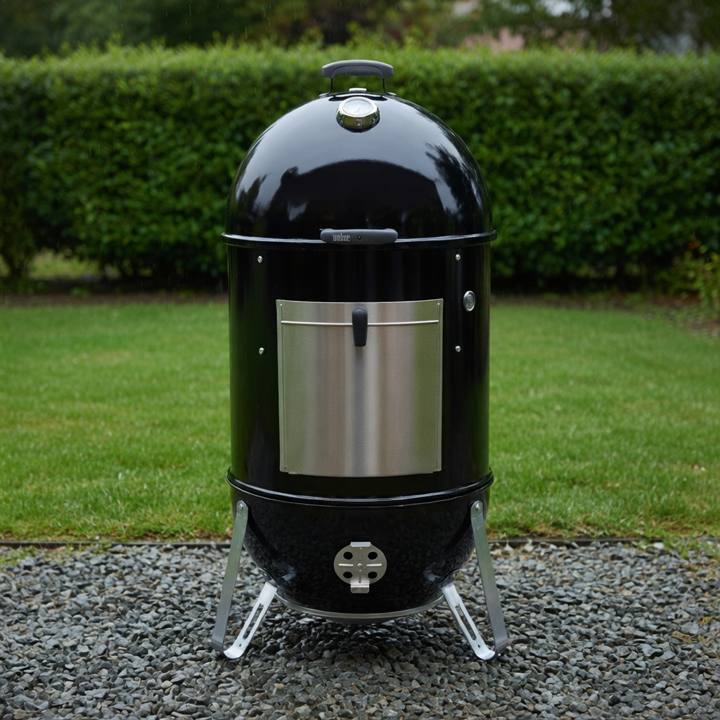
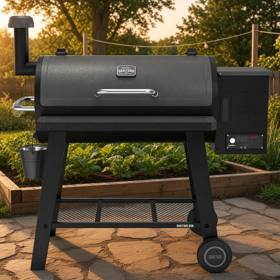
Anyone buying this smoker has already decided about smoke. The argument left is about size.
Weber builds the Smokey Mountain in three. The 14 offers 286 sq in. The 18 offers 481. Model 731001, the one here, offers 726.
Weber also answers the sizing question itself, though only in a picture. Its own range card sits in the listing gallery, printed in Japanese.
That card sorts the three by guest count. 37 cm for 2 to 4 people. 47 cm for 6 to 8. 57 cm, which is this one, for 10 to 12.
Whether the 22 cooks well is not really in doubt. What matters is the evenings you are not feeding twelve.
726 sq inCooking area, two grates, one fire
10 to 12People, by Weber's own range chart
48.5 inHeight, lid closed
22 inBarrel, the largest of three sizes
First Impressions of the Weber Smokey Mountain 22
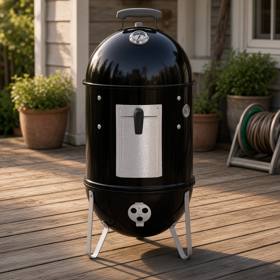
Three pieces come out of the carton and stack. A bowl takes the legs. The middle ring seats on top. Then the dome.
Height is what registers before anything else. Weber lists 48.5”H x 23”W x 24”D with the lid down. The 18 lists 41”H x 19”W x 21”D.
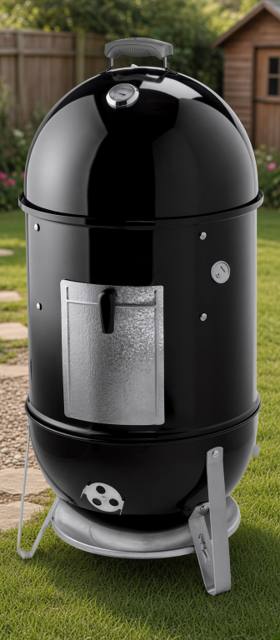
Ground space hardly moves between the two. Eye level does. Two glass-reinforced nylon handles are fitted here, where the 18 carries one.
That is the only fitting Weber changes going up the range. The reason arrives the first time a full center section comes off.
The enamel is the same across all three sizes. It is fired onto steel, not sprayed over it. The warranty schedule names it as the part Weber trusts.
A first cook goes quickly, then stops. Load the chamber, fill the pan, set four dampers, drop the lid. Nothing you do for the next several hours will improve the result.
Key Features of the Weber Smokey Mountain 22
Very little on this smoker is a mechanism. A fire, some water, two racks and four holes account for nearly all of it. The list below is mostly those.
- Two cooking grates: Both racks sit above one bed of charcoal, one over the other. Whatever reaches the top rack has already been past the bottom one. Room is bought by height rather than by burning more fuel.
- Multiple vents and dampers: Four rust-resistant aluminum dampers meter the burn. Weber’s own wording is that closing them fully cuts oxygen to help put coals out. Nothing else here changes the heat.
- Coal door: No hinge. The whole aluminum panel comes away in your hand. Topping up fuel does not require taking anything apart. Refueling costs a couple of minutes, not the cook.
- Porcelain-enameled body: Weber glazes four parts: the bowl, the lid, the middle ring and the pan. Weber claims it resists rusting, cracking and peeling at high temperatures. Nothing on this cooker ever wants oiling.
- Water pan: Glazed steel, parked directly above the burning charcoal. Water takes heat in slowly and returns it slowly, which flattens the peaks. It also keeps the air inside damp.
- Charcoal chamber: A perforated ring holds fuel in one body so it burns as one. Loose ash drops through the ring and misses the vents underneath. Ash in the vents is the usual way control disappears.
- Heavy-gauge steel charcoal grate: The fuel sits on steel chosen for the job, under the chamber. It is the only part of this smoker asked to sit in the fire.
- Built-in lid thermometer: The dial reads whatever the air under the dome is doing. A silicone grommet is fitted beside it for somebody else’s probe lead.
- Rust-resistant aluminum heat shield: It sits under the bowl, shielding whatever the smoker stands on. On a cooker standing on three narrow legs that matters for where you put it.
- Cover: Weber packs one with the smoker, at no separate charge. Nothing you need to run this is an extra purchase.
A charcoal smoker trades in stored heat, and this one stores the most in the range. A 22 in barrel takes the widest fuel bed Weber puts under this shape. Wide beds drift slowly, and slow drift is the whole point.
That steadiness has a condition attached, and the condition is the interesting part. This cooker has no low setting. It has the same fire with less food above it.
One pan, one chamber and one bed serve both grates. Cooking two racks of ribs asks for the same setup as cooking eight. You light a 22 in smoker either way, and it takes its time either way.
Weber’s two sizing claims are worth reading side by side. The US page offers a turkey and two layers of ribs. The Japanese card says 10 to 12 people. Neither is a measurement, and they are not the same promise.
Weber publishes nothing about how hot this gets or how long a load runs. The range card and the area figure are what the company will commit to. Everything about the fire is left for you to learn by running it.
Build, handling and durability
Weber’s warranty schedule reads like an inventory of its own confidence. Rust through on the bowl, the lid or the middle ring is covered for ten years. Five years on plastic. Two on all remaining parts.
On this size, that last line covers more than it does on the others. Three slim legs and every fastener carry the tallest charcoal column Weber makes. The cover is shortest on exactly the parts holding 726 sq in off the ground.
The grates stay plated steel across the range. Searing is not this smoker’s job, so the choice costs the cook almost nothing here. It is still the one place the specification stops being generous.
Running costs, upkeep and value
Price needs stating carefully, because the record and the shelf disagree. Weber’s page listed $549.00 on 17 September 2026. Our own capture that day found Amazon holding $549.00, stocked and orderable.
This site’s older catalogue entry still carries $439 for the same smoker. Both figures were real when recorded, and the gap is worth checking before ordering.
Against the middle size the sum is plain. Weber’s page showed $419.00 for the 18 in August, for 481 sq in. This asks $549.00 and delivers 726 sq in.
Weber’s own page rates the 22 at 4.6 out of 5 across 1084 reviews. Our capture put the Amazon rating slightly higher, at 4.7.
Weber ships free above $99, with restrictions applying. Assembly can be booked out to Angi for a flat $99, once a grill passes $399. The 22 clears that threshold comfortably, and it is the size where paying someone might appeal.
Upkeep divides neatly. Enamel takes a damp cloth. The chamber keeps ash clear of the only controls you have.
The water pan is the job that never goes away. Here it is the biggest one in the range.
Possible Weber Smokey Mountain 22 Complaints
- Only the barrel scaled up: Four dampers appear on the 14, and four appear here. One lid thermometer covers both. The largest fire in the range is steered by the hardware fitted to the smallest. Weber drills a grommet and supplies no probe for it.
- Height is a daily cost, not a line on the spec sheet: At 48.5 in the upper grate sits near chest height. Reaching coals means lifting a loaded, hot center section away. Two handles help with that. They do not turn it into a job for one person.