First Impressions of the Weber Smokey Joe 14
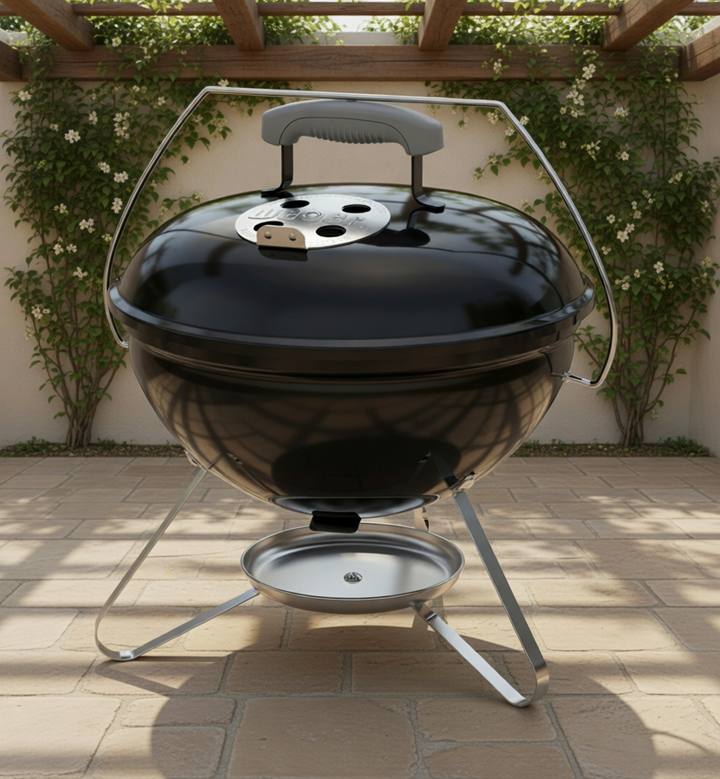
The object is smaller in person than photographs suggest. Lid closed, it stands 17 inches tall on a 14.2 inch footprint.
Porcelain enamel covers the bowl and lid. Weber describes the finish as scratch and rust-resistant. It is the enamel the bigger kettles wear.
Three legs hold it up. An ash catcher hangs beneath, which on a grill this size is the whole cleanup story.
There is nothing else underneath. No shelf, no cart, no wheels, and nothing that needs assembling.
The new part is the lid lock. Weber calls it Tuck-N-Carry, and it does two jobs. It clamps the lid to the bowl for transport, then holds the lid while you cook.
That second job matters more than it sounds. A kettle lid has nowhere to go once removed. On a grill this small there is no shelf for it.
The handle is glass-reinforced nylon. Weber lists exactly one on this model, which tells you how simple the object is.
Key Features of the Weber Smokey Joe 14
- 147 square inches, and that is the whole number. Primary and total cooking area are identical. There is no warming rack inflating a headline figure here.
- Lid and bowl dampers. Weber describes them as giving precise heat control. This is the same two-damper system the full-size kettles use.
- The Tuck-N-Carry lid lock. New on this model. It secures the lid for travel and doubles as a lid holder in use.
- Porcelain-enamel finish. Stated scratch and rust-resistant, over both bowl and lid.
- An ash catcher. It hangs under the bowl and lifts away for emptying. Whatever the grill stands on stays clean.
- A heavy-duty fuel grate. Weber describes it as built to withstand high temperatures, holding the coals above the bowl floor.
- Three colours. Black, Deep Ocean Blue and Burnt Orange, at the same price.
- A tiered warranty. Ten years on bowl and lid against rust through. Five on plastics, two on everything else.
Two dampers is the entire control system, and it is enough. Air in at the bowl, air out at the lid, and the fire follows.
Closing down gives a slow cook. Opening up gives a hot grate. Nothing here needs learning that a charcoal cook does not already want to know.
That simplicity is the point of the design. There is no ignition to fail, no battery to flatten and no electronics to weatherproof.
The limit is size rather than capability. A 14-inch bowl holds a small fire. A small fire has less mass to steady it.
That shows up as a shorter useful window. A big kettle coasts through a long cook. This one wants checking.
Weber publishes no temperature figure anywhere, which is normal for a kettle and still worth saying. The dampers are described as precise with no scale attached to them.
Capacity is honest. Six burgers, and Weber qualifies even that by naming its own burger press. The page frames the grill as feeding two to four.
For direct cooking at that scale it does what the big kettles do. It simply does less of it at once.
Banking coals to one side still works here. The bowl is small, so the cool side is smaller again.
That is the honest limit of a 14-inch kettle. Two zones exist, but neither of them is generous.
Build, handling and durability
Porcelain enamel over steel is the right material for a grill that lives outside. Weber has been refining that finish for decades and puts ten years behind it here.
Enamel does have one weakness worth knowing. Chip it hard enough to reach the steel and rust starts at that point.
On a grill that travels, that risk is real. The carry bag Weber sells separately exists for exactly this reason.
The nylon handle is glass-reinforced rather than plain plastic. That matters on a part you grab while it is hot.
Then there is the grate, and here Weber contradicts itself. The specification chip beside the price says cast iron. A feature bullet further down the same page says rust-resistant plated steel.
Those are not interchangeable. Cast iron holds heat and wants oiling. Plated steel heats faster and wants less attention.
A buyer cannot tell from the page which one arrives in the box. That is a documentation failure rather than a hardware one, but it is Weber’s page.
The care instructions differ between the two. One wants a wipe of oil after cooking. The other wants nothing at all.
Anyone buying this grill should look at the grate before deciding how to treat it.
The warranty is tiered rather than flat. Rust through and burn through on the bowl and lid are guarded for a decade. Plastics get five years, everything else two.
The feature bullets simply say “10-year limited warranty” and stop there. The table further down is the honest version.
Neither is wrong. They answer different questions. Only one tells you what happens in year six.
Running costs, upkeep and value
Charcoal is the only fuel and it is bought separately. Lump or briquettes both suit a bowl this size.
Upkeep is close to trivial. Porcelain wipes down and the ash catcher lifts off. No grease tray exists anywhere on the grill.
The accessory ladder is where the price gets interesting. Weber’s Premium Carry Bag is $27.99, which is half the cost of the grill it carries.
The Floor Protection Mat is $49.99, very nearly the price of the cooker. A grill cover is listed as sold separately and never priced on the page.
None of that is required. All of it is offered beside a $54.99 product, which makes the basket easy to double.
The carry bag is the one worth thinking about. A grill sold on portability arrives without a way to carry it cleanly.
There is a smaller irony in the shipping. Weber offers free shipping on orders of $99 and above. This grill cannot reach that alone.
Value still lands where it should. At $54.99 the bowl and lid carry ten years. Weber puts that same term on kettles costing far more.
That is the whole argument for buying this rather than a supermarket kettle. The cheap alternative is cheaper once. This one is backed for a decade.
Possible Weber Smokey Joe 14 Complaints
The grate contradiction is the real one. Weber names two different materials for the same part on one page.
Capacity is the obvious one. 147 square inches and six burgers feeds two to four. No arrangement of the food changes that.
The third is the accessory pricing. A bag at half the grill’s price sits oddly beside it. So does a mat at nearly the full price.