Weber Smokey Joe 14 vs Smokey Mountain 18
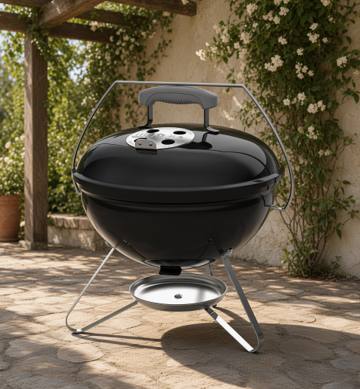
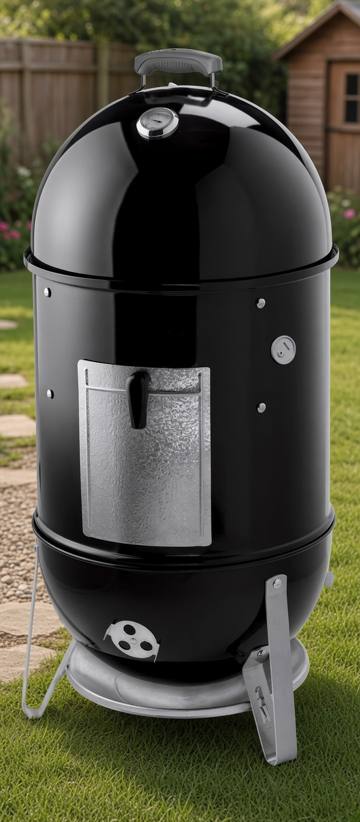
147 sq in on one grate against 481 on two. The Smokey Joe 14 grills hot and travels; the Smokey Mountain 18 is a 41-inch column built for long cooks.
It depends — and here is on what
This turns on what you cook, not on which is better made. For steaks, burgers and sausages for two to four, the Smokey Joe 14 does it for $54.99 and fits in a car. For brisket, pork shoulder and ribs over hours, the Smokey Mountain 18 is built for it: a water pan and two stacked grates, 481 sq in. Neither does the other's job well. The Joe's cool side is small, and nothing on the Smokey Mountain sears.
What actually differs
-
Food over the fire, or food above it
The Joe puts 147 sq in directly over a 14-inch bowl of coals. The Smokey Mountain stacks two grates above a water pan, so the meat sits in moderated heat rather than over flame.
-
A small fire needs watching; a big one coasts
A 14-inch bed has little mass, so the Joe wants checking on anything long. The Smokey Mountain's 18-inch bed is the point of it: cold meat or a wind costs it proportionally less.
-
Both put ten years where rust starts
Bowl and lid on the Joe; bowl, lid and center ring on the Smokey Mountain. Neither has a cord or a controller to fail. The Smokey Mountain ships with a cover and a lid thermometer; the Joe's cover is sold separately.
The scorecard, side by side
Both reviews are scored on the same six weighted categories, each bar on the same 0–10 scale, and every cell carries the reason that review gave. A row is marked won only where the two differ by a tenth or more. How we score →
Lid and bowl dampers give the full kettle control system, over a fire only 14 inches across.
A wider barrel carries a bigger charcoal bed, and a bigger bed resists change better than the 14 inch model.
Ten years against rust through on bowl and lid, five on plastics, two on the rest, over porcelain enamel.
Ten years against rust through on bowl, lid and center ring, so the cover is longest exactly where rust starts.
Porcelain enamel matches the big kettles, but it stands on a short wire tripod, and Weber names the grate two different materials.
Plated steel grates sit inside porcelain enamel, the one place Weber economised on this cooker.
The Tuck-N-Carry lock holds the lid for travel and while cooking, but at 17 in tall it wants a table to cook at.
One built-in reading, taken at the lid, on a cooker whose fire you otherwise cannot see at all.
At $54.99 the bowl and lid carry the same ten years Weber puts on kettles costing several times more.
Weber's page showed $419.00 in August, and a cover and a decade of rust protection are included.
Porcelain wipes down and the catcher lifts away, but the feature list names no One-Touch sweep to push ash into it.
A water pan comes out dirty after every cook, which is the price of the steadiness it buys.
Published figures that differ
Quoted from each maker's own specifications, as each review records them. Figures the two products publish identically are left out — only the differences are listed.
Which one is for you
You grill direct for two to four, want it in the car boot, and smoke only the odd chicken over banked coals.
Check price →You already own something that sears and want weekend brisket and ribs that hold steady without a cord.
Check price →More head-to-heads
Every score and figure on this page comes from our own reviews of these two products, linked above. We have not tested them side by side in one place; the comparison is between two full reviews, each built from the maker's published specifications and documentation. Prices move, and the ones quoted are the ones each review checked on its own date.