Weber Go-Anywhere vs Weber Smokey Joe 14
160 sq in at $89.99 against 147 sq in at $54.99. Nearly the same cooking area for $35 less — and only one of them has an ash catcher.
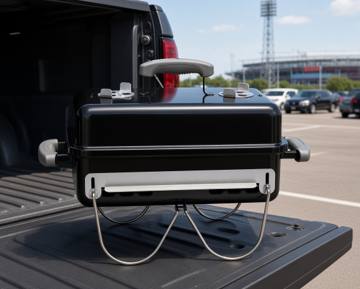
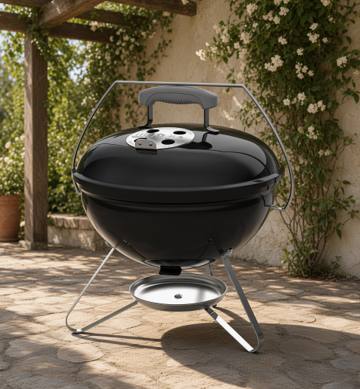
We pick the Weber Smokey Joe 14 Charcoal Grill
The Smokey Joe wins on almost every count that matters here. It cooks on 147 sq in against the Go-Anywhere's 160 — a difference of 13 square inches — for $54.99 against $89.99, and it lists an ash catcher the Go-Anywhere does not. Both carry Weber's full ten years against rust-through on bowl and lid, and both give you the complete kettle damper system over a small fire.
What actually differs
-
13 square inches, $35
The areas are close enough to call equal in use. Our reviews score them 8.27 and 8.72, and the gap is mostly the price and the ash.
-
Ash removal, which is the chore
Weber publishes an ash catcher for the $54.99 Smokey Joe and none for the $89.99 Go-Anywhere, so spent ash leaves the dearer grill by hand. On a charcoal grill used often, that is the difference you feel.
-
The Go-Anywhere earns its keep on shape, not size
Folding legs clamp over the lid to lock it shut, the tools pack inside, and the rectangular box with its char-rail holds a hot end and a cool end more naturally than a 14-inch bowl. For a car boot or a motorcycle pannier, that geometry is the point.
The scorecard, side by side
Both reviews are scored on the same six weighted categories, each bar on the same 0–10 scale, and every cell carries the reason that review gave. A row is marked won only where the two differ by a tenth or more. How we score →
Two lid dampers, two sliding side vents and a char-rail put a hot end and a cool end across 160 square inches.
Lid and bowl dampers give the full kettle control system, over a fire only 14 inches across.
Ten years on cookbox and lid is Weber's full rust cover, but the folding legs sit under a two-year tail.
Ten years against rust through on bowl and lid, five on plastics, two on the rest, over porcelain enamel.
Porcelain-enamel over steel with comfort-grip handles, though the grate is plated steel, the same commodity fitted to the cheaper Jumbo Joe.
Porcelain enamel and a glass-reinforced nylon handle, though Weber names the grate two different materials.
Legs fold over the lid to lock it shut and the tools pack inside, which no kettle on Weber's page manages.
The Tuck-N-Carry lock secures the lid for the journey and then holds it while you cook.
The same $89.99 buys the Jumbo Joe's 240 square inches, so 160 here is paid for in geometry alone.
At $54.99 the bowl and lid carry the same ten years Weber puts on kettles costing several times more.
No ash catcher is published, while the $54.99 Smokey Joe lists one, so spent ash leaves this box by hand.
Porcelain wipes down, the ash catcher lifts away, and there is no grease tray to service.
Published figures that differ
Quoted from each maker's own specifications, as each review records them. Figures the two products publish identically are left out — only the differences are listed.
Which one is for you
You want a flat packable box that locks itself shut and carries its own tools.
Check price →You want the most kettle for the least money — same warranty, an ash catcher, $35 cheaper.
Check price →Every score and figure on this page comes from our own reviews of these two products, linked above. We have not tested them side by side in one place; the comparison is between two full reviews, each built from the maker's published specifications and documentation. Prices move, and the ones quoted are the ones each review checked on its own date.