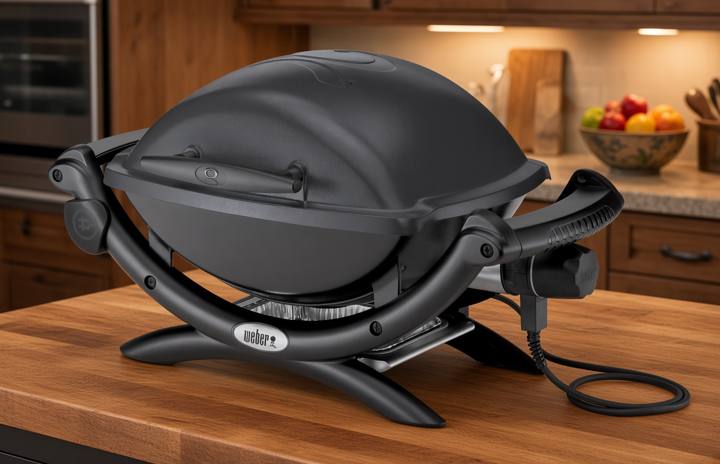
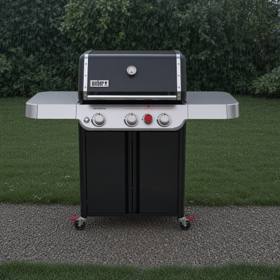
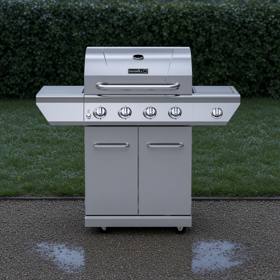
Weber built the Q 1400 around the gas Q 1200’s 189 square inch grate. The gas grill feeds that grate from an 8,500 BTU burner. This one has a wall plug, and a plug stops at 1,560 watts.
Restate those watts as heat with the federal energy conversion. The element supplies about 5,323 BTU an hour. That is under two thirds of the gas rating, poured into the same cast iron.
So this review turns on one question. Can a lined cast aluminum lid and heavy grates close a gap the plug cannot?
Model 52020001 sold for $349.00 at both Weber and Amazon in October 2026.
First Impressions of the Weber Q1400 Electric Grill
The Q 1400 looks like a Q that left its gas behind. The rounded cast aluminum lid is there, in dark grey. So is the swept nylon frame that curls under the cookbox.
The difference sits on the right side. A control unit and a coiled black cord replace the burner valve.
Setup is short, because so little needs connecting. Nothing threads onto a valve, and nothing needs to spark. Fit the catch pan, plug in, turn the dial and close the lid.
The first cook explains the grill. Sausages pick up dark, defined bars from the cast iron, and the casings tighten and split. Peppers blister where they meet the metal and stay firm in between. Thin food is home ground, and that shows on the first plate.
The shape matters more than it looks. Only 5 3/4 inches separate the grate from the closed lid. That rules out anything tall before you have bought the meat. Plan around burgers, chops, fish and skewers rather than a chicken.
Key Features of the Weber Q1400 Electric Grill
Weber gave this grill a short parts list. Nearly every item works against the same limit. The design is about keeping heat, not making more of it. Seen like that, the list stops looking thin.
- 1,560 watts at 120 volts. That is the element’s full rating, drawn from an ordinary household outlet. Nothing on the grill can raise it.
- Infinite heat control. One dial moves the element anywhere across its range rather than in fixed clicks. You choose a position, not a number, because the dial has no scale.
- Cast-iron grates, porcelain-enameled. Iron is the mass that matters here. It banks what the element sends between batches and releases it when cold food lands.
- Cast aluminum lid and body. Both halves are cast rather than stamped. Weber lines each one with aluminum to hold heat inside the cookbox.
- Aluminum heat retention liners. On a gas grill this would be a detail. On a socket-fed one, it is half the heat strategy.
- Glass-reinforced nylon frame. It lifts the cookbox clear of the table. It also gives you something to grip when moving it.
- Removable catch pan. Drippings collect in a shallow pan under the cookbox, and the pan pulls free. Nothing collects in a cabinet, because there is no cabinet.
- 6-foot grounded cord. Weber’s own copy pictures it reaching an outdoor outlet. Six feet is the radius this grill lives inside.
Two absences are worth naming too. There is no warming rack, since primary and total area are both 189 square inches. And there is no cover in the box.
Start with the plain arithmetic. Spread 1,560 watts across 189 square inches and each square inch gets about 8.3 watts. That figure is ours, and it cannot be raised by turning anything further.
What the numbers cannot say is how hot the grate gets. Weber publishes no maximum for the Q 1400. Its newer Lumin electrics carry a printed 600°F figure. We will not borrow the Lumin’s number for an older, different cookbox.
The real gap with the gas Q 1200 is narrower than the ratings suggest. A gas rating counts fuel burned, and much of that heat leaves through the vents. Here, the element sits inside a closed, lined box. Still, every lid opening spends heat that comes back only at a fixed rate.
Weber’s real answer is cast iron. Give the grates time to soak with the lid shut before food goes on. Marks then come from banked heat, not from the element’s live output.
Weber’s artwork puts six burgers on the grate, which is dinner for four. Load all six at once and the iron, not the element, carries the first minutes. Stagger the batch and the element has a chance to keep up.
Fish and vegetables want the element backed off. Then edges do not scorch before the middle cooks. Burgers and sausages want it at the top, lid shut, and left alone. With one zone and no scale, you learn this grill by position rather than by number.
Build, handling and durability
The materials outrank the price. Cast aluminum will not rust like painted steel, and the grates are enameled iron. The warranty draws a sharper line than the spec sheet does.
Rust or burn through on the cast parts and grates is covered for five years. Plastics match that term.
The heating element carries two years, less than half the cookbox’s term. On an electric grill, that element is the engine. Paint on the lid and cookbox carries two years, excluding fading. Every remaining part sits at two years as well.
Lid down, it takes 27 inches by 16.5 of table and stands 14.5 tall. Opened, the lid lifts it to 23.5 inches. Weber prints a 28.5 lb weight for the shipping carton only. The bare grill’s own heft goes unstated.
Running costs, upkeep and value
Here the fuel is a line on the electricity bill. Nobody drives a cylinder to the refill station, and nobody watches a gauge mid-cook. That is the practical case for an electric grill, and it holds here.
Upkeep stays light for the same reason. There is no ash, no charcoal grate and no row of burner ports to clear. The enamel needs no seasoning.
Grease drains into the catch pan, which slides out and can be lined or washed. A brush across warm cast iron after each cook does most of the rest. Unplug first, then let the grates cool before any deeper clean.
Price is where the comparison gets close. Weber and Amazon both listed the Q 1400 at $349.00 in October 2026. Weber’s own page showed $329.00 in January 2025. The price has crept up, not down.
The Lumin Compact sold at Walmart for $399.00 on 9 August 2026. It runs the same 1,560 watts over nine fewer square inches and prints a ceiling. The Q 1400 is the cheaper door into the same socket. The full Lumin, around $499.00 in August 2026, spreads those watts over 242 square inches.
In January 2025, 1502 buyers on Weber’s site had averaged 4.6 out of 5. A long-selling model with that average rarely hides a surprise. The limits described here are ones you buy knowingly.
Possible Weber Q1400 Electric Grill Complaints
- No published ceiling. Weber states the watts and the area and stops. A buyer comparing grills cannot weigh this one’s top end against anything. The mitigation is the cast iron, given time to soak before food goes down.
- The heat source has the shortest warranty. The element carries two years while the box carries five. If the element goes in year three, the bill is yours. Registering the grill with Weber at least keeps the parts lookup simple.