Weber Lumin vs Q 1400
1,560 watts on both: the Lumin spreads them over 242 sq in for around $499 with a published 600°F ceiling; the Q 1400 packs them into 189 for $349.
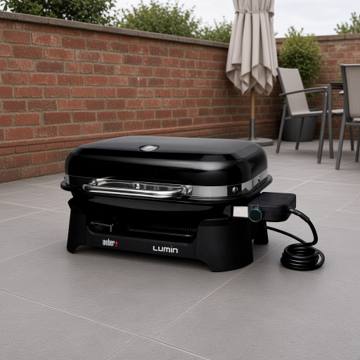
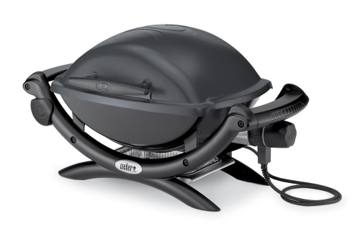
We pick the Weber Q1400 Electric Grill
The Q 1400, if you grill and nothing else. It is $150 cheaper and its smaller grate is the denser one: about 8.3 watts per square inch against the Lumin's 6.4. What the Lumin adds is 53 more square inches, a printed 600°F ceiling and a rain rating. Buy it for those, not for heat.
What actually differs
-
The cheaper grill has the hotter ratio
Weber put the same 1,560 watts under both grates. The Q 1400's 189 sq in concentrates them; the Lumin's 242 thins them. Only the Lumin prints a ceiling, so the denser grill is the one you cannot quote.
-
What Weber will put in writing
The Lumin's maker publishes 600°F and above, says it can stand out in the rain, and allows a 16 AWG extension up to 20 feet. For the Q 1400 Weber states a six-foot cord and stops.
-
Room past six burgers
Six burgers fill the Q 1400, by Weber's own artwork. The Lumin adds 53 square inches past that, room for sides beside a full round of burgers. Neither has a second level.
The scorecard, side by side
Both reviews are scored on the same six weighted categories, each bar on the same 0–10 scale, and every cell carries the reason that review gave. A row is marked won only where the two differ by a tenth or more. How we score →
Weber publishes a 600°F ceiling and keeps the grate small enough that 1,560 watts still bites, but the power cannot grow.
1,560 watts over 189 sq in beats the Q 2400 on density, yet trails the gas Q 1200, and Weber publishes no ceiling.
Cookbox, lid and cast iron grates carry five years, while the heating element that defines the product carries two.
Cookbox, lid, grates and plastics carry five years, but the heating element, the one part that makes heat, gets only two.
Porcelain enamel over cast iron on a 36.5 pound cookbox that Weber says can be left out in the rain.
Cast aluminum lid and body, aluminum liners and enameled cast iron grates, carried on a glass-reinforced nylon frame rather than stamped steel.
Settings replace judgment on the fuel, though a six-foot cord and a 13 amp draw decide where it can stand.
One infinite dial, no cylinder and no igniter, held back only by a six-foot cord that decides where the grill can stand.
Around $499.00 buys 242 square inches and no legs, and Weber's stand asks $179.99 more before it stands up.
At $349.00 it undercuts the $399.00 Lumin Compact on the same wattage, but without the Lumin's published 600°F figure.
Enamel wipes down and there is no ash, though the steam pan and reservoir are two more things to wash.
No ash, no burner ports and enamel that needs no seasoning; grease drops into a catch pan that slides out from underneath.
Published figures that differ
Quoted from each maker's own specifications, as each review records them. Figures the two products publish identically are left out — only the differences are listed.
Which one is for you
You want the published ceiling, steam and smoke settings, and a grill rated to sit out in the rain.
Check price →You grill burgers, chops and fish for up to four and want the most watts per inch for the least money.
Check price →More head-to-heads
Every score and figure on this page comes from our own reviews of these two products, linked above. We have not tested them side by side in one place; the comparison is between two full reviews, each built from the maker's published specifications and documentation. Prices move, and the ones quoted are the ones each review checked on its own date.