First Impressions of the Weber Go-Anywhere
The box looks too small at first. Then the legs make their case.
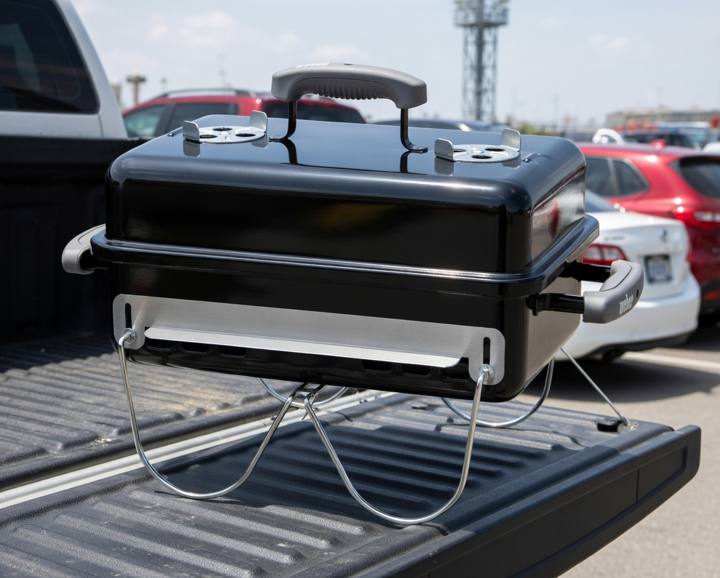
They are two lengths of chromed wire, hinged low on the body. Each swings through almost half a circle. Down, they lock and hold the grill at working height. Up, they fold across the lid.
That second position explains the product. There is no catch and no strap. The stand becomes the lock. A grill turns into luggage with a handle on top.
Under the lid, the layout is as plain as it gets. A shallow porcelain-enamel box. A plated steel grate in two halves. Sliding vents cut into each side of the base.
Weber says tools, a compact chimney starter and drip trays travel inside. They do. That is the gap between packing a grill and packing a grill plus a bag.
Then there is what it weighs, which cuts the other way. At 11.50 pounds it lifts with two fingers. A loaded car notices the shape long before it notices the mass.
First cook comes fast, because there is little metal to heat. Burgers and peppers sat over an even bed. Both came off carrying real charcoal smell rather than the faint version.
Key Features of the Weber Go-Anywhere
One decision drives almost everything here. The cook box is a rectangle rather than a bowl. Every feature below follows from it.
- Multiple vents and dampers: Two adjustable dampers sit on the lid. Two sliding vents cut into the sides of the base. Weber describes them as opening to sear and closing for slow-fire work.
- A two-piece cooking grate: The grate splits in half. Half the surface comes away, and the fire underneath is suddenly reachable. Food stays exactly where it is.
- Char-rail insert: A rail holds coals to one end of the box. Hot and cool then sit in a straight line. A circle cannot arrange itself that way.
- Legs that lock the lid: Swing them over the top and the lid cannot open. Swing them under and they lock at cooking height. One part doing two jobs, with no extra hardware.
- Porcelain-enamel finish: Weber’s usual coating covers the lid and the cook box. The company rates it against scratching and rust.
- Everything stores inside: Cooking tools, a compact chimney starter and drip trays go in the box. The grill is its own carrying case.
- Comfort-grip handles: One sits on top and one on each side. The side pair is what you grab when the grill is hot.
Weber puts the grate at 160 square inches. That figure is the primary area and the total area alike. Nothing sits above it, so the number is honest. The company pitches the grill at two to four people.
The grate itself is plated steel. Weber lists the same material on the Jumbo Joe. So the price is not buying a better cooking surface either.
A small charcoal fire lights easily and steers badly. Four air controls are what make the steering work.
Two dampers on the lid set the exhaust. Two sliding vents at the sides set the intake. Between them you get finer control than a single damper allows. Searing and slow-fire cooking both stay on the table.
The shape does real cooking work, not only packing work. Coals banked behind the char-rail leave a genuinely cool end. In a rectangle that end is a long strip. A rack of ribs lies down it comfortably.
A round bowl of similar size offers a crescent instead. Long food has to curve or overhang. Geometry, not fire, is what separates the two here.
The two-piece grate earns itself on longer cooks. A bed this small burns down inside an hour of hard work. Lifting half the grate to refuel beats every alternative. On a quick cook it never comes up.
Capacity is the honest limit here rather than heat. Four people eat in one sitting, with nothing held in reserve. No second tier exists to park a cooked batch on. Plan the order of the food before the coals are lit.
Build, handling and durability
Materials here are honest rather than impressive. Porcelain-enamel over steel is Weber’s usual answer. At 11.50 pounds there is not much steel to coat. The grill feels light, which is the entire point in a car.
The legs are what this design leans on hardest. They are stand, lid catch and carry mechanism at once. They have to lock in two separate positions. Most grills spread that work across three parts.
Nothing about the wire looks fragile in use. Both locking positions feel positive rather than approximate. It is still a lot of responsibility for one component.
The warranty schedule sorts the parts by how long Weber expects them to last. The two big steel pressings carry ten years, covering rust-through and burn-through. Plastic gets five. Everything else, legs included, gets two.
Running costs, upkeep and value
Charcoal is the cheap part, and a box this size eats little of it. The expensive part is a comparison Weber never prints on one page.
Weber lists the Go-Anywhere at $89.99. Weber lists the 18-inch Jumbo Joe at $89.99 too. One gives 160 square inches and the other 240. Both wear plated steel and the same rust warranty.
So the Go-Anywhere holds exactly one advantage over its sibling. It is a rectangle that closes. That is worth paying for, but only if the grill travels.
Parked on a patio it earns nothing at all. The missing third of the grate then shows up whenever four people do. Buyers should be honest about which life the grill will lead.
Two prices are in play. Weber’s page reads $89.99 and offers a notify button rather than a cart. That $89.99 would not clear the $99 free-shipping floor anyway. Our own capture put Amazon around $93.96 in September 2026.
The ratings agree with each other better than the prices do. Amazon shows 4.6 out of 5 across 1354 ratings. Weber’s own page shows 4.6 out of 5 from 439.
There is very little to buy on top, which suits a grill this cheap. Weber’s Rapidfire Compact Chimney Starter runs $18.99 and is the one worth having. The storage pitch leans on it, since the box is sized around a chimney. A Small Premium Tool Set adds $24.99 if the kitchen drawer cannot spare any.
Upkeep is where the cheaper sibling wins outright. Weber publishes no ash catcher for the Go-Anywhere. The only cleanup item named on the page is a foil pan. The $54.99 Smokey Joe lists a catcher.
Possible Weber Go-Anywhere Complaints
- Ash has nowhere to go. No catcher hangs under this box, so cold ash comes out by hand. Beside a bin at home that is fine. In a car park it is the low point of the day.
- Weber’s own dimensions disagree. The spec table says 15 inches tall with the lid shut, 14.3 open. Weber’s listing drawing calls 11.5 inches the height instead. Measure your boot against all three figures.