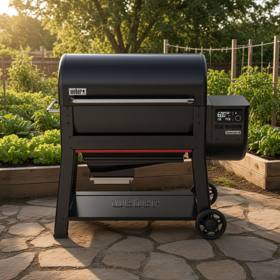
823 sq inGrate area across two racks, 540 and 283
56 inWidth assembled, where the smaller Westwood needs 41
18 lbHopper, the same load the 653 sq in model carries
1 yearCover on the igniter, the cord and the RTD
First Impressions of the Traeger Westwood XL
Clear a 10 ft square of ground before anything comes out of the carton. Seventeen numbered steps follow. The manual recommends two people, and it is not being polite.
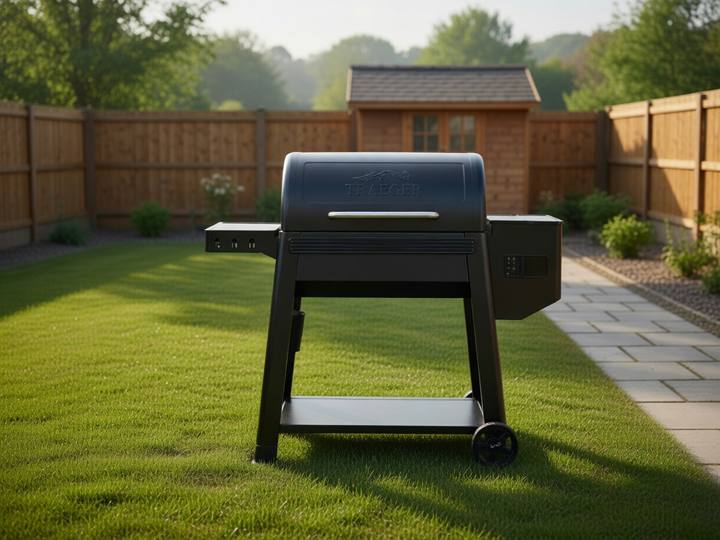
What stands up at the end is wider than most people picture. Height and depth match the smaller Westwood exactly. Width does not, at 56 in against 41 in. Measure the run between your wall and your railing before you order.
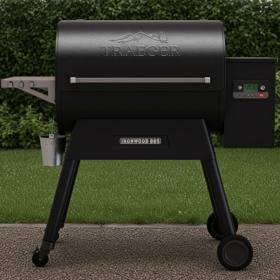
The shape is a long black barrel on four legs. Two legs finish in all-terrain wheels. The other two finish in fixed hooves, so the grill pivots rather than rolls.
Nothing gets cooked on day one. Traeger wants 350 F held for 15 minutes. Then 450 F for another 45.
Siting comes first as well. Keep 20 in clear of anything combustible, and find an outlet with working GFCI protection.
Day two tastes like a Traeger. Pork and chicken come off carrying smoke right through, not just on the outside. The flavor is mild next to what a firebox and split logs produce. It is also much harder to get wrong.
Key Features of the Traeger Westwood XL
Strip the badges off and what remains is a barrel, an auger and a fan. What you are paying Traeger for sits on the hopper and in your pocket. The list below is identical to the smaller Westwood’s, row for row.
- WiFIRE and Bluetooth controller: You set a number on the dial much as you would an oven. The app then takes over from your phone, and firmware arrives the same way. One catch: a 5 GHz router is invisible to it, so 2.4 GHz is required.
- Two cooking racks: Traeger’s panel gives 540 sq in for one and 283 sq in for the other. Both lift out. Loaded together, Traeger claims 7 rib racks, 28 chicken breasts or 25 burgers.
- Wired meat probe, in the box: The controller takes a wired probe, and Traeger includes one. A dedicated button swaps the readout from grill to meat. Traeger’s wireless probes have a button of their own here.
- P.A.L. Pop-And-Lock rail: You bolt the rail across the front during assembly, and it stays there. Shelves and hooks lock onto it afterwards. It is the only route Traeger offers to reshaping your working area.
- Side shelf and bottom shelf: Both belong to the frame rather than to an accessory catalogue. Traeger puts a number on each: 40 lb up top, 60 lb underneath. Most makers say nothing at all about what their shelves will take.
- Electric Igniter: Holding one button starts the fire, and an element in the firepot does the rest. Nothing about lighting this grill asks for a flame of your own. Traeger’s table then gives that element the thinnest cover on the machine.
- Hopper clean-out door: Unscrewing a knob at the back empties the hopper into Traeger’s StayDry bin. Changing from one wood to another stops being a job with a scoop.
The dial runs 180 to 450 F, and that range covers the smaller Westwood as well. Nothing about the fire changed when the chamber did. More air to heat, the same ceiling above it.
Pizza, whole birds and weeknight burgers are all comfortable under 450 F. Steak is where pellet grills have always struggled. The XL adds no sear zone and no higher setting. The answer stays a heavy pan on the rack.
Traeger is unusually straight about steadiness. Its manual puts normal drift at 25 F either side of your setting. Good weather, it adds. And then it argues the drift is where the smoke flavor comes from.
Two of the Excluded rows bite harder on the bigger grill than on the small one. Super Smoke is the first. Without it, asking for more smoke means setting a lower number. Added insulation is the second, and there is now more cold air inside to fight.
Build, handling and durability
128 lbs is not heavy for a grill this wide. Two legs roll and two do not, so moving it means lifting an end. On grass and gravel the all-terrain wheels earn the name.
What Traeger will not say is what any of it is made from. Not the barrel, not the lid, not the racks. The published record names no material anywhere, and at this money that silence is worth noticing.
What Traeger does spell out is how long each part is covered, and for what. The manual states outright that its table covers the Westwood XL. No guessing by family resemblance is needed here.
Seven years attaches to the body, the legs, both shelves and the hopper cover. It attaches to one failure only, which is rusting through. Read down the table and the terms shorten fast.
Grates get three years, and only against rust. Three years also covers the auger motor, the fan and the controller. Drop to the last row and the igniter, cord and RTD have a single year.
Running costs, upkeep and value
$799.99 is the figure on Traeger’s own page. The picker beside it reads $699.99 for 653 sq in. Judged on grate area alone, the XL is the better buy of the pair. Judged on anything else, the two columns read the same.
Ordering direct adds freight. Traeger charges $49.99 to ship a grill. Dispatch runs 5 to 7 business days, with about 7 more in transit. Add it to the sticker before you set this grill against a rival.
The only consumable here is pellets, and Traeger has a preference about whose. The manual’s line is that other brands risk uneven heat and poorer flavor. The warranty is blunter still, and voids cover outright if the fuel is wrong.
Where you buy matters to the paperwork as well. The clock starts on the day an authorized seller sold it to you. Cover is void if the grill came from anyone else. Cover is void again if you later sell it on.
Upkeep is light for the size. Every internal part comes out by hand, racks and drip tray and baffle. The grease bucket unclips from the side.
Two exclusions are worth knowing before a grease fire. Warping of the drip tray and heat baffle is not covered. Neither is paint damage from the fire.
Possible Traeger Westwood XL Complaints
- The hopper did not grow with the grill: The smaller Westwood feeds 653 sq in from 18 lb. The XL feeds 823 sq in from the same 18 lb. Traeger publishes no burn figure, so the gap cannot be planned. Topping up before a long cook is the only real answer.
- No level warning on the model that needs one most: Nothing on the grill or in the app reports how much fuel remains. That omission is deliberate and published, sitting in the Excluded column of Traeger’s own grid. Across a brisket it becomes a trip outside with a flashlight.