Kamado Joe Classic I Ceramic Charcoal Grill Review
8.0out of 10
Avid Griller Score
The average across all 215 grills we have rated is 8.0, and this grill sits level with it.
The KJ23RH cooks exactly like its dearer sibling, and it opens like an older kamado. Every dollar of the $500 gap went into the lid, the seal and the vent. If you can lift a ceramic dome without a second thought, keep the money.
We receive free products to review and participate in affiliate programs. See our disclosure page for more information.
Three series of the 18 inch Classic Joe sit on Kamado Joe’s shelf. The KJ23RH is the first of them. It lists at $999.99 on the maker’s site, exactly $500 below the Series II. Yet the maker’s own comparison chart shows the pair sharing far more than they differ.
Both carry the same ceramic body and the same 250 sq in grate. Both use the 2-tier Divide and Conquer system and the same cast iron cart. So where did the $500 go? The chart answers in three lines.
The Air Lift Hinge is missing here. So are the fiberglass mesh gasket and the Kontrol Tower vent. Every one of them touches the lid, not the food. Whether a lid is worth $500 to you decides this purchase.
250 sq inCooking space on one 18 in grate
225 to 750 FMaker's stated heat range
$500Saved against the Series II at list
227.7 lbGrill weight on the maker's sheet
First Impressions of the Kamado Joe KJ23RH
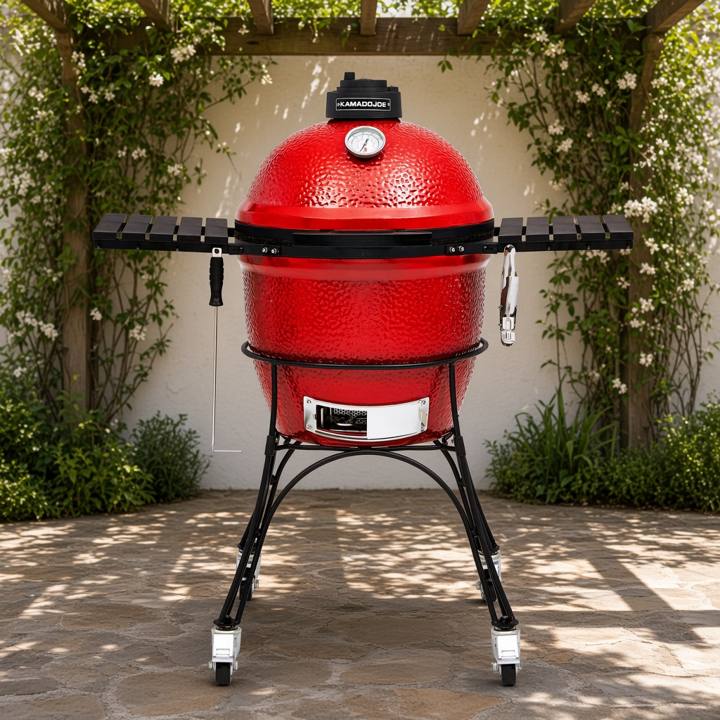
The first thing you notice is mass. Kamado Joe lists the grill at 227.7 lb, and the cart carries every pound. Rolling it off the pallet needs two people and a plan. On its locking wheels, though, it crosses flat paving without drama.
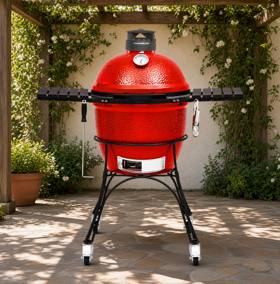
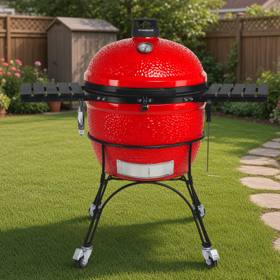
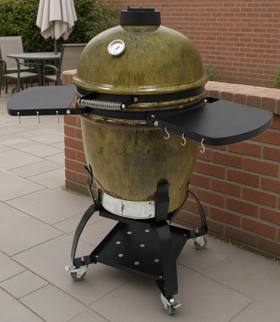
The glaze is a deep Blaze Red with a pebbled texture. A dial thermometer sits in the dome, and a black cast iron cap crowns the top. Dark folding shelves flank the body. With both raised, the whole thing spans 46.2 inches.
Raising that dome is the second surprise. The dome is solid ceramic, and nothing helps you raise it. On a Series II, a lift assist takes much of that weight. Here your arm does all the work, on the first lift and the fiftieth.
The first cook makes the case anyway. A thick ceramic shell holds heat calmly. Pork chops leave the grate darkly browned and tasting of lump smoke. That is the result kamado owners chase, and it arrives without fuss.
Key Features of the Kamado Joe KJ23RH
Here is the hardware that ships with this series. Most of it is shared with the dearer models. Keep that in mind as you read the list.
2-Tier Divide and Conquer: The grate splits into half-moon sections at two heights. You can sear on one side and run gentler indirect heat on the other.
Cast-iron top vent: A rotating cap that meters exhaust and holds a fire steady. It is the older design, not the Kontrol Tower.
Slide-out ash drawer: It pulls from the base and empties ash without lifting the grates and firebox out first.
AMP firebox: A ceramic firebox built in several pieces. The maker says the sections retain heat and resist breakage.
Stainless steel: The grates are stainless steel. There is no cast iron to season on the cooking surface.
Cast iron cart with locking wheels: The same cart the Series II rides on, according to the maker’s chart.
Folding HDPE side shelves: Plastic prep space that drops down when you need clearance.
Built-in thermometer: A dome dial reads air temperature under the lid.
Multiple vents or dampers: The bottom draft door and the top cap work as a pair.
Ash tool and grill gripper: Both come in the box, according to the Amazon listing title.
One caution about the Amazon listing. Its bullets call the vent a “Control Tower Top Vent”. Kamado Joe’s own page says cast iron, and its photo shows a cast iron cap. Trust the maker and the picture.
Heat density does not apply here. The site figures it for gas and pellet cookers only. Charcoal carries no rated output to divide.
Metric
Figure
What it means
Cooking space
250 sq in, 18 in grate
The maker's chart says 13 burgers, 4 chickens or 2 pork butts.
Heat range
225 to 750 F
Low enough for overnight brisket. Hot enough to crust a steak in minutes.
Footprint
46.2 in wide, 47.6 in tall
Width counts both shelves out. Fold them to tuck it closer to a wall.
Weight
227.7 lb
Wheels make it movable on a patio. Stairs are another matter entirely.
Top vent
Cast iron cap
Adjusts fine, but it holds no marked positions you can return to.
Price
$999 on Amazon, Oct 2026
Exactly $500 under the Series II at both the maker and Amazon.
Warranty
Lifetime ceramics, five years metal
Per Amazon's table. Check Kamado Joe's own terms for gasket and dial cover.
Shipping
Free room of choice delivery on Amazon
The carrier places it in the room you pick. Worth having at this weight.
Heat and cooking performance
The KJ23RH cooks exactly like a Series II, because the cooking parts are identical. Same ceramic, same 18 inch grate, same 225 to 750 F range. None of the $500 saving came out of the fire.
Overnight smoking shows off the thick walls best. Once the vents settle, the shell soaks up heat and gives it back evenly. A pork butt can ride through the night with little attention. The maker’s chart claims two butts fit, and the round grate makes room for them.
At the other end, a wide-open draft pushes the fire hard. Steaks crust fast on the stainless grate. Split the 2-tier system for two jobs at once. Chops can sear low while potatoes roast higher on the far side.
The cast iron cap is the one place heat control feels older. It adjusts well, but it has no marked stops. Finding last weekend’s smoking position takes a little trial. That costs patience, not food quality.
Build, handling and durability
Ceramic is heavy, and here it pays for its weight. The shell holds heat in rain and wind, and it does not rust. The AMP firebox comes in sections, which the maker says prevents breakage. A cracked one-piece firebox is a familiar kamado failure, so this matters.
Two of the parts held back for the Series II do affect durability. The fiberglass mesh gasket is listed only for Series II and III. Kamado Joe does not say what this series seals with instead. Treat the seal as a part you may one day replace.
The missing Air Lift Hinge matters more to the owner than to the grill. A heavy dome dropped hard can chip the rim. Lowering it by hand, every time, is a habit worth forming early.
The plastic side shelves are the soft spot in an otherwise solid build. They fold away neatly. They will not take the abuse that the cast iron cart beneath them shrugs off.
Running costs, upkeep and value
Fuel is lump charcoal, and a sealed ceramic burns through very little of it. A well-sealed kamado can shut its vents and smother the fire. Leftover lump then lights again next cook.
The slide-out drawer is the upkeep win. On many kamados, ash removal means pulling the grates, deflectors and firebox first. On this grill, the drawer slides out and gets dumped in seconds. It turns a chore into a quick habit, so it actually gets done.
The warranty on Amazon’s listing reads lifetime on ceramics, five years on metal parts. The ceramic coverage is the one that counts most. For the seal and the dial, check Kamado Joe’s own terms before you buy.
Now the money. Amazon had it at $999 in October 2026, $500 under the Series II. That difference buys three things, and none of them cooks.
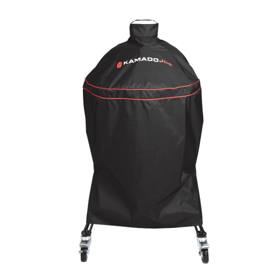
Extras add up on any kamado, and this one is no exception. Kamado Joe sells a heavy-duty cover for the Classic Joe at $99.99. Bought as a bundle with this grill, the pair runs $1,069.99, a small saving. The JoeTisserie adds a spinning spit for $349.99.
Weigh those against the gap, too. A cover plus the spit nearly matches the Series II premium on its own.
So the sum is personal. Strong arms and some patience with the vent make the saving real. If either is in short supply, $500 for a lift assist may be the better trade.
Possible Kamado Joe KJ23RH Complaints
The dome is heavy to open. The Air Lift Hinge went to Series II and III. Every cook starts with an unassisted lift, and an awkward one if you are shorter. Opening from the side with a bent knee helps.
Vent settings are hard to repeat. The cast iron cap has no marked stops. Small changes need waiting, so set it early and adjust slowly.
8.0out of 10
The verdict
How we scored the Kamado Joe Classic I Ceramic Charcoal Grill
Six categories, each with a fixed weight, applied the same way to every grill. Scored under Avid Griller Scoring System 2.2.
Heat PerformanceStrongest25% of the score
8.6
Same ceramic and 225 to 750 F range as the Series II, and the split 2-tier grate runs two zones from one fire.
Long-term Reliability20% of the score
7.6
Lifetime ceramic cover is strong, but the fiberglass mesh gasket went to Series II and III, and metal parts carry only five years.
Build Quality18% of the score
8.3
Ceramic shell, cast iron cart, stainless grates and a multi-piece firebox built to resist cracking; plastic HDPE shelves are the soft spot.
Ease of UseWeakest15% of the score
6.9
No Air Lift Hinge means lifting a heavy ceramic dome unassisted every cook, and the cast iron cap lacks the Kontrol Tower's repeatable settings.
Value12% of the score
7.7
Identical food to a $1,499 Series II for $999, yet still four figures for a design whose comforts were moved upmarket.
Maintenance10% of the score
8.4
The slide-out ash drawer empties the firebox without unloading the grate stack, a real edge over basic kamados.
Best for
The cook who wants Series II foodThe ceramic, grate and cart match the dearer model. If the hinge and vent do not matter, keep the $500.
The two-zone weekend smokerHalf-moon grates let ribs sit over a deflector while sausages sear beside them. One fire covers both jobs.
A strong, patient lid lifterEvery cook starts by raising the dome by hand. If that is no burden, the main penalty disappears.
Skip it if
Lifting is a problem for youThe Air Lift Hinge lives on the Series II and III. Without it, opening the dome is real effort.
You want a cheaper kamadoAt $999 this is not an entry price. Steel kamados cost a fraction of it.
Bottom line
The KJ23RH cooks exactly like its dearer sibling, and it opens like an older kamado. Every dollar of the $500 gap went into the lid, the seal and the vent. If you can lift a ceramic dome without a second thought, keep the money.
Kamado Joe Classic I Ceramic Charcoal Grill dimensions and cover size
The Kamado Joe Classic I Ceramic Charcoal Grill measures 46.2 inches wide, 28 deep
and 47.6 tall, on its cart with the side shelves, and weighs 227.7 pounds.
Measurement
US
Metric
Width
46.2 in
117 cm
Depth
28 in
71 cm
Height
47.6 in
121 cm
Weight
227.7 lb
103.3 kg
Which cover fits the Kamado Joe Classic I Ceramic Charcoal Grill
The cover Kamado Joe lists for this grill is the Kamado Joe Heavy-Duty Grill Cover, Classic Joe size, part number KJ-GC23BWFS.
Kamado Joe prints the width, height and weight but no depth. The 28 inch depth is the figure two retailers give for this model, KJ23RH.
Figures from kamadojoe.com (pages 1, 2), greentoe.com (page) and socal.co.uk (page).
Kamado Joe Classic I Ceramic Charcoal Grill head to head