Char-Griller AKORN vs Kamado Joe Classic I
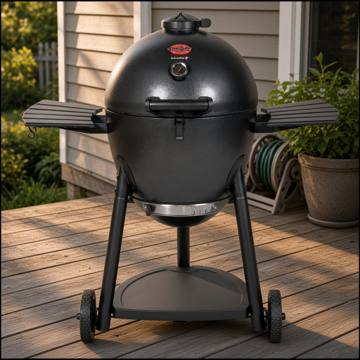
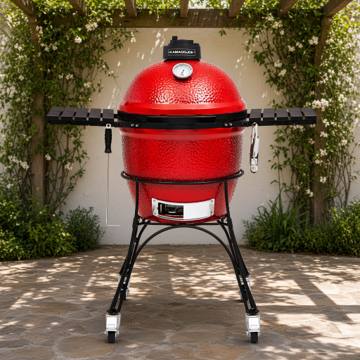
AKORN or Kamado Joe Classic I: insulated steel against ceramic, 325 against 250 sq in, $399.99 against $999. What the extra $600 buys.

No single winner. Here is how to choose.
It depends on whether you want to buy a kamado once. The AKORN gives you the kamado way of cooking for $399.99: insulated steel, a 200 to 700 F range, 325 sq in of grate, wheels and shelves, and the easiest handling of the two. The Kamado Joe Classic I is ceramic, with a 225 to 750 F range, a split two zone grate and a lifetime warranty on the ceramic, at $999. Steel can rust and the AKORN's warranty excludes surface rust, which is why our reliability score is 7.1 against the Classic I's 7.6. If you want to try kamado cooking or your budget stops at $400, the AKORN is the smart buy. If you want a grill for the next twenty years, save for the ceramic.
What actually differs
-
Ceramic lasts, steel needs care
The Classic I's ceramic is covered for life and does not rust. The AKORN's steel needs a cover and oil, and its 5 year warranty covers burn and rust-through, not surface rust.
-
The AKORN is easier to live with
Wheels, two shelves and a light steel lid give the AKORN an ease of use score of 8.7. The Classic I's heavy dome, with no hinge assist, scores 6.9.
-
How long a fire lasts
The AKORN holds at most 3.1 lb of charcoal. Ceramic's mass holds a low fire steadier and longer, which matters most on overnight smokes.
How they score, category by category
The Char-Griller AKORN scores higher in 2 categories, the Kamado Joe Classic I in 4 categories.
Level overall: within a tenth of each other.
-
Heat Performance
Counts for 25% of the scoreChar-Griller AKORN 8.2Kamado Joe Classic I 8.6 Better by 0.4Why the Kamado Joe Classic I scores 8.6Same ceramic and 225 to 750 F range as the Series II, and the split 2-tier grate runs two zones from one fire.
Why the Char-Griller AKORN scores 8.2
Holds 200 to 700 F on lump with indexed dampers, but a 3.1 lb fuel ceiling makes long smokes a refuelling job.
-
Long-term Reliability
Counts for 20% of the scoreChar-Griller AKORN 7.1Kamado Joe Classic I 7.6 Better by 0.5Why the Kamado Joe Classic I scores 7.6Lifetime ceramic cover is strong, but the fiberglass mesh gasket went to Series II and III, and metal parts carry only five years.
Why the Char-Griller AKORN scores 7.1
A coated steel shell can rust where ceramic cannot, and the 5-year burn and rust-through term excludes surface rust.
-
Build Quality
Counts for 18% of the scoreChar-Griller AKORN 7.3Kamado Joe Classic I 8.3 Better by 1.0Why the Kamado Joe Classic I scores 8.3Ceramic shell, cast iron cart, stainless grates and a multi-piece firebox built to resist cracking; plastic HDPE shelves are the soft spot.
Why the Char-Griller AKORN scores 7.3
Cast iron grates and a three wall steel body are sound; powder coat over steel is the compromise that sets the price.
-
Ease of Use
Counts for 15% of the scoreChar-Griller AKORN 8.7 Better by 1.8Kamado Joe Classic I 6.9Why the Char-Griller AKORN scores 8.7Wheels, two side shelves, a numbered top damper and a slide out ash pan make it the easiest kamado to live beside.
Why the Kamado Joe Classic I scores 6.9
No Air Lift Hinge means lifting a heavy ceramic dome unassisted every cook, and the cast iron cap lacks the Kontrol Tower's repeatable settings.
-
Value
Counts for 12% of the scoreChar-Griller AKORN 8.6 Better by 0.9Kamado Joe Classic I 7.7Why the Char-Griller AKORN scores 8.6Around $399.99 for a working kamado on a cart; the $59.99 Smokin' Stone is extra and you will want it.
Why the Kamado Joe Classic I scores 7.7
Identical food to a $1,499 Series II for $999, yet still four figures for a design whose comforts were moved upmarket.
-
Maintenance
Counts for 10% of the scoreChar-Griller AKORN 7.6Kamado Joe Classic I 8.4 Better by 0.8Why the Kamado Joe Classic I scores 8.4The slide-out ash drawer empties the firebox without unloading the grate stack, a real edge over basic kamados.
Why the Char-Griller AKORN scores 7.6
The EasyDump pan clears ash in seconds, but bare cast iron and a coated steel shell both ask for regular oil and cover.
See all six scores in one table
| Category | Char-Griller AKORN | Kamado Joe Classic I |
|---|---|---|
| Heat Performance (25%) | 8.2 | 8.6 Better |
| Long-term Reliability (20%) | 7.1 | 7.6 Better |
| Build Quality (18%) | 7.3 | 8.3 Better |
| Ease of Use (15%) | 8.7 Better | 6.9 |
| Value (12%) | 8.6 Better | 7.7 |
| Maintenance (10%) | 7.6 | 8.4 Better |
| Avid Griller Score | 7.9 | 8.0 |
Both reviews are scored on the same six weighted categories, on the same 0 to 10 scale, and each reason is the one that review gave. A category is marked better only where the two differ by a tenth or more. How we score →
Where the spec sheets differ
Quoted from each maker's own specifications, as each review records them. Figures the two products publish identically are left out, so only the differences are listed.
Which one is for you
You want real kamado cooking on wheels for $399.99, and will cover and oil it.
Check price →You want ceramic that lasts decades and do not mind lifting the dome.
Check price →More head-to-heads
Every score and figure on this page comes from our own reviews of these two products, linked above. We have not tested them side by side in one place; the comparison is between two full reviews, each built from the maker's published specifications and documentation. Prices move, and the ones quoted are the ones each review checked on its own date.