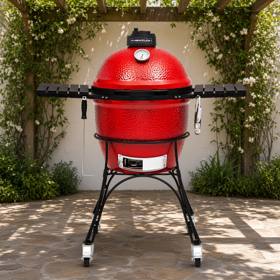
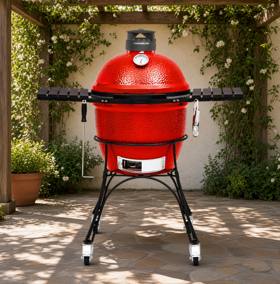
Bayou Classic is a Louisiana name built on burners, fryers and cast iron. A ceramic kamado sits oddly in that catalogue. The Cypress grill, model 500-515, was the company’s answer. Ceramic had become an expensive shape to own.
Its pitch was blunt. Cart, folding shelves, cover, thermometer and ash rake all shipped in one carton. Most ceramic rivals charged separately for nearly all of it.
Something in that package had to give. This review is about which part.
First Impressions of the Bayou Classic Cypress Grill
The carton is heavy, and the cart is hiding inside it. Bayou Classic packs the cart components around and inside the grill body itself. Unpacking therefore comes first, then building the cart, then lifting the grill onto it. That last step needs two people, and the manual says so in capitals.
Cart assembly is twenty carriage bolts and twenty nuts. A wrench and an allen key come with the product. Nothing calls for a drill or a workbench. The struts slide out, the grill goes down, then the struts slide back to meet it.
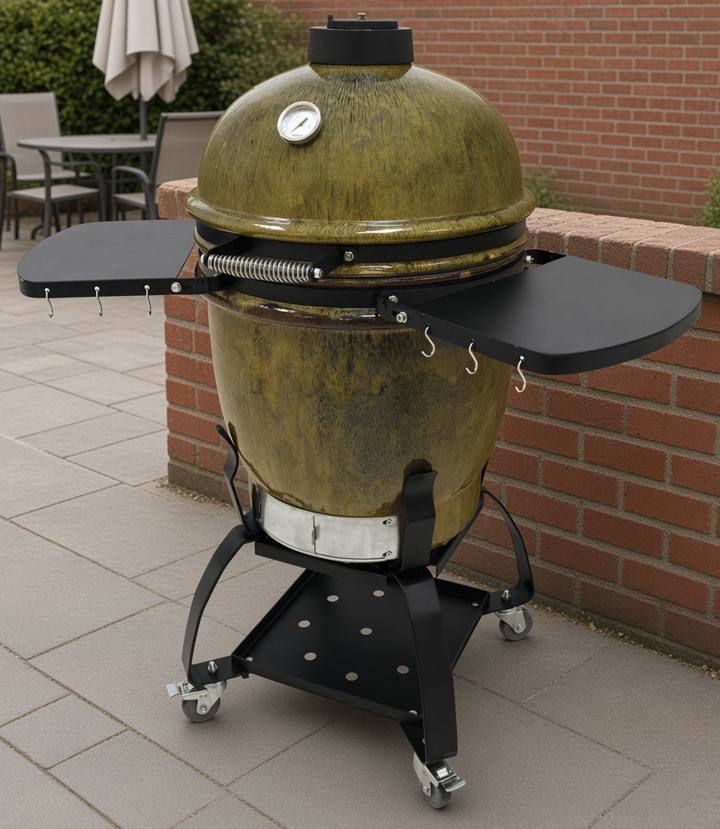
What ends up on the cart looks handmade, because in part it is. The Cypress Leaf glaze runs green and mottled, and no two bodies come out alike. Bayou Classic states plainly that pin holes and uncovered patches near the metal bands are normal. Treat that as character or as a flaw, but know about it before ordering.
Lighting is lump charcoal and crumpled newspaper with both vents open. Coals are usually ready inside ten minutes, with no waiting for white ash.
Chicken thighs at 300°F came off with skin that had properly rendered. The surprise is not the heat. It is how rarely the vents then need touching.
Key Features of the Bayou Classic Cypress Grill
Almost everything on this grill is either ceramic or a way of holding ceramic. The moving parts number two vents and a hinge. What follows is the rest of the carton.
- Multiple vents: A top dome vent and a bottom vent are the only heat controls. Air flow sets the number, so the two move as a pair. Reading them takes a few cooks.
- Stainless steel: The reversible cooking grate is stainless, built from 5.5 mm bars. Bars that heavy hold their heat against a cold steak. The grate also carries its own part number for replacement later.
- Two ceramic inserts: A fire bowl holds the coals and an insulation ring carries the grate. Both are handcrafted ceramic. Both are sold separately as spares.
- Solid steel charcoal plate: The plate sits inside the fire bowl and lifts coals off the narrow base. Ash drops through it and gathers near the bottom vent, where the rake reaches.
- Stainless thermometer: The dial reads 50°F to 750°F behind a tempered glass face. One instrument therefore covers an overnight smoke and a hard sear.
- Cover: A fitted grill cover is in the carton rather than in the accessories aisle. On a ceramic body that lives outdoors all year, that is not a small inclusion.
- Folding side shelves: Two shelves fold flat against the body and accept twelve utensil hooks. They also slide forward or back on their bolts before you tighten them.
- Cart with locking casters: Four legs, a bottom tray and four casters, two of which lock. Its presence in the box is the whole commercial argument for this grill.
Every ceramic cooker trades on heat retention, and this one is no exception. The more useful question is how the maker expects you to reach a number. Bayou Classic answers it with a chart of vent positions set against food.
That chart runs from 200°F for smoking up to 450°F and beyond for steak. Poultry and turkey breast sit at 325°F, roast beef and pork at 350°F. Burgers and ribs share 300°F. None of that is exotic, but a new owner gets somewhere to start.
The catch is the direction of travel. Heat keeps climbing after both vents are shut. That is the ceramic giving back what it absorbed.
So you close down before the dial arrives rather than when it does. Overshooting on a kamado is a slow and patient thing to undo.
Searing is where the 18.5 inch grate draws its line. That is a modest circle by ceramic standards, and it fills faster than the dome suggests. Four steaks are comfortable. Crowd it further and a sear quietly turns into a braise.
Build, handling and durability
The body arrives with lid, hinge and bands already fitted. That is worth more than it sounds. Aligning a ceramic hinge is nobody’s favourite afternoon. The felt seal between lid and base is the component that actually wears.
Bayou Classic includes a spare felt liner, 140 inches of self-adhesive strip, in the box. Read that as an admission with the remedy attached. A dome that leaks air cannot hold a low number. Felt is what stops the leak.
Then comes the honest part, and it is printed in the warranty. Five years covers parts against defects in material and workmanship. It does not cover cracks in the fire bowl or the insulation ring.
Bayou Classic calls that cracking normal and explains the reasoning. The insert is the buffer absorbing extreme heat so the outer body does not. A cracked insert here is not a fault. It is the part doing its job.
Running costs, upkeep and value
Our own price check in July 2026 found it near $899 at Amazon. A dealer price of $789.95 also sits on file. That dealer site has since gone dark, so the Amazon figure is the live one.
Bayou Classic’s current ceramic grill, item 500-430, lists at $1,124.99 with the cart sold separately. Those are different models and not a like for like comparison. The direction of travel is still legible.
Fuel is natural lump charcoal, and the manual asks for nothing else. Lighter fluid is forbidden outright. The porous inserts hold the smell and pass it into food.
A chimney or an electric starter becomes a habit within a week. Lump also leaves less ash, which keeps the bottom vent clear.
Ash comes out through that bottom vent with a rake. The inserts stay where they are. That is faster than lifting ceramic, and it spares parts you would rather not replace. The felt strip will want renewing eventually, which is why the spare ships in the box.
Bayou Classic also owns up to mold, in print, in its own manual. A dome that sits shut for a month in damp weather can grow it. The published fix is to light the grill and bake at 450°F for half an hour. Then brush out the residue once everything is cold.
Possible Bayou Classic Cypress Grill Complaints
- The inserts are consumables, and the paperwork says so: Five years on parts reads generously until you reach the exclusions. The two ceramic pieces closest to the fire sit outside the cover. The bill for that arrives long after the receipt has been filed away. Price a spare fire bowl into the purchase and the surprise disappears.
- Every part of moving it is a two-person job: The grill goes onto its cart empty, by hand, with the support struts slid clear. Casters help afterwards on smooth paving and very little else. Choose the spot in the garden before assembly, because changing your mind later is a project.