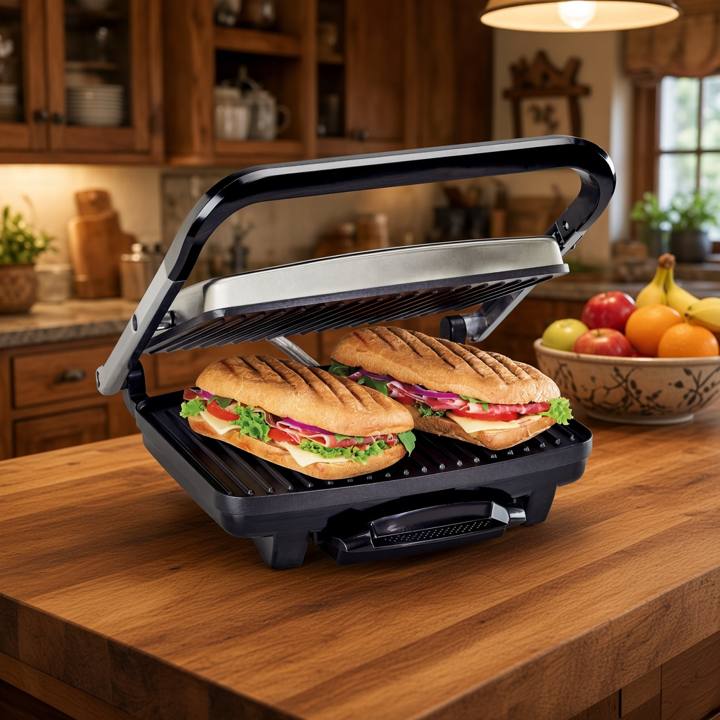
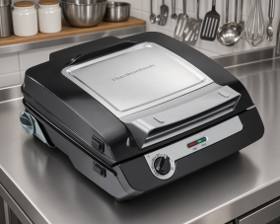
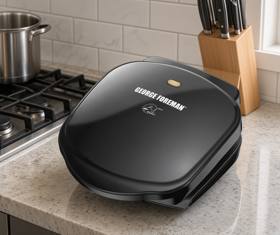
Call it a panini press or call it an indoor grill. Hamilton Beach’s 25410MN answers to both names. The press half is the unusual one here. A hinged upper plate lowers onto the food, so both faces cook together.
That changes what a cooking-area figure means. Hamilton Beach adds its two plates together and calls the total 95 square inches. Half of that is the lid, and the lid never holds anything.
The other surprise is the interface. There is no dial, no switch and no setting of any kind. Two lights and a hinge are all of it. So what is left for a cook to steer?
1,500 WRated draw, printed only in the guide's Mexico block
95 sq inNonstick surface, counting both plates together
ZeroDials, switches or settings of any kind
7 of 15Cook-chart meat rows that can pass the 10-minute claim
First Impressions of the Hamilton Beach Panini Press
Nothing needs building. The guide’s entire setup is one step. The drip tray slides in under the front lip, and then the cord goes in. Before the first cook, both plates want a wipe with a soapy cloth.
The lid earns attention first. Brushed stainless runs across the top with the brand name pressed into the metal. A chrome strut carries it, and the hinge floats instead of pivoting on one fixed point. Close it on something thick and the upper plate stays level.
Start-up is two lamps. Red says the press has power. Green says it has reached heat and you can load it.
Then the cooking begins, and it is unremarkable in the good way. Hamilton Beach’s chart puts a hot dog at 5 minutes and sliced onions at 4. Lift the lid to look and the guide tells you to wear an oven mitt. It gives that instruction twice.
Afterwards a tab on the right side slides across and locks the lid shut. Closed, the press measures 4.3 inches thick. It stands on its back edge rather than lying flat.
Key Features of the Hamilton Beach Panini Press
No chip, no display, no app. Every part of this press that does a job swings, slides or drains instead. For a countertop cooker sold now, that is an odd little inventory.
- A floating hinge, not a fixed pivot. Hamilton Beach calls it cafe-style. A fat Reuben gets the same contact as a flat quesadilla. The upper plate finds the food’s height and sits level on it.
- Two heated plates counted as one figure. The published 95 square inches covers the pair. Neither plate is given a size of its own anywhere.
- Stainless steel on the lid. The clamshell top is brushed stainless with vent slots stamped into it. The base underneath is moulded plastic.
- Lights instead of controls. Red for power, green for ready, and that is the whole panel. Nothing on this press can be set.
- A slide-out drip tray at the front. Fat runs forward off the ridges into a shallow perforated tray. The guide insists the press sits level so drainage works.
- A locking tab for storage. Slide it and the lid cannot flop open. The spatula then tucks into the drip tray and travels with the unit.
- PFAS-free ceramic nonstick, fixed in place. Hamilton Beach names the coating now. What it does not do is let you take the plates out.
- A spatula and scraper, probably. The product page lists one as included. The guide’s parts diagram footnotes it as supplied on certain models only.
Two things are worth noticing by their absence. There is no removable-plate release, so the cooking surfaces are part of the appliance. And no cool-touch claim attaches to the handle. An oven mitt keeps appearing in the instructions instead.
One more oddity sits in the paperwork. A single guide covers three model numbers at once. Safety lines about securing removable plates survive in a press that has none.
Contact cooking from both sides is the whole argument, and on thin food it works. An 8 oz strip steak is 5 minutes on Hamilton Beach’s chart. A fresh chicken breast is 5 to 8. Sliced peppers are 5 and mushrooms are 6.
Both plates heat, and both touch the food at once. That halves the number of times you handle a sandwich. It is also why nothing here ever needs turning over.
Read further down the same chart and the picture changes. Sausage is 15 minutes. Bacon is 10 to 15, and so are turkey burgers. Three frozen rows sit at 10 to 12.
Seven of the fifteen meat rows reach or pass the ten-minute line the marketing promises. That spread is the fixed heat showing itself. One setting can suit bread or suit rendering fat, not both. Hamilton Beach chose bread.
Vegetables suit that fixed heat best of all. Onions and zucchini come off at 4 minutes. Nothing about them wants a hotter or a cooler plate.
So the real levers are cut thickness and time under the lid. The hinge does the rest, and the guide is blunt about it. There is no need to press down on the handle. The cover’s own weight does the work.
Build, handling and durability
The stainless lid and the hinge assembly are better than the price suggests. That chrome strut is a proper linkage, not a moulded plastic arm. It gets worked on every single cook.
Below it the story is ordinary. The base is plastic, the feet are plastic, and the plates are fixed into the casting. Nothing comes apart for service, which keeps the shell rigid and leaves nothing to replace.
The locking tab is a small part doing real work. It holds the clamshell shut so the press can stand upright. Fit and finish hold up where hands land, and the stainless does not flex.
The handle is the weak point in daily handling. Hamilton Beach’s own instruction is to open the press with an oven mitt. It repeats that as a burn warning beside the loading step.
Running costs, upkeep and value
Electricity is not the running cost worth thinking about. A 1,500 W press works for 5 to 15 minutes at a time. That is very little per sandwich, and there is no fuel and no tank.
The coating is the real consumable. Fixed plates mean the surface and the appliance share one lifespan. The US warranty runs one year, and it explicitly excludes wear from normal use. Wear is exactly how nonstick ends.
Cleaning is quick but constrained. Two parts are dishwasher work: the drip tray and the spatula. Keep them off a SANI cycle, which the guide warns can damage them. Metal utensils are out, so a plastic scraper replaces scrubbing.
The plates get a damp sponge and detergent while still in the press. The base must never meet water.
Spares matter more than usual on a press with fixed plates. The tray and the spatula are the only parts to order. Then there is the price. Around $69.78 at Amazon buys a press Hamilton Beach already calls no longer available.
Possible Hamilton Beach Panini Press Complaints
- The headline area counts a surface you cannot load. Hamilton Beach totals both plates to reach 95 square inches. A press squeezes one sandwich between them. Neither plate is published alone, so capacity comes from photographs.
- Every look inside costs an oven mitt. The guide tells you to lift the cover and check the food. It also tells you twice to wear a mitt. A mitt in one hand and a spatula in the other is clumsy.