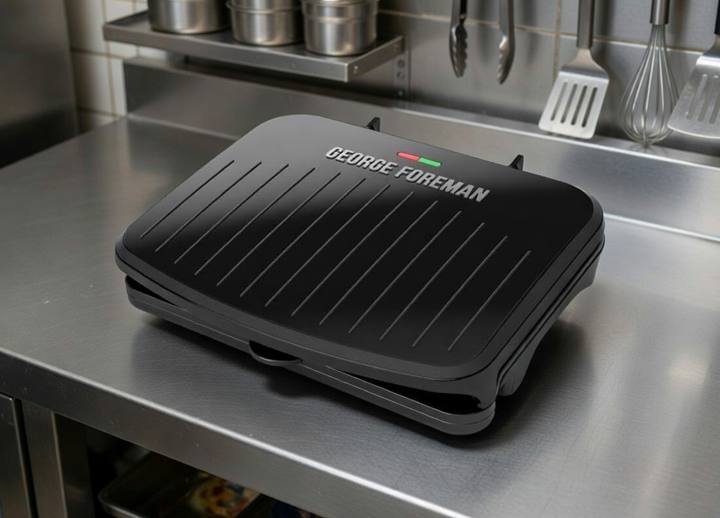
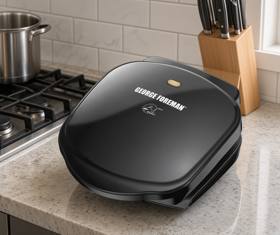
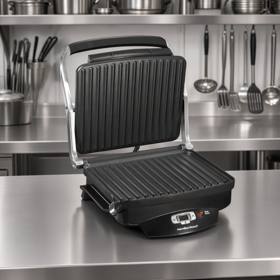
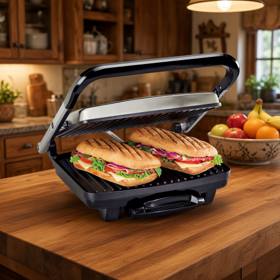
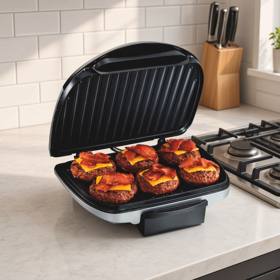
George Foreman prints two capacities for this grill, and they do not agree. The box sells five servings. The GRS075 series manual, written for the same machine, says two burgers fit.
Both statements are published, and the gap between them is this review. 75 square inches is a genuine cooking surface. A contact grill spends that area on one flat layer of food. The heated lid then comes down on top of it.
The Classic Plate cooks, and it costs very little. The open question is what five servings means on a machine like this. Model GRS075BX answers that in its own manual, and the answer counts in twos.
First Impressions of the George Foreman Classic Plate Grill
Assembly does not exist here, which is rarer than it sounds. The drip tray slides between two runners under the front of the grill. Close the lid, plug it in, and a red power light comes on. A green thermostat light follows when the plates reach cooking heat.
That green light then starts cycling on and off. The thermostat is holding a level nobody chose and cannot be asked to change. Watching it blink is the closest thing to feedback this grill offers.
Burgers are the obvious first test, and the chart sets the terms. Four ounce patties, half an inch thick, two at a time. With the stand flipped out the plates tilt, and fat runs forward into the tray. Six to eight minutes is what George Foreman allows for the pair.
Nothing about the object feels expensive. Nothing about it feels difficult either, and that is the whole proposition.
Key Features of the George Foreman Classic Plate Grill
Almost everything here follows from one decision, which is that the plates never move. They are bonded into the body, and the body never goes near a sink. Read the list with that in mind.
- 1,500 watts over 75 square inches: The rating block gives the power and the product page gives the area. Divide one by the other and you get 20 watts per square inch. Both plates touch the food, so that density arrives from two directions.
- Two fixed plates with embedded elements: George Foreman lists removable plates as not fitted. The elements sit inside the plates rather than below them. Nothing lifts out, so nothing warps in a drawer or goes missing.
- A dual grill position stand: Flip it out and the grill tilts for burgers or chicken. Fold it away and the plates sit level for paninis and hot dogs. That stand is the only setting on the machine.
- Adjustable-Height Cooking Grates: The hinge is articulated to take thick or oddly shaped food. The manual asks you to keep the two plates roughly parallel. Uneven pressure is what makes a contact grill cook unevenly.
- A red light and a green light: Red means powered. Green means the thermostat is satisfied. No dial, no display and no numbered range appears anywhere on the body.
- A drip tray with a part number: The tray is listed as GRS075-01 in the parts diagram. A dagger in that diagram marks it, and marks nothing else. Everything else sits behind a tamper-resistant screw.
- A coating with more than one name: The specification block calls it George Tough nonstick. The copy beside it calls the same surface PFAS-free ceramic, Advanced, and 8x more durable. George Foreman never reconciles those descriptions.
- A space claim carrying a footnote: The page says the design takes up 28% less space. Its footnote measures that against one older model, the GR350VB, on height alone. Height is not counter space.
Contact grilling flatters a small appliance, and this one is not especially small in output. 20 watts per square inch is real density for a countertop machine. It shows in the chart. Two burgers take six to eight minutes, and bacon takes four to seven.
What the power cannot buy is a choice. George Foreman’s own spec sheet answers no to variable control. No page of the manual describes choosing a heat. Amazon’s own listing puts the number of settings at one.
So cooking here is done on a clock. The manual also asks you to test doneness with a meat thermometer.
George Foreman’s manual also disagrees with itself about the light. The English and Spanish pages say the grill is ready when the green light comes on. The French page in the same PDF says it is ready when that light goes out. Follow whichever half matches the timings you are working to.
Capacity closes the argument, and George Foreman’s two documents split on it. The chart fits two burgers, two chicken breasts, two salmon fillets or three bratwurst. Its largest entry is four pork sausage patties. Five servings is a sales count, and two burgers is a cooking one.
Build, handling and durability
George Foreman describes the coating at length and the casing not at all. Nothing first-party states what the shell is made of, how heavy it is, or how big. Amazon fills that gap with a dimension field giving the same figure for depth and height. A hinged grill cannot be as deep as it is tall, so the field is wrong.
What is published is mechanical and checkable. The elements are embedded in the plates, and the fat slope is a patented design. The hinge articulates, the stand has two positions, and the cord stows on hooks underneath.
Serviceability then stops at the drip tray. One tamper-resistant screw locks the outer cover, and nothing behind it is meant for owners. One part carries the replaceable mark, and its job is catching grease.
Running costs, upkeep and value
Electricity is the whole of the running cost. Its rating block reads 1,500 watts, 120 volts, 60 hertz. George Foreman restricts the grill to indoor household use, lid closed while it runs. No bottle, no bag of charcoal, no seasonal top-up.
Upkeep is where fixed plates charge their rent. Everything waits until the grill is completely cool. Plates get warm water and dish soap, and the shell gets a damp sponge. The unit itself is barred from water, and the brand marks it not dishwasher safe.
Only the drip tray escapes that, in the dishwasher’s upper rack. Empty it, wash it and dry it once the grilling stops. Let it cool before sliding it out from under the front.
The coating is the thing you are protecting, and the rules are strict. Nylon, wood or heatproof plastic utensils only, and never metal. Skip aerosol cooking spray, whose propellant leaves a film that dulls the plates. Scouring pads, steel wool and abrasive cleaner are barred from every part.
Against that routine the money argument is simple. The limited warranty runs three years, in the United States and Canada only. Support is a replacement unit, new or factory refurbished, with proof of purchase. Amazon had it buyable on 17 September 2026, rated 4.3 stars by 124 buyers.
Possible George Foreman Classic Plate Grill Complaints
- Five servings arrive in shifts, not together: The chart seats two burgers, two chicken breasts or two salmon fillets. Only small items such as sausage patties reach four. A household of five therefore eats in two rounds. Grilling vegetables in the level position while the meat rests recovers some of the time.
- Cleaning happens in place, every single time: The plates do not detach and the body cannot go in water. That leaves a cooled grill, a soapy cloth and patience with the ridges. A sugary marinade is the case that really hurts. Lining the tray is easy, but the plates have no shortcut.