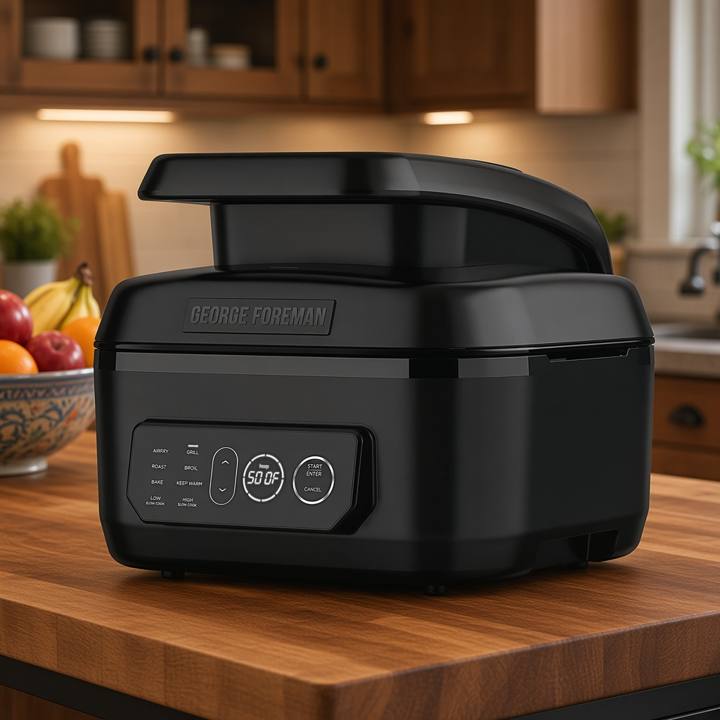
Seven cooking modes sound like seven appliances. They are not. The George Foreman Beyond Grill, model MCAFD800DX, has one pot and one removable plate. Every mode drives that same hardware differently.
So the modes cannot all be free. A machine this size gets designed around one job, and the others borrow what is left. Grill comes first in the name and first on the menu.
The question is not whether it grills. It is what grilling had to give up so the other six could exist beside it.
First Impressions of the George Foreman Beyond Grill
Two things come out of the packaging, and both of them are cooking surfaces. A deep pot drops into the body. A ridged aluminum plate drops into the pot. Assembly finishes there.
The hood is the part that resets expectations. This is not a clamshell that presses down on food. It is a lid over a chamber, with air moving inside it. Closer to a small oven than to a sandwich press.
The control panel does the talking. A ring of eight small lights surrounds one display. Each light stands for an eighth of the cycle. Heat moves in five degree steps, time in single minutes.
The manual’s own opening act is four quarter-pound patties at 500°F. 14 to 18 minutes, flipped once, cooked to 145°F. The ridges mark the meat properly. The fat leaves the food and lands in the pot underneath.
That first cook is convincing, and it also shows you the shape of the thing. Four patties is the whole surface. Not four now and four in a moment. Four, then a pause, then four more.
Key Features of the George Foreman Beyond Grill
Almost everything interesting here comes from the fact that seven modes share one chamber. The features are less about parts than about which mode gets what. Reading the list this way tells you more than the box does.
- Seven presets in two classes: Grill, Air Fry, Bake and Roast let you choose a heat. Slow Cook, Broil and Keep Warm do not. The manual says so for each of the three.
- A 500°F grill setting: This is the highest figure George Foreman prints for the machine. Grill opens at 450°F by default. Every other mode opens lower.
- Air frying with the plate removed: The grill plate lifts out and food goes straight into the pot. George Foreman rates the function at 99% less oil than a deep fryer. A pound of thick steak fries runs 18 to 22 minutes at 425°F.
- A slow cooker that finishes politely: Low defaults to 8 hours and High to 4. When the time runs out the machine holds the food warm for another 4 hours.
- LED Controls: The eight-segment ring is genuinely useful across a room. You read progress as a shape rather than as digits. The display also toggles between time left and the heat you set.
- A pot the machine insists on: Without the pot fitted, the panel shows ERR and nothing starts. Grilling therefore happens over the same bowl that later holds a stew.
- PFAS-free ceramic nonstick: The coating covers the grill plate and the pot. George Foreman claims it is 8x more durable than its older nonstick. Both parts are dishwasher safe according to the manual.
- A hood that pauses the clock: Open it mid-cycle and the timer stops. Close it and the timer picks up where it left off. Checking food costs nothing.
Grill mode got the best of the hardware, and the manual admits it in the defaults. Grill opens at 450°F. Air fry opens at 425°F, and bake and roast both open at 375°F.
Only grill is ever taken to 500°F. That matters more indoors than it does outside. Searing is the one thing a countertop machine usually cannot do. Heat arrives from above and from below, with a fan moving air between them.
Nothing presses down, so a thick chop stays a thick chop. The cooking chart is where the real evidence sits. Two 12 ounce New York strips take 12 to 16 minutes at 500°F. Two 8 ounce salmon fillets take 12 to 16 at 450°F.
Frozen chicken breast goes in at 450°F for 22 to 26 minutes. Read that chart for volume rather than time and the trade appears. Four patties, two steaks, two fillets. The numbers never grow, because the chamber never grows.
So the price of seven modes is paid in queueing. Between batches the plate wants 3 to 5 minutes to come back up. Come to grilling straight after another function and the wait is at least 6 minutes. A machine that does everything still does one thing at a time.
Build, handling and durability
The published record here is thin in a specific way. Target lists the plate as aluminum. George Foreman calls the elements embedded and gives the coating a full paragraph. The hood and the housing get no material at all.
Power draw is stranger still. Amazon’s listing states 1,500 watts and Target’s states 1,600. George Foreman states neither figure anywhere. The two listings also disagree about weight, at 14.05 and 14.26 pounds.
None of that is alarming at this size, but it does set expectations. Roughly 14 pounds is liftable with two hands and awkward with one. At 14.9 inches wide and 11.2 inches tall, it stays out on the counter.
Serviceability stops at the two parts you can lift. The grill plate and the pot are marked as consumer replaceable. Everything else sits behind a tamper-resistant screw. The coating is therefore the part whose life sets the machine’s life.
Running costs, upkeep and value
Running cost is a socket and nothing else. There is no fuel, no ash and no seasonal storage. George Foreman restricts it to countertop use indoors. The manual warns against outdoor use and against extension cords.
Upkeep is where the shared chamber sends the bill. Grilling drips fat into the pot, which is the same pot that bakes and slow cooks. The manual asks you to empty the oil after every two batches. Leave it and the grease burns and smokes.
The cleaning story is otherwise good, with one piece of confusion worth knowing. The manual says the pot and the plate are both dishwasher safe. The brand page’s specification block says grill plates only, while its own product copy says both. Stuck residue soaks in warm soapy water, sometimes overnight.
Price sat at around $119 on Amazon on 25 August 2026, when this project checked. Stock was showing, with 4.7 stars from 559 buyers. Buying direct is free over $99, with returns free for 30 days. Against seven modes and a three-year warranty, that is a fair trade for the counter space.
Possible George Foreman Beyond Grill Complaints
- Three of the seven modes give you no heat to choose: Slow Cook, Broil and Keep Warm all run at whatever the machine decides. The manual states it for each one. You feel it most on Broil, which offers a timer and nothing else. Watching the food is the only control, and opening the hood at least pauses the clock.
- Grilling shares its pot with every other job: The machine will not start without the pot fitted. Burger fat lands in the vessel your stew uses next. Emptying it after two batches is a manual instruction, not a suggestion. Coming back to grilling then costs another six minutes.