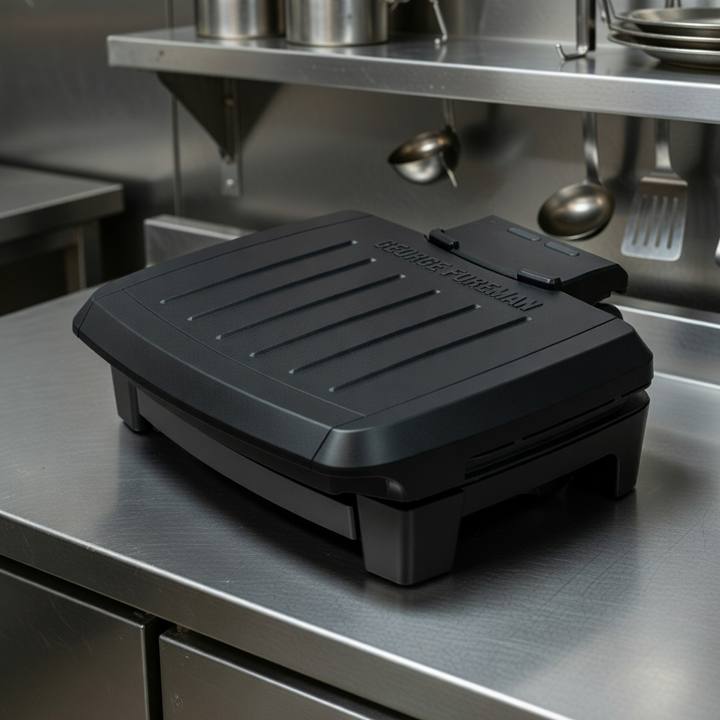
Most kitchen appliances are cleaned around their electronics. This one is not. George Foreman’s 4-serving Submersible grill comes apart into a probe and two hot plates. Only the probe stays dry.
The rating plate inside the manual reads GRES060BS, which is the model you are actually buying. George Foreman’s own website files it under the catalog code GRES060BSX.
That split is the whole design. Everything a sink could ruin was moved into one detachable part. Washability is not in doubt. The interesting part is what left the grill when the wiring did.
First Impressions of the George Foreman Submersible Grill
Assembly is one motion, and it is the motion you will repeat forever. The top housing sits on the bottom housing. The probe slides into two sockets until it seats in both halves. Push the drip tray under the front and the grill is built.
A red light then comes on, and that is the entire interface. Wait roughly 4½ minutes with the lid down. A green light says the plates have arrived. Nothing on the machine tells you where they arrived.
The first cook is a burger, because George Foreman’s own manual makes it one. A pound of 80/20 beef becomes four patties, cooked two at a time. Each pair takes about 8 to 10 minutes under a closed lid. Fat runs down the sloped plate and into the tray below.
The real difference arrives afterward. One thumb pushes the probe out of its sockets. The grill that just cooked goes into the water in one piece. There are no removable plates to unclip, misplace or warp.
Key Features of the George Foreman Submersible Grill
Nearly everything on this grill follows from one decision about where the wiring lives. Read the list as consequences and it makes more sense than the box does. Two of these are genuinely unusual at the price.
- A probe that carries the electronics: The control panel and its plug form one detachable piece. It pushes out with a thumb and pulls the grill’s brain with it. The manual is direct: the probe should not get wet.
- Full submersion for everything else: Grill top, grill bottom and drip tray are cleared for warm soapy water or a dishwasher. The tray is top rack only. George Foreman’s wording is that you can fully submerse the grill.
- An interlock you cannot talk your way past: If the probe is not seated, the light stays off and nothing heats. On a design where the user detaches the electrical part daily, that is the right answer.
- Adjustable-Height Cooking Grates: The 3/4 inch hinge lets the upper plate float to whatever is under it. Thick burgers and flat sandwiches both get even contact. George Foreman heads its own section adjustable cooking height.
- PFAS-free ceramic nonstick: The coating is branded Advanced George Tough and claimed 3X more durable than the older version. It covers both plates. Nothing else about the materials is published.
- A drip tray that is not optional: The manual says never to run the grill without it. Fit it before plugging in. It is also the one part flagged as replaceable. The brand claims up to 50% of the fat leaves a quarter-pound patty.
- No heat setting whatsoever: The specification block on George Foreman’s site lists variable control as not fitted. There is no dial, no numbered range and no display. The green light is the whole readout.
- Vertical storage on the probe: The unit stands upright, resting on the probe end. George Foreman calls the design 35% smaller than its GRP1060B removable-plate grill.
Contact grilling is a different proposition from a grate, and it flatters a modest wattage. Both plates touch the food at once. Heat goes in from above and below rather than radiating up through gaps. That is why 1,100 watts is enough here and would be nothing outdoors.
What the wattage cannot tell you is the setting, because none exists. The part you can wash is also the part that decides nothing. Every judgment lives in a probe with no dial on it. You get ready or not ready, and then a clock.
George Foreman’s own paperwork does not agree here, and we will not tidy it. The English manual gives no step for choosing a heat level. The Spanish half of the same PDF describes a dial with minimum, medium and maximum. One recipe then tells you to use the highest setting you can.
Volume is the other fixed limit. Four servings is the published capacity, and the manual’s recipe cooks two patties at a time. No cooking area is published anywhere, so plan by servings rather than by inches. A second batch simply waits for the green light to return.
Build, handling and durability
The published record on materials is close to empty. George Foreman names the coating in detail and then stops. No housing material, weight or dimensions appear in the specification block or the manual. The one physical figure anywhere is the 3/4 inch hinge.
What the design does state clearly is a doctrine about water. Three parts are cleared for the sink and the fourth is banned from it twice. The safeguards forbid immersing the probe, and the cleaning steps repeat the warning. Wipe it, dry it properly, push it back in.
Serviceability then stops dead. A tamper-resistant screw covers the outer shell, and the manual says no user-serviceable parts sit inside. Exactly one component gets the replaceable mark, and it is the nested drip tray. Three years of cover on that footing is a replacement policy rather than a repair one.
Handling follows from the same partition. The grill is a hinged pair of sealed plates with nothing to catch or clog. The probe sockets are the only wear point that matters. The manual asks you to keep particles out of them, which is a fair warning.
Running costs, upkeep and value
Nothing burns here, so there is no fuel line in the budget. The rating plate reads 1,100 watts at 120 volts, and that is the entire energy story. This is an indoor appliance only, and George Foreman bans outdoor use outright. It also insists the lid be closed while it runs.
Upkeep is the reason this grill exists, so it deserves the detail. The two halves go into warm soapy water or the dishwasher without ceremony. The drip tray takes the top rack. The probe is the only step that asks you to think.
The coating sets the clock, and it wants defending. No aerosol spray, because the propellant builds up and dulls the plates. No metal tongs, forks, knives or skewers. No steel wool and no abrasive cleaner on any part of the grill.
The money is easy to read against that routine. Our own check on 25 August 2026 found it at around $55.99. Amazon held stock, shipped it itself, and showed 4.2 stars from 6,436 buyers. George Foreman ships direct at no charge above $99 and allows 30 days to return.
Possible George Foreman Submersible Grill Complaints
- The heat is a decision somebody else made: With the controls inside the probe, no dial ever reached the grill body. The specification block confirms it in one word. You feel it with anything but a burger, since salmon and chicken want different plates. The fix is a timer and a meat thermometer, which the manual already recommends.
- Everything is disposable except the drip tray: The tamper-resistant screw is standard on a mains appliance, but it ends the conversation. One replaceable part is listed and no others. When the nonstick eventually fails, the warranty either covers it or the grill is finished. Keep the receipt, because three years is the only route back.