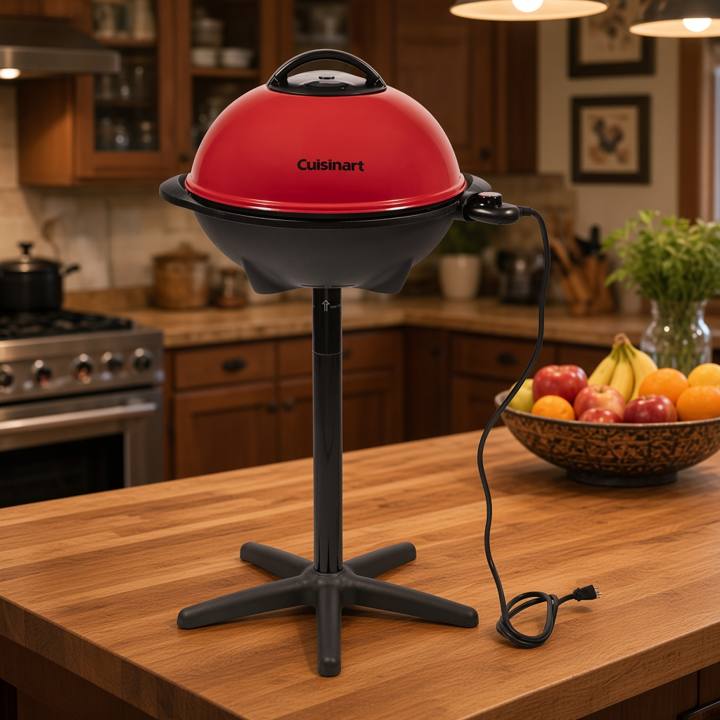
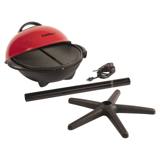
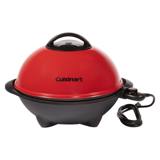
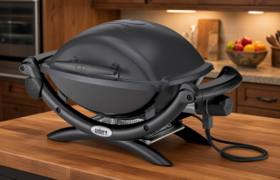
Cuisinart sells the CEG-115 as two grills in one box. Unpack it and you find four objects. There is the grill body, a pole and a five-leg base.
The fourth is a control probe with the cord attached. The pole and the base are the second grill. Lift the body off and it sits on its own moulded feet.
Nothing electrical changes between the two modes. The element, the plate and the cord are the same indoors as out.
Conversion itself is not in doubt. Ten seconds, and the body is off the pole. The open question is what Cuisinart solved, and what it left to you.
First Impressions of the Cuisinart CEG-115
Assembly is the first pleasant surprise. Cuisinart claims under 10 minutes, with no tools and no hardware. The pole slides into the star base. The body drops on, and the probe plugs into the side.
The pole is printed “THIS WAY UP” with an arrow. That label exists because the pole is not symmetrical. Someone, at some point, got it wrong.
Standing, the grill reaches 39 inches. That is closer to counter height than kettle height. You work over it rather than stooping to it.
The red lid is deep and glossy. The dome closes over a full load without touching food. One cook makes the category obvious. Heat arrives through a solid ribbed plate, not through bars over a fire.
You get contact marks rather than flame char. Fat runs to the middle instead of dropping and flaring. The smell is cooking rather than burning.
Key Features of the Cuisinart CEG-115
What the CEG-115 offers splits in two. There is the cooking hardware, which is conventional for a socket-powered grill. Then there is the two-mode trick, which is mostly geometry.
- 240 square inches under one lid. Cuisinart rates the nonstick plate for up to 12 burgers at a time.
- A published span of 350°F to 550°F. The upper figure is high for anything drawing on household current.
- Five heat settings on a detachable probe. The knob, the cord and the plug form one module that pulls out.
- A stand that is two loose parts. A pole and a five-leg base. The bowl carries moulded feet of its own.
- A central channel in the cooking plate. Fat runs to the middle and drains into a cup, away from the element.
- A hook that parks the lid. The hood rests against the grill’s side while you cook, never on the floor.
- An indicator lamp on the control pod. One light, below the knob, telling you the element is drawing.
- Nothing to refill. No tank, no bag, no chimney, no ash, and no fuel gauge to squint at.
Look at what else comes in the box and the grill turns plain. No cover, no carry bag, no rotisserie, no side burner. That is ordinary for the money.
But the box holds exactly what you saw, and nothing more. The more interesting silence is about materials. Cuisinart calls the plate nonstick and never says what sits under the coating. The bowl goes unnamed too.
That gap deserves a moment before the card comes out. Better before you buy than after.
The headline figure is honest. The control is not quite. Cuisinart publishes a span of 350°F to 550°F. For a socket-powered grill, 550°F is a genuinely useful ceiling.
A steak gets a real crust on a plate that hot. Then you look at the dial. It reads OFF, and then 1, 2, 3, 4 and 5.
No degree figures are printed on it anywhere. Cuisinart advertises a range in Fahrenheit. The cook gets a knob calibrated in integers. What each integer means is never published.
You learn the numbers by cooking, which is workable and common enough. It still leaves a gap between the box copy and the object. The range is real; dialling a number inside it is not.
The firmer limit is structural. One element sits under one plate, so the surface holds a single heat. There is no cool side for chicken. No shelf either, for resting a steak while vegetables catch up.
So you sequence the cook rather than arranging it across the plate. Start with whatever needs the crust. Drop the dial, then finish the rest.
Cuisinart also describes the ceiling twice, and differently. The description says the surface heats to over 550°F. The feature list says the settings run to 550°F. Read 550°F as the figure and the “over” as enthusiasm.
Build, handling and durability
The bowl rides on a single pole above a five-leg base. That is stable at 39 inches. The wide star foot does most of that work.
It is still a fair amount of grill on one tube. Worth a thought on an exposed balcony. Cuisinart lists the weight as 20 and prints no unit beside it.
Then there is the stand, which comes in two pieces. A pole in a base is quick to build and quick to undo. It is also the joint that takes every knock.
Read it as pounds and this is a two-handed carry. Not something you shift while holding a plate. On materials, the page simply goes quiet.
Nonstick describes a coating, not what lies beneath it. Coatings of that kind sit near their limit around 550°F. The coating, in other words, will wear out while the grill underneath is still sound.
The lid hook and the “THIS WAY UP” arrow point the other way. Both are signs of a design somebody used before it shipped.
Running costs, upkeep and value
Cleanup is where the CEG-115 earns back what the dial costs it. Pull the probe and the electrics leave in your hand. What remains is a bowl, a plate and a cup.
None of those mind a sink. The grease route helps as well. Fat runs along the central channel and drops into a cup underneath.
Cuisinart calls it a cup in the description. The FAQ calls it a tray. One part, two names, one page.
Feeding it costs whatever your electricity costs. There is no tank, no sack of pellets, no ash pan. For the element’s draw, Cuisinart prints no figure at all.
So what it costs to run cannot be worked out from the page. Parts are stocked individually, and that cuts both ways. The control probe is $25.50 and the lid handle is $13.50.
Makers stock what breaks. The probe carries the knob, the cord and the plug. That is most of the work in one hand-held part. Neither part needs a service call to fit.
Cuisinart lists the grill at $209.99. Amazon was $21 under that in September 2026, at $188.99. Three years of limited cover is generous in this band. Against unnamed materials, it is the reassurance on offer.
Possible Cuisinart CEG-115 Complaints
- The cord decides where you cook. Cuisinart gives the length twice on one page, as 6.5 feet and then 6 feet. Either figure is short for a patio. So you cook beside an outlet, or you run an extension lead.
- Weather goes unmentioned. The page sells balconies and patios, then covers assembly, grease, capacity and heat. Rain, covering and storage never come up. A grill with a mains socket in its flank deserves a sentence on exposure.