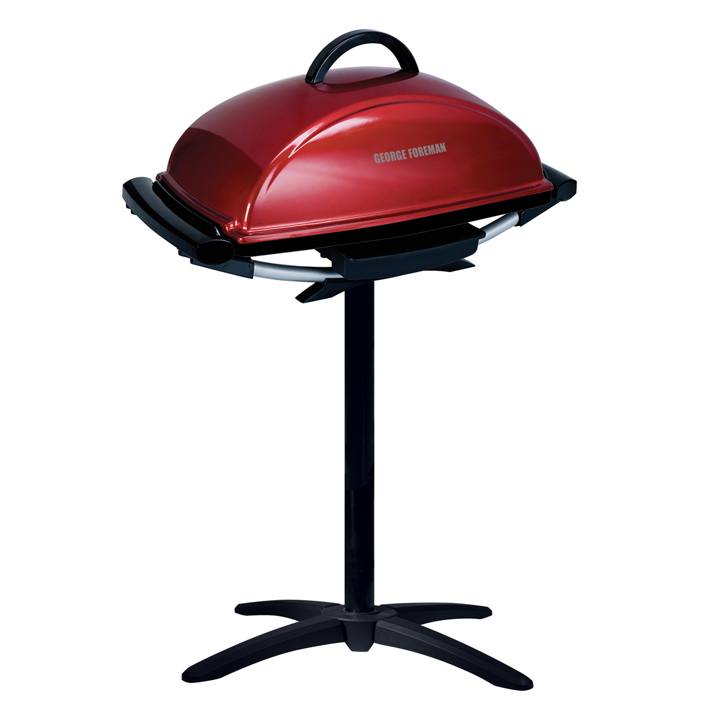
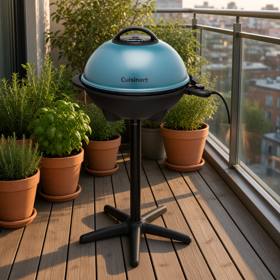
George Foreman calls the GFO201R an indoor/outdoor grill. It is a red domed lid over one rectangular plate, sitting on a pedestal stand. The plate is rated at 1440 watts and covers 200 square inches.
The box shows it on a patio, crowded with sausages, drinks on the table. The manual tells a quieter story. It says this grill is not intended for outdoor storage. It asks you to store it indoors whenever you are not cooking.
That gap between box and manual is worth settling first. Is the GFO201R a patio grill, or a counter grill that visits the patio?
1440 WElement rating, from the manual, at 120 volts
200 sq inGrilling surface, one rectangular plate
7.2 W/sq inPower over area, derived
14.3 lbListed weight, at Amazon
First Impressions of the George Foreman GFO201R
Unpacking lays the whole grill out on the floor. First come the lid, its handle, a black grill base, the tray and the plate. Then come two halves of a pedestal tube, a base, four feet and the probe. A Phillips screwdriver is the only tool needed.
Building it takes minutes, not an afternoon. The tube halves screw together and the feet click into the base. The grill base drops onto the tube and a clip holds it. The lid handle screws on from inside.
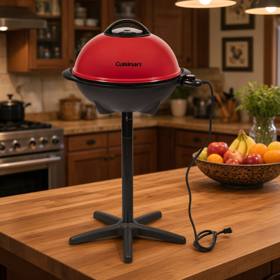
Standing up, the red lid is the whole look. It is glossy and rounded, with the George Foreman name across the front. The black base and pedestal disappear under it. On a deck it looks like a small kettle grill until you notice the cord.
The first cook was sausages, onion rounds and halved sweet peppers on setting 4. The lid stayed down through the ten-minute warm-up. The sausages took dark stripes where they met the ridges. The pale skin between filled in on the second turn.
Lift the lid partway through and you meet a small cloud. Moisture beads on the inside of the dome. The manual warns of that, and it shapes how this grill cooks.
Key Features of the George Foreman GFO201R
Strip the grill to its working parts and there are three. A heated plate, a dial on a plug, and a lid to trap heat. Everything else is about moving the first two between rooms.
- The heat lives in the plate: The probe plugs into a receptacle on the grill plate itself. That receptacle pokes out through a cutout in the base. Food sits directly on the heater, with no grate in between.
- A probe dial, numbered and nothing more: OFF, then settings 1 to 5. A light on the probe cycles as the thermostat holds the plate. Setting 1 doubles as a short keep-warm.
- A sloped plate with a tray below: The plate is pitched, so grease slides between the ridges into a tray below. George Foreman claims up to 42% of fat removed. Its test is a quarter-pound patty of raw 80/20 chuck.
- Nonstick, named two ways: On the product page, a table of specs calls the plate George Tough Nonstick. The feature list on the same page adds a PFAS-free ceramic coating. Whether those name the same finish, the page leaves you to guess.
- A domed lid: It is removable and holds heat over the food. There is no thermometer in it and no vent mentioned anywhere.
- A stand that lets go: Unclip the grill base from the upper tube and lift it off. The grill then sits on any counter that tolerates 150°F underneath.
- Parts with numbers: The lid, plate, probe, tray, base, both tubes and the feet all carry part numbers. The plate is 22873GP and the probe is 22866.
- Outdoor cord rules: The cord is short on purpose. Any extension used outside must be marked with a W. The manual also forbids cleaning with a water spray.
Beyond the lid, the usual extras are absent. Cast iron, a side burner and a cover are all missing.
Set 1440 watts against 200 square inches: about 7.2 watts for each one. That places the GFO201R between the two Weber Lumins. Weber’s bigger Lumin works out near 6.4, with 1,560 watts across 242 square inches. Its Compact sibling, at 180 square inches, reaches about 8.7.
So the plate has a fair heat budget for its size. What limits it is not wattage but geometry. Heat rises from one side only, and the lid holds in the steam food gives off. The result is a grill that browns well and chars gently.
The manual’s own chart confirms the pattern. Lean steak goes on setting 5 for 3 to 4 minutes a side, medium rare. Salmon gets the same. Burgers and chicken breast sit one notch lower, on 4.
Everything gets turned, because nothing heats the top. Thin, even food is the sweet spot. Kabobs, sliced peppers, onion rounds and fish fillets all suit a ridged plate under a dome. A thick steak will cook, but it will not build a crust worth the wait.
Build, handling and durability
The structure is simple to the point of being plain. One central tube in two screwed halves holds the whole grill up. Four clip-in feet spread the load at the bottom. George Foreman names no metal or plastic for the lid, base or tube.
Amazon lists the grill at 14.3 pounds, and the part you lift is lighter still. That matters, because the manual expects a carry after every cook. Store indoors, it says, and keep it out of children’s reach.
The case uses a tamper-resistant screw, and nothing inside is user serviceable. The outside pieces are another story. Every visible part carries a number, from the lid handle down to the pedestal feet. A cracked tube or a lost probe is an order, not a dead grill.
The design itself is old. The manual’s date code reads 2014, and the grill is still sold in 2026. That long run usually means parts stay findable for a while. It also explains the numbered dial.
Running costs, upkeep and value
There is nothing to buy between cooks. No tank, no bag of briquettes, no pellets. Electricity from a grounded three-prong socket is all it burns.
Amazon had it in stock at $129.99 on 20 October 2026, sold by Amazon itself. A month earlier the same listing showed $126.90. That is a small drift, and the figure is what you should expect to pay.
Against the Weber Lumin Compact the price looks very different. That grill costs $399.00 and gives you 180 square inches. The GFO201R costs about a third of that and gives you 200. The Weber buys cast iron and heat density; the Foreman buys room.
Cleanup is mostly a sink job. Once the grill is unplugged and cold, the probe comes out for a damp-cloth wipe. Then the plate, tray and lid wash in warm, soapy water. The probe socket must be bone dry before the next cook.
The gallery calls the drip tray dishwasher safe. The manual only ever describes washing it by hand. Until George Foreman settles that, the sink is the safer bet.
Possible George Foreman GFO201R Complaints
- It is an outdoor grill that cannot live outdoors: The manual rules out outdoor storage and spray cleaning. No rain rating exists for it either. So every patio cook ends with a carry back to the kitchen.
- The dial tells you nothing in degrees: Settings run 1 to 5, and no source maps a number to a heat. Add one-sided heat and a steamy lid, and early cooks become guesswork. Keep a probe thermometer handy until the settings feel familiar.