Weber Q 1200 vs Q 2000
8,500 BTU over 189 sq in against 12,000 BTU over 280 sq in. Near-equal heat per inch, but only the Q 2000 lights without a battery. Which Weber Q to buy.
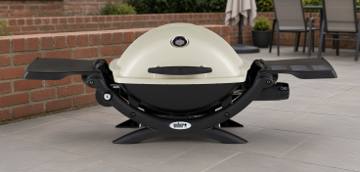
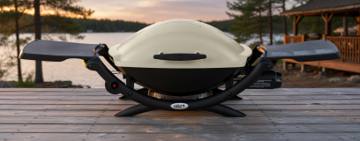
We pick the Weber Q 2000 Gas Grill
The Q 2000, for most buyers, and the igniter matters as much as the grate. It puts 12,000 BTU under 280 sq in and lights on a piezo with no battery in the circuit. The Q 1200 runs 8,500 BTU over 189 sq in and needs one AAA to light. Per square inch they are near-level, about 45 BTU against 43. On the prices our reviews logged, $279 list for the Q 1200 and $249 to $299 for the Q 2000, the two overlap.
What actually differs
-
91 more square inches, in two halves
The Q 2000 grate is two cast iron panels. One lifts out for Weber's griddle while the other keeps searing. The Q 1200's 189 sq in is one surface, which suits two people and pinches at four.
-
A battery against a piezo
A flat AAA is the one failure that stops the Q 1200 cold. The Q 2000's piezo is a wear part too, but nothing in it needs charging before a trip.
-
Only the smaller one has a thermometer
The Q 1200 carries a dial in its lid, though Weber publishes no range for it. The Q 2000's listed features include no dome gauge, so pacing a whole chicken needs a probe of your own.
The scorecard, side by side
Both reviews are scored on the same six weighted categories, each bar on the same 0–10 scale, and every cell carries the reason that review gave. A row is marked won only where the two differ by a tenth or more. How we score →
8,500 BTU across 189 square inches works out hotter per inch than the Q 2000, and cast iron holds it.
The looped stainless burner sears out to the grate edges, but a single zone leaves nowhere cool to finish a thick cut.
Five years on cookbox, lid, burner tube and grates, matching the bigger grill, though the igniter now has a battery in it.
Cast aluminum and a stainless burner tube rule out rust, leaving the piezo igniter and the nylon frame as the wear points.
Porcelain-enamelled cast iron grates on a 31 pound grill, where most of this weight class folds thin steel.
Lid heft, a hinge with no slop, and tables that hold a loaded platter put this closer to Weber's kettles than to rival portables.
Electronic ignition is easy until the AAA dies, and a flat battery is the one failure a matchbox cannot outrank.
Assembly takes minutes and one dial runs everything, though the low stance wants a table and the missing gauge wants a probe.
Captured near $209 against Weber's $279 list, with no cart and no cylinder included at either figure.
The hardware justifies $249 to $299, but disposable cylinders charge rent forever and Weber's own range crowds it from both sides.
Enamel needs no seasoning, the catch pan lifts straight out, and there is very little else to clean.
Porcelain enamel needs no seasoning, the catch pan takes a disposable tray, and two light grate panels beat one heavy slab.
Heat density
Burner output over the surface it has to heat, derived in each review from that cooker's own published figures. A bigger number is not a better grill — it says how hard the cooker can drive its grate, nothing more. All grills ranked →
Published figures that differ
Quoted from each maker's own specifications, as each review records them. Figures the two products publish identically are left out — only the differences are listed.
Which one is for you
You cook for two on a balcony where 16.5 inches of depth is all the room there is.
Check price →You tailgate or camp for a family and want a grill that lights with no battery to remember.
Check price →More head-to-heads
Every score and figure on this page comes from our own reviews of these two products, linked above. We have not tested them side by side in one place; the comparison is between two full reviews, each built from the maker's published specifications and documentation. Prices move, and the ones quoted are the ones each review checked on its own date.