Traeger publishes a comparison grid for the Westwood series, and it is unusually candid. Three feature rows carry a check mark. Five carry the word Excluded.
That makes the Westwood a grill defined by subtraction. It is the cheapest way into WiFIRE that Traeger sells. The price is $699.99, and something had to come out to reach it.
There is also a Westwood XL in the catalog. This one is the 653 sq in model, part number TFB65YLJU. The useful question is not what is missing. It is which of the missing things you would ever feel.
653 sq inCooking area, split 428 and 225 across two racks
41 inWidth, narrower than most carts at this capacity
5 of 8Feature rows Traeger's own grid marks Excluded
$49.99Shipping, if you order direct from Traeger
First Impressions of the Traeger Westwood
Traeger asks for a 10 foot by 10 foot working area before you start. Seventeen numbered steps follow. Two of them say outright that a second person helps. One is standing the grill on its legs, and the other is refitting the lid.
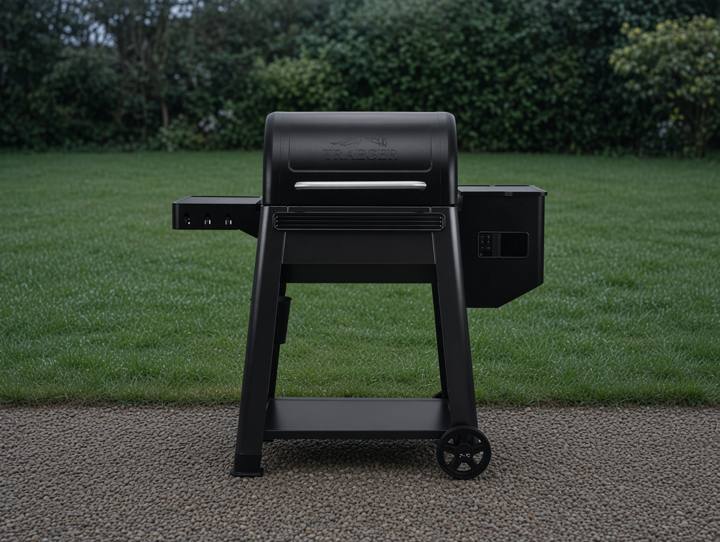
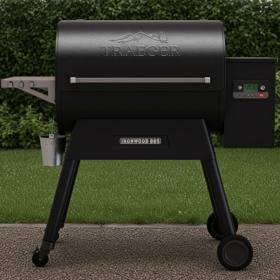
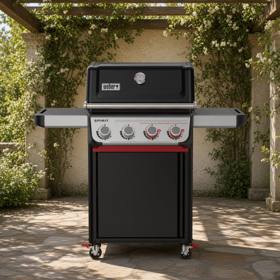
What emerges is black on black, shaped like a barrel. The hopper hangs off one side. The side shelf and bottom shelf are part of the frame rather than accessories. Two legs finish in all-terrain wheels and two finish in fixed hooves.
Day one is not a cooking day. The auger has to be primed first, which takes about two minutes. Then the grill seasons itself at 350 F for 15 minutes. It runs another 45 minutes at 450 F after that.
Siting matters before any of that. The manual wants 20 in of clear space around the grill. Siding, railings, furniture and trees all count. It also wants a grounded outlet with working GFCI protection.
Food arrives on day two tasting the way a Traeger tastes. Smoke works into pork and chicken instead of sitting on the surface. It is a softer flavor than a stick burner gives. It is also far easier to repeat.
Key Features of the Traeger Westwood
Underneath, this is a fan, an auger and a steel box. What separates it from a cheaper pellet grill is the controller. What separates it from a dearer Traeger is the job list that controller never got.
- WiFIRE and Bluetooth controller: The dial sets a number and the app takes it from there. Firmware updates arrive over the same connection. The grill needs a 2.4 GHz network, since it cannot see 5 GHz.
- Two cooking racks: One holds 428 sq in and the other 225 sq in. Both lift out. Traeger rates the pair at 21 chicken breasts, 20 burgers or six rib racks.
- Wired probe included: A probe comes in the box and plugs into the controller. Its own button toggles the display between food and grill. Traeger’s wireless probes work here too.
- P.A.L. Pop-And-Lock rail: The accessory rail runs along the front panel and is fitted during assembly. Shelves and hooks clip onto it. This is the one route to customizing the working area.
- Side shelf and bottom shelf: Traeger rates them at 40 lb and 60 lb. Published load ratings are rare on grill shelving. The bottom shelf will take a pellet bag between cooks.
- Electric Igniter: Pellets catch from a heating element, not from a flame you supply. Nothing about starting it involves a match or a chimney. Traeger covers that element for the shortest term of any part here.
- Rear hopper release door: Unscrew a knob at the back and the pellets pour out. Changing wood flavors takes a minute rather than an arm. Most grills at this price make you scoop.
The working range runs 180 to 450 F. The two ends do completely different jobs. The bottom end is the reason pellet grills exist at all. The top end is where this one gives up early.
450 F will brown burgers, roast a chicken and cook a pizza. Steak is where the difference from a gas grill shows. Pellet grills sear weakly as a class. A lower ceiling sharpens that rather than softening it.
Traeger is refreshingly blunt about steadiness. The Westwood manual calls a swing of 25 F either side completely normal. That is on a good weather day. It goes further, and says the wobble is part of the smoke flavor.
Capacity is split unevenly, and that is worth planning around. One rack carries 428 sq in and the other 225. The smaller one takes sides, buns and anything that wants gentler air. Traeger’s claim of six rib racks assumes both are loaded.
Two absences shape the rest of the cooking. There is no Super Smoke mode. The low end of the dial is your only smoke lever. There is no added insulation either, so cold weather counts for more.
Build, handling and durability
At 116 lbs this is not a heavy grill for its footprint. Nowhere does the company say what any of it is made from. That silence is worth noticing. What it does publish is what each part is guaranteed against.
Seven years attaches only to rusting through. That group is the sheet metal: panels, legs, both shelves, the hopper cover. Grates get 3 years on the same rust terms. The auger motor, fan and controller get 3 years.
The igniter, the cord and the sensor get 1 year. Read the list in that order and its shape changes. The parts that stop a pellet grill working are the moving and electrical ones. Those carry the shortest terms.
Traeger’s answer is that the grills are modular. The company sends the part and the instructions, and you fit it. Labor and freight for that part are yours. Paint damage from a grease fire is not covered at all.
Moving it is a two-wheel affair, with one end lifted and pushed. The shelf ratings of 40 lb and 60 lb say something quiet about the frame. Very few makers commit to a number there at all.
Running costs, upkeep and value
$699.99 is the least Traeger asks for a grill with WiFIRE on board. The XL is $799.99 for 823 sq in. The Woodridge one rung up is $899.99. That buys 860 sq in and a 24 lb hopper.
Buying direct is not the sticker price. Traeger charges $49.99 to ship a grill. It quotes 5 to 7 business days before dispatch. That belongs in the comparison rather than in the checkout.
Pellets are the running cost, and the manual asks for Traeger’s own. It warns that other brands may cook unevenly and taste worse. Whether you follow that is a matter for your own hopper.
One clause in the warranty deserves reading before you order. The 7-year cover starts at purchase from Traeger or an authorized dealer. Buying from anywhere else puts that term at risk.
Upkeep otherwise is light. Racks, drip tray and heat baffle all lift straight out. The grease bucket clips off the side. Ash and grease still need a hand, since neither is collected for you.
Possible Traeger Westwood Complaints
- Nothing watches the hopper for you: Traeger’s grid marks the pellet sensor as excluded on this model. Across an afternoon that hardly matters. Across a brisket it means walking out to look. The models above it tell you instead.
- The heat ceiling is low for the money: 450 F is the end of the dial. Anyone hoping for a hard crust meets that limit on day one. A heavy pan on the rack is the usual dodge. A dodge is what it is.