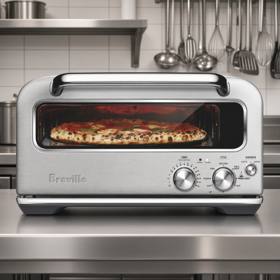
Most countertop pizza ovens do one thing. The Gourmia Indoor Pizza Oven, model GPM1270A, claims two. In pizza mode its floor element climbs to 800°F under a cordierite stone. Pick any of its seven other functions and the ceiling drops to 500°F.
That split is the whole story. The stone rests on rails just above the bottom element. Gourmia forbids it during every cook that is not pizza. So the stone decides which appliance you own tonight.
The question is simple. Does one box at around $129.98 do both jobs well, or each job halfway?
First Impressions of the Gourmia Indoor Pizza Oven
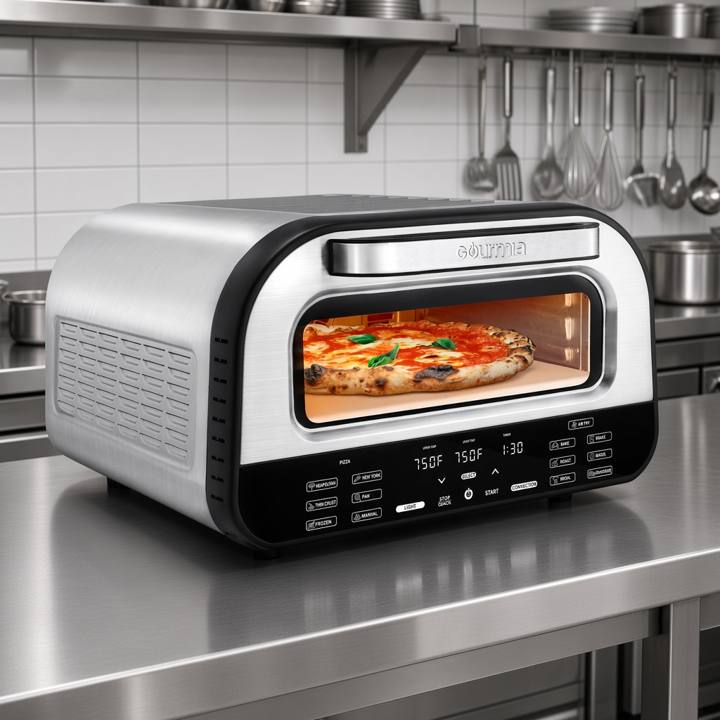
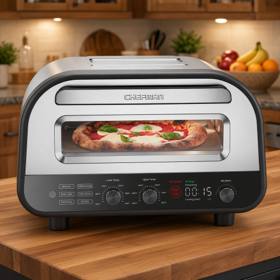
Unpacked, the Gourmia reads as a broad stainless toaster oven with rounded shoulders. A long bar handle runs across the top of the door. Under the window sits a black glass control strip. Pizza styles line its left side, and cooking functions fill the right.
The carton holds the oven, the stone, an air fry basket and an oven rack. A baking pan that doubles as a drip tray completes the set. There is no pizza peel. Gourmia’s own launch steps assume you own one, so budget for it.
Before the first pizza, the manual wants an empty burn. Load the stone, set both elements to 800°F, and let it run 20 minutes. Expect a little smell. After that, the Neapolitan preset loads 750°F top and bottom with a 2 minute timer.
The first Margherita came out with a crisp, spotted base and soft, bubbling cheese. The crust browned more on one side than the other. That is why the manual says to turn the pie halfway. With a peel, the turn takes seconds.
Size is the other first impression. At 21 inches wide and 17.5 deep, it claims more counter than most toaster ovens. Measure the spot before it arrives, and remember the clearance it needs.
Key Features of the Gourmia Indoor Pizza Oven
The feature list reads as two appliances sharing one control panel. Pizza mode runs the stone hot from both sides. The cooking functions run a fan and a wire rack, like any toaster oven. These are the parts that matter.
- Two independent elements. Upper and lower heat each get their own number on the display. Crust and cheese can be tuned apart.
- Six pizza presets. Neapolitan, New York, Thin Crust, Pan, Frozen and Manual each have one button. One press fills in both element settings and a countdown.
- Floor hotter than roof, by design. New York runs 525°F above and 575°F below for 6 minutes. Thin Crust pairs a 525°F roof with a 625°F floor. Only Neapolitan runs both elements level.
- Cordierite stone. It sits on metal rails just above the bottom element. Nothing else is allowed on those rails.
- Seven cooking functions. Air Fry, Bake, Roast, Broil, Toast, Bagel and Dehydrate share the same cavity. Bake, roast and broil can add convection.
- Stainless steel. Brushed stainless wraps the body and frames the door. Its window is double-glazed.
- LED Controls. Upper temp, lower temp and the timer sit side by side on the panel. An interior light lets you watch the crust.
- Auto shut-off. With no cook time set, the oven turns itself off after 60 minutes.
The printed recipe book carries 28 recipes, mostly for the air fryer side. A pizza chapter in the manual covers dough, sauce and launching from the peel.
On the pizza side, the numbers match ovens that cost far more. The floor reaches 800°F, the same top setting as the Chefman Indoor. A Neapolitan pie bakes in about 2 minutes at 750°F. With the stone fully hot, the base picks up proper leopard spots.
The cost shows up around each bake rather than during it. Warm-up runs 20 to 30 minutes. After each pie, the stone wants 5 to 10 minutes to recover.
Gourmia also asks for a turn halfway through. That tells you the heat is not perfectly even across a 12 inch pie. Build the turn into your timing from the first pie.
The other side is a capable toaster oven. Air fry defaults to 425°F with the fan running. Fries came out crisp and evenly coloured in the basket.
But nothing outside pizza mode goes past 500°F. Broil spans 450°F to 500°F, so it browns a gratin rather than charring a steak. Dehydrate sits at the opposite end, from 120°F to 160°F for up to 72 hrs.
The gentler pizza presets deserve a word too. Frozen runs 425°F over 475°F for 12 minutes, which suits a supermarket pie. Manual starts at 500°F on both elements for 5 minutes. From there you can push either number toward the top setting.
Build, handling and durability
Our sample’s door closed squarely, with no gap at the corners. At 28.5 pounds the oven stays put while you slide a peel in and out. It also needs 4 inches of clear space on every side.
Inside, this is a toaster oven cavity fitted with rails for a stone. That is the compromise the price buys. A dedicated pizza oven shapes its chamber around the hearth. This one adds a hearth to a toaster oven.
The weak point is time, not material. Gourmia covers it for one year, original buyer only. Breville gives the Pizzaiolo two.
After every bake, the fan must run another 20 to 30 minutes to cool the electronics. Unplug it early and you cut off the one thing protecting the board.
Running costs, upkeep and value
The Amazon listing sat around $129.98 in October 2026, against a $169.99 list price. The Chefman Indoor costs near $199.98 and bakes pizza only. Breville wants $999.95 for its Pizzaiolo, whose dial tops out at 750°F.
Running cost is simple. It draws 1,800W at 120V, a full circuit for most kitchens. Give it its own outlet and keep the kettle elsewhere. Since warm-up is the long part, bake several pies per session.
Value is where this oven pulls clear. The Chefman reaches the same 800°F floor for more money, with no air fryer. You are paying toaster oven prices for a stone that reaches pizzeria heat.
Upkeep is the easiest part of ownership. Basket, rack and baking pan are top rack dishwasher safe. The stone takes a damp sponge after every use, plus a scraper for stuck cheese. Never soak or wash it, since a wet stone can crack once heated.
Two habits keep it safe. Never line the crumb tray or the walls with foil. And go light on flour, because loose flour burns on the stone and smokes.
Possible Gourmia Indoor Pizza Oven Complaints
- The stone has to move. It is banned during every function except pizza. So it comes out for fries, toast and roasts. A hot stone needs time to cool before you lift it.
- Pizza nights run slow. Warm-up plus recovery between pies stretches a family dinner. Topping the next pizza during recovery helps, but a stack of pies still takes a while.
Neither complaint is a defect. Both are the price of fitting a hearth into a toaster oven. If you would switch modes on the same night, the first one will bite hardest. Pizza first, then fries, means waiting for the stone to cool between them.