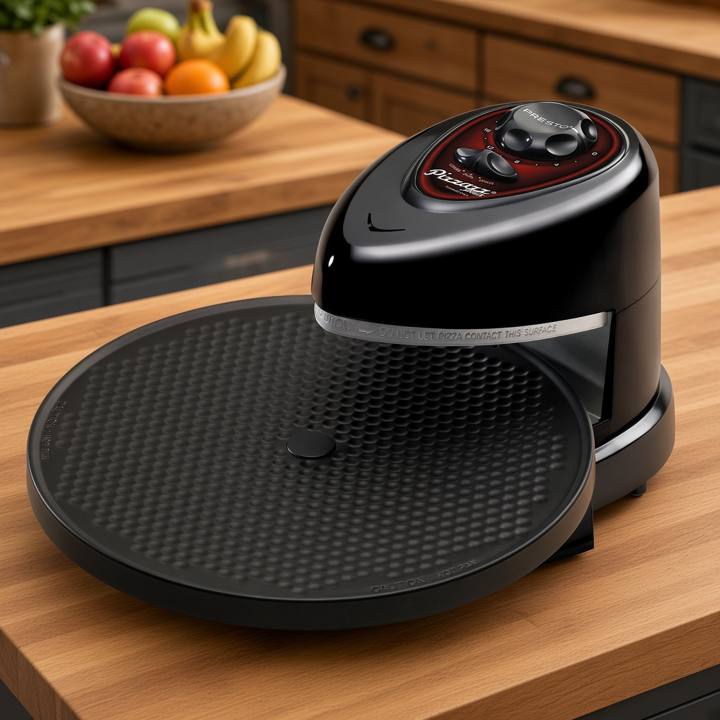
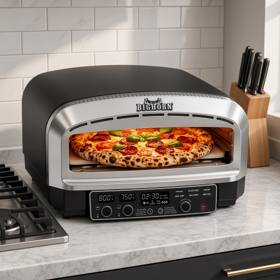
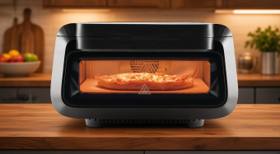
The Presto Pizzazz Plus Rotating Oven, model 03430, has no door and no heat dial. A pan turns under two bare heating elements. You decide which element runs, and for how long. That is the whole machine.
So what is it actually controlling, if not heat? This review answers that, because the answer decides who should buy one. It is a very different thing from the stone ovens beside it in the pizza aisle.
The short version: the Pizzazz Plus sets a clock and a direction, never a heat. Its strengths and its ceiling both trace back to those two controls.
First Impressions of the Presto Pizzazz Plus
Setup amounts to seating one pan. The black base holds a motor and the lower element tray. A curved hood carries the upper element over one side. The nonstick pan drops onto a drive shaft and centres itself.
Plug it in and the pan starts turning straight away, before any heat is on. That turning pan is the first surprise. It spins whenever the cord is in the wall, with the timer at zero. It stops only when you lift the pan off or pull the plug.
The first cook was a regular frozen pizza on DUAL. Presto prints its chart on the back of the unit. There was no manual to hunt for.
Through the open sides, you can watch the cheese start to bubble. That turns out to be the main pleasure of the thing. The crust came off crisp underneath and golden on top, with even colour all round.
It tasted like a well made frozen pizza, which is exactly what it was. A wood fired pie it was not, and it never claimed to be.
Key Features of the Presto Pizzazz Plus
Presto built this oven around very few parts. The list below is close to complete, and each item shapes how it cooks.
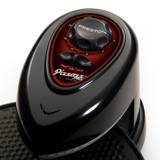
- Two heating elements, chosen by a switch. The slider reads LOWER, DUAL and UPPER. LOWER crisps the crust, UPPER browns toppings, and DUAL runs both.
- A mechanical timer, marked to 20 minutes. Setting it turns the elements on, and the bell shuts them off. Short times need a trick: turn past the 4 mark, then back.
- A rotating nonstick pan. The motor turns it continuously, so every slice passes under the heat in turn. Its hub is what locks onto the motor’s shaft.
- No preheat. Presto says not to preheat at all. Running an empty pan under the elements can damage its finish.
- An open design. Nothing encloses the food. You see the moment it is done and can switch elements mid cook.
- Chart on the back. Pizza settings and times live on the unit itself. That matters once the manual goes missing.
- Countertop size. It measures 15.8 by 14.5 by 10.3 inches and weighs 7.6 pounds.
Beyond pizza, Presto charts frozen wings, nuggets, egg rolls, taquitos and pretzels. Refrigerated cookies and cinnamon rolls get times too, starting on UPPER. Quesadillas and grilled sandwiches round it out.
There are firm exclusions as well. Raw meat, poultry and fish are off the menu. The maker says they may damage the unit. Foil is banned anywhere on the pan or body.
The oven’s heat is fixed. What you control is where it comes from and how long it runs. For frozen pizza that is enough, and the chart reflects real thought about each crust type.
A regular frozen crust gets 12 to 15 minutes on DUAL. A rising crust starts with 10 to 12 minutes on LOWER. Then it gets the same again on DUAL.
Stuffed crust gets 7 minutes underneath first. A fresh pizza of 9 to 12 inches takes 11 to 13 minutes on DUAL. Those are kitchen oven times, not stone oven times, and the chart never pretends otherwise.
Evenness is the oven’s real strength. The pan never stops moving, so no slice sits in a hot corner. With no preheat to rebuild, the second pizza bakes on the same chart as the first. Lift one pan off, load the next, set the timer.
The ceiling is just as clear. Open sides cannot trap heat, and there is no stone to store it. Homemade dough bakes through and browns, but it will not blister or leopard. A rising crust can also climb into the top element near the end, scorching the edge.
Build, handling and durability
The housing is lightweight plastic over a metal element tray. It feels like a kitchen gadget rather than an oven. At this price, that is honest. You can hear the metal tick and hum as it heats, which Presto calls normal.
Of every part, the pan is the one to protect. It is the cooking surface and the drive coupling in one. Presto warns that a dented or warped pan may turn partway and stall. If that happens, the pan needs replacing before the oven works properly again.
Handling takes some care. The top element stays exposed. Lift a hot pan with hot pads, keeping the food clear of it.
Shutting down has its own small ritual. Presto asks for a short wait before unplugging. Let the motor run 60 to 90 seconds after the pan comes off.
The cord is deliberately short, and the plug is polarized. Plan its spot near an outlet, away from curtains, walls and the paper towel holder.
Running costs, upkeep and value
Running it costs little, and the reason is structural. Presto claims it saves as much as 60% against a conventional oven. That figure is the maker’s own and we have not checked it. The logic is plain enough, though: no preheat, and only 1,235 watts.
Cleaning is mostly the pan. Wash it in warm, soapy water after each use. A nylon mesh pad shifts anything stuck on.
Be warned that nothing here is dishwasher safe, and metal utensils will scratch the coating. Cut the pizza on a board, never on the pan. The body only needs a damp cloth.
On price, Amazon listed it around $87.69 in October 2026. Presto’s own store asks $129.99, with free U.S. shipping on most orders. Compare both stores on the day, because the two figures sit far apart.
The one year limited warranty is thin. Presto repairs or replaces at its option, but you pay the shipping to its service department. For an appliance this simple, that is a modest risk.
What the money buys is a specialist. It is a frozen pizza and snack machine, sold in the pizza oven aisle. Judged as that, it is fairly priced. Judged as a pizza oven, it is answering a different question.
Possible Presto Pizzazz Plus Complaints
- It cannot leave your sight. Presto says never to leave it unattended, because overcooked food smokes and may ignite. The open frame and bare top element make that rule real. Plan to stay in the room for the full 12 to 15 minutes.
- The pan is a single point of failure. Drop it, dent it, or let it warp, and rotation stalls. Store it flat and use plastic or wooden tools. A spare pan is worth pricing if you cook often.