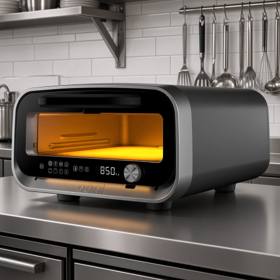
Chefman’s own store prints a regular price of $599.99 for the RJ25-PO12-SS. On Amazon in October 2026, the same oven sold for around $199.98. At that figure, few ovens put an 800°F stone on a kitchen counter for less.
That gap sets up the whole review. The heat sounds expensive, and the price does not. What does the low price cost you, and will you feel it at dinner?
The short answer is time, not temperature. The bake itself is fast. Everything wrapped around the bake is slow, and Chefman’s own guide is candid about how slow.
First Impressions of the Chefman Indoor Pizza Oven
The box holds the oven, a stone and a perforated metal peel. The peel’s wooden handle screws on by hand, and that is the entire assembly. A QR code leads to a digital cookbook in place of a printed one.
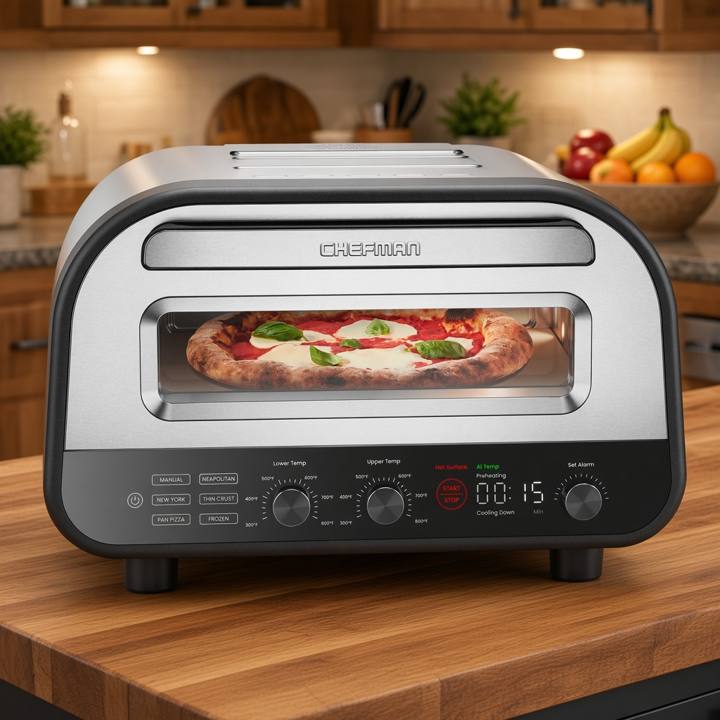
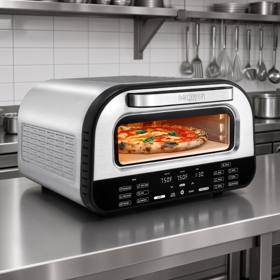
The body is brushed stainless over a black base, with a wide window across the door. Lifting its 23.32 lbs is a two-handed job. It also claims a real slab of counter, so measure before it arrives.
The first firing is an empty one, to burn off factory residue. Both elements go to 800°F, then hold there for 20 minutes once At Temp shows. A faint factory smell is normal on that run.
Then the fans spin up for the cool down. That is the first hint of this oven’s character, and it lasts.
Our first proper pie went in on the Neapolitan preset. The rim puffed and freckled in about the time it takes to tear basil. The base came out crisp, with dark spots near the edge and a soft middle. It tasted like a pizza from a hotter box than this one looks.
Key Features of the Chefman Indoor Pizza Oven
Most of the design thinking lives in the control strip. Two temperature dials, five style buttons and a timer knob sit under one glossy panel. Here is what each part does, and where it stops.
- Two elements, two dials. Lower Temp drives the floor and Upper Temp drives the roof. Each runs 300°F to 800°F, and either can move mid bake.
- A 200°F leash between them. In Manual, the two settings never sit more than 200°F apart. Thin Crust uses that whole allowance, at 700°F under 500°F.
- Five presets plus Manual. The styles are Neapolitan, New York, Thin Crust, Pan Pizza and Frozen. Each loads a floor heat, a roof heat and a time.
- A timer that only nags. The Set Alarm knob beeps three times when time is up. The elements keep running, so a forgotten pie keeps cooking.
- Lit touch controls and three status lights. Hot Surface, At Temp and Cooling Down tell you what the box is doing without guesswork.
- Stainless steel. The outer shell is stainless, sitting on a black base and control strip.
- Double-paned window and cool-touch handle. The cornicione is visible through the glass, so the door can stay shut.
- Stone and peel included. The stone is meant to live inside the oven, and the guide forbids cooking without it.
- A built-in cooling fan. It runs after every session to protect the electronics, and it decides when you may unplug.
Heat is where the low price hides nothing. The top setting is 800°F on both elements, and the Neapolitan preset runs both at 750°F. Chefman’s chart puts that bake at 2 1/2 minutes, and our pies landed close to it.
The presets show how the oven thinks about a pizza. Thin Crust runs the floor well above the roof, for crunch under a lightly cooked top. Pan Pizza drops both, so a deep base cooks through before the cheese scorches. The split between floor and roof is the real tool here, more than the headline number.
Recovery is the soft spot, and it answers half of the opening question. Chefman says to give the stone at least 5 minutes between pizzas. With a 2 1/2 minute Neapolitan, the oven rests about twice as long as it bakes. A third pie arrives a good while after the first.
Chefman lists warm up at 1 to 26 minutes. Where the oven starts decides most of it. Asking for high heat from a cold box sits at the long end. Start prepping toppings when you press Start, not after.
The At Temp light is the cue that matters. Chefman blames an undercooked base on loading before it glows. If the floor still runs pale, the fix is more Lower Temp, not more time.
Build, handling and durability
The parts you touch feel sorted. The door carries a cool-touch handle over a double-paned window, and the shell is stainless. The outside still gets very hot, though, and Chefman warns against leaning anything on the sides.
Of everything in the box, the stone needs the gentlest hands. The guide calls it fragile and sensitive to sudden changes in heat. It stays in the oven between uses and comes out only to flip or clean. Chefman states no size or mineral for it, so shopping for a spare is guesswork.
Durability also rests on electronics, not just metal. Fans cool the board after every session. Unplugging before they stop is off limits. Pull the plug early and you skip the step meant to protect them.
That rule shapes daily life with this oven more than any spec line does.
Running costs, upkeep and value
Running it means a 1700W draw on a 120V grounded outlet. The cord is short by design, so the oven lives beside a three-prong socket. If you must use an extension, its rating has to match the oven’s.
Upkeep is mostly heat. Between pies, brush loose flour off the stone. Use a long brush with a wooden handle, since plastic can melt.
Cheese welded on? Flip the stone and run it empty at 800°F for 30 minutes. The stone never sees water or oil, and the peel is hand wash only.
Then the time cost returns. From 800°F, Chefman says cooling takes a couple of hours, fans running throughout. The oven also slips into cool down by itself after 60 minutes idle. Your counter is spoken for long after the last slice.
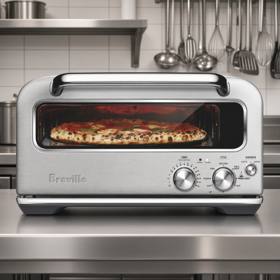
Value depends on which price you meet. At around $199.98, the Chefman sits far below the Breville Pizzaiolo’s $999.95 maker price. It also lists a higher top setting, 800°F against 750°F. At Chefman’s own $599.99 regular price, the argument gets much thinner.
The Breville also carries two years of cover against this oven’s one. That missing year is part of the bargain too. Buy from an authorized seller and keep the receipt, or the year means little.
Possible Chefman Indoor Pizza Oven Complaints
Neither complaint is about how the pizza tastes. Both are about the clock.
- The pause between pies. The stone needs about 5 minutes after each bake. Four hungry people feel every one. Build the next pie during the pause, and bake low heat styles first.
- The long goodbye. An 800°F session ends with a couple of hours of fan noise. The plug must stay in throughout, though lower presets cool sooner. If you cook late, plan the cool down before bedtime.