First Impressions of the Traeger Tailgater
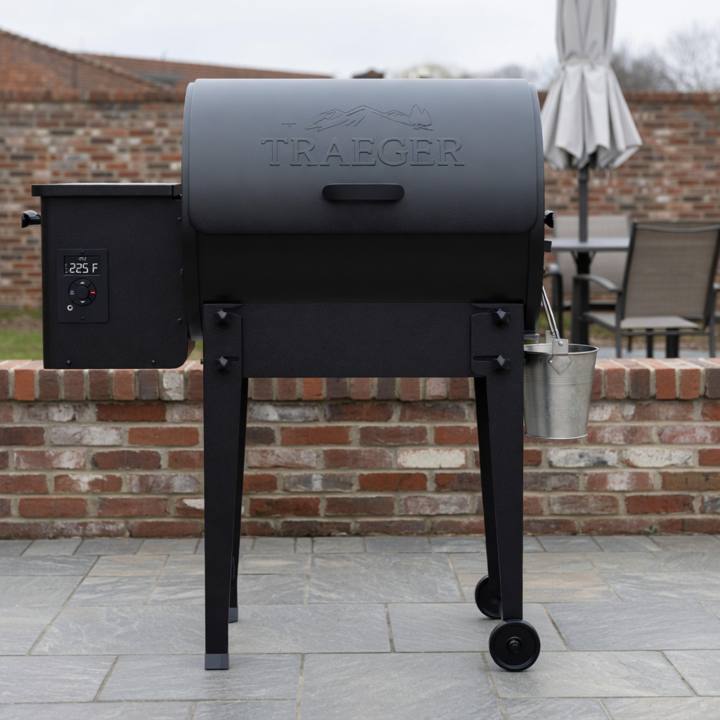
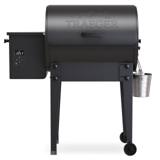
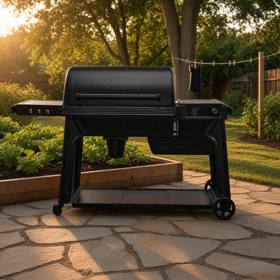
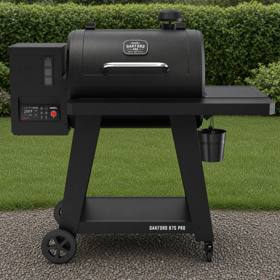
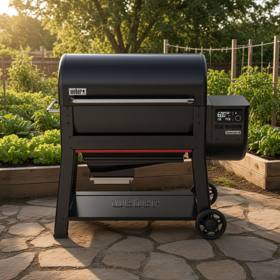
Uncrated, it reads as a patio grill that has been told to travel. A barrel body with a front door. A hopper bolted to the left end, wearing the controller on its face. Two fixed legs, two legs on an axle, two wheels.
Assembly is the first surprise, because the owner’s manual does not contain any. It points you at a separate Assembly Guide instead. Traeger does not serve that guide from the product page or the manuals index.
The first fire is the pellet-grill ritual. Prime the auger and wait while wood travels down the tube. Reckon on 2 minutes, or as much as 7 from a dry hopper. Then season the empty grill at 450 F for 30 minutes with the door shut.
After that it behaves like the big Traegers, because it more or less is one. The barrel is doing real convection work, and the ribs show it. Three racks fit at once.
Key Features of the Traeger Tailgater
The feature list is short, and the absences tell you as much as the entries. This grill joins no network, runs no app, and tracks no fuel. What you get is a barrel, a firepot, a controller and a pair of wheels.
- 300 sq in on one grate: Traeger states it identically on the page, in the manual and on its own graphics. Two chickens, three rib racks or twelve burgers is the rated load.
- Porcelain-coated steel grate: The coating is the only thing Traeger will name about this grill’s metal. A damp cloth deals with it, and no seasoning is needed.
- Electric igniter: Press IGNITE and a rod down in the firepot glows red. Pellets drop onto it and take. There is nothing else to light.
- Digital Arc Controller: Five buttons, a status display and three indicator icons. Three modes hide behind the centre button: heat, timer, probe alarm.
- Keep Warm at 165 F: It pauses a cook wherever you are. Press it again and cooking resumes. Traeger says plainly that it will not cook food.
- One wired meat probe: The plug goes into a jack beside the display. Traeger asks for 2 in of penetration into the thickest part. The reading holds five seconds before the grill figure returns.
- Folding legs and two wheels: Two jobs, not one. Wheels cross a car park. The fold takes the grill down to 18 in for a boot or a shelf.
- External grease bucket: Fat lands on the drip tray, then follows a V-shaped trough to a drain tube. A pail on the outside catches whatever comes down.
- No fuel gauge and no network: The page rules WiFIRE out in one flat line. Checking the hopper means lifting its lid and looking in.
Judge this grill on smoke and it does well, which is the point of the fuel. The barrel shape circulates hot air around the food. The exhaust then pulls it down and out the back. Three rib racks on one level is a useful low-and-slow load.
Turn it the other way and the limit appears. 450 F is the top, and it is also the only heat worth naming. That number roasts. The Ranger meets the same ceiling with a cast iron slab in the box.
The Tailgater meets it with nothing at all. Searing is a job you will finish somewhere else. The odd part is what Traeger declines to publish. No output rating appears on the page, in the manual, or on any product graphic.
Traeger’s smaller portable gets one printed in black and white. What you do get instead is the fault chart. The controller calls an overheat above 550 F held for 45 seconds. It calls a stall below 120 F held for 10 minutes.
Neither is a setting. Together they bracket the machine better than the marketing does.
Build, handling and durability
62 lbs inside a 37 in case is dense. Two stationary legs, two on an axle, rubber feet, a side lift handle. The wheels mean this crosses a car park without anyone lifting anything.
Beyond the grate coating, Traeger says nothing about the metal. No gauge, no panel spec, not even the vague phrase it gives the Ranger. It cannot quite agree on the weight either. The product page says 62 lbs; its own dimensions card says 60 lbs.
Then read what the fold actually asks for, because the fold is the product. Loosen the knurled and knob screws on all four legs. Pull the grate, the drip tray and the heat baffle out first. That keeps the interior from getting scratched.
Now lift one side at a time. Swing each leg down and sideways, pivot it up, retighten. Five numbered steps, and step five is doing the whole thing backwards. Traeger’s word for this is easy.
Running costs, upkeep and value
Price is where this grill makes its best argument. Direct from Traeger it is $499.99. Amazon had it at $444.87 on 2026-09-17. Buying direct adds $49.99 of freight and 5 to 7 business days.
Set that against the Ranger. This grill works out around $1.48 per square inch, where the smaller one lands near $2.73. On Amazon it was also $35.11 cheaper than the grill with 124 sq in less space. Direct, the ordering flips and the Tailgater costs $20 more.
Power is 250 watts down a 6 ft lead, into a GFCI socket. Only Traeger’s own pellets are sanctioned in the manual. Damp pellets swell, and a swollen pellet will seize the auger. Swapping wood flavour is a scooping job, since the hopper has no drain.
Upkeep is steady rather than heavy. Inspect the grease system before every cook and clear ash every 20 hours. Check the exhaust twice a year and clean the paint every 90 days. A cover is sold separately.
Whatever the Ranger’s warranty taught you, set it aside for this grill. Seven years is the headline, and it covers material and manufacturing defects rather than rust. Then comes the table.
Body, legs and hopper cover get the full seven. Controller, auger, grate and feet get three. Fan, hot rod and auger motor get one.
The shape of that is worth saying plainly. Seven years protects the barrel, and one year covers the machine inside it.
Labour and freight are yours either way. A second owner inherits the grill but not its warranty. Traeger also states that it applies only to Authorized Seller purchases. Check that before you check the term.
Possible Traeger Tailgater Complaints
- The parts that actually fail get the shortest cover. A fan quits, a hot rod burns out, an auger motor seizes. Traeger gives each of those one year. The Ranger costs $20 less direct and covers the same three for three years.
- The buy page hands you the wrong manual. Its one manual link serves a 24-page file for a different model. That document never prints the word Tailgater and carries no warranty clause. The correct 32-page manual sits on Traeger’s manuals index instead.