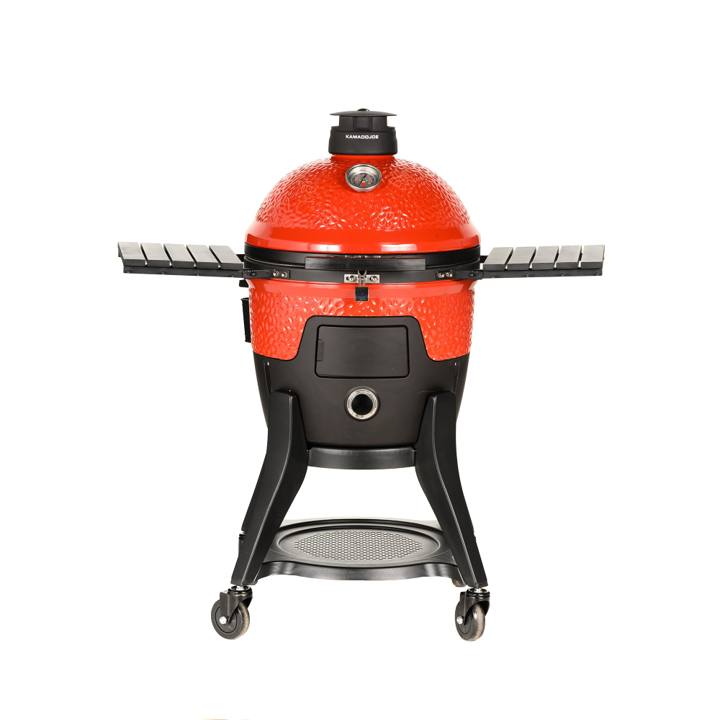
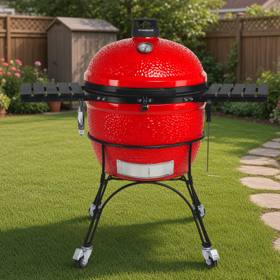
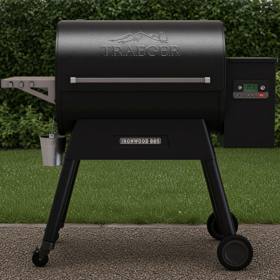
The Pellet Joe looks like any red Classic Joe. Lift the dome and the fuel is different. Model KJ15260020 burns wood pellets inside an 18 in ceramic shell. A hopper feeds the fire and a thermostat runs it.
That makes it two machines with two different lifespans. On the shell, Kamado Joe offers a lifetime term, tied to whoever bought it first. The electronics that feed and fire it get three years.
So which grill are you buying? Is it the kamado that should outlast you, or the pellet grill bolted to it? And does it keep the best of either parent? This grill review holds it to both standards.
250 sq inOne round grate, 18 in across, the same area as a Classic Joe
600°FTop of the thermostat, against 750°F on the charcoal Series III
Up to 14 hoursSmoking time from one 10 lb hopper fill, per Kamado Joe
3 yearsWarranty on the electronics that feed and fire it
First Impressions of the Kamado Joe Pellet Joe
From across the patio, nothing gives it away. The pebbled red dome and black Kontrol Tower cap are pure Classic Joe, shelves included. The tell sits lower down, on the black base. A round dial sits where a charcoal model has a draft door.
Look at the side and you find the hopper, a lidded box under the shelf. Kamado Joe’s page calls it stainless steel. The Amazon listing and its own artwork call it powder-coated steel. Those age differently outdoors, and nobody has corrected either.
The box holds more than a grill. A pellet scoop, a drip bucket, a mesh gasket and three probes come along. The Amazon art adds a grate gripper and two aluminum side shelves. It all rides on a steel cart with locking wheels.
Weight is the first argument. Kamado Joe says 202.4 lbs, while Amazon lists 235 pounds. Neither figure lets one person wrestle it off a pallet.
Clear a path before delivery day. Pick its spot near an outlet, too, since this kamado needs power. A charcoal kamado can sit at the far end of a garden; this one cannot.
Notice what neither parts list mentions. There is no heat deflector and no Divide & Conquer rack. A charcoal Classic Joe owner will look for both, and should ask before ordering.
Key Features of the Kamado Joe Pellet Joe
Most of this list belongs to a kamado. The rest is what a pellet grill brings to it. Watch the seams, where the two parents overlap and quietly fight.
- Thermostat dial and app control. The knob on the base works alone. The app reaches the same controls over Wi-Fi. The app charts the cook and sends alerts.
- Three probes in the box. Two meat probes and one pit probe report to the app. A brisket and a pork shoulder can be tracked at once.
- A 10 lb hopper. Kamado Joe rates one fill at up to 14 hours at smoking temperatures. Agitators inside stir the pellets to stop bridging and jams.
- Kontrol Tower top vent. Opening the lid leaves its dial position untouched. On a pellet fire it shapes airflow; the controller sets the heat.
- Air Lift Hinge. Springs take much of the dome’s weight. Kamado Joe attaches no figure to how much.
- Stainless steel. Stainless covers what you touch and what holds food: grates and latch. The hopper may be too, depending on which Kamado Joe text you trust.
- Accessory fit. The grate takes most Kamado Joe inserts. The DōJoe pizza dome and Karbon Steel griddle are both named, sold separately.
- Cover. The Classic Joe Cover fits it, also sold separately.
Here is the honest headline. The Pellet Joe keeps a kamado’s grate and a pellet grill’s ceiling.
Its 18 in grate gives 250 sq in. A Classic Joe Series II or III offers the same. The thermostat stops at 600°F, while the charcoal Series III is rated to 750°F.
That 150 degree gap is the whole difference at the top end. Steaks will brown well at 600°F on stainless grates. A Neapolitan pizza on the DōJoe wants more than the dial allows.
What the ceramic does give is steadiness. Thick walls soak up heat and give it back, so the controller has less to correct. That matters most on a long, low cook, and in cold weather. A thin steel barrel loses heat to wind; a dome like this barely notices it.
Even the low end is muddled. Kamado Joe’s prose promises 150°F, yet its own spec table starts at 250°F. If you plan to smoke salmon or cheese cool, that gap decides it.
Heat density cannot be worked out either. Kamado Joe prints no heat output for the fire, so there is nothing to divide.
Smoke is the quieter gain. A steel pellet grill vents its smoke freely and tastes mild for it. A gasketed ceramic dome holds moisture and smoke around the meat for longer. Expect a kamado’s juicy bark, with pellet wood rather than lump doing the flavoring.
Room is set by the circle. Kamado Joe’s art fits 13 burgers, 4 chickens or 2 pork butts. That is a family cook, not a block party. A long rack of ribs may need cutting in half to lie flat.
Build, handling and durability
The shell and hardware come straight from the Classic Joe line. Cast aluminum caps the dome. Stainless steel handles the grates and latch, and the cart is heavy steel with locking wheels.
Durability is where the spine bites. A charcoal kamado has little to fail besides a gasket. This one adds a controller, plus the parts that feed and light the fire. All of it lives in a warm base.
Kamado Joe covers the ceramic for life and metal parts for 5 years. Electronic components get 3 years. The shell will very likely outlive its first controller. Fill in the registration form the week it arrives; unregistered, none of those terms apply.
The app adds one more layer to keep alive. It needs your phone, your home Wi-Fi and Kamado Joe’s software to keep working. The dial on the base still runs the fire if any of those lapse. That fallback matters on a grill meant to last decades.
Running costs, upkeep and value
Feeding it means bags of wood pellets and a socket. The ceramic should help here. Walls that hold heat ask for fewer pellets than thin steel would. How many pounds an hour it eats is not on any page we found.
Upkeep is split between the two parents. A drip bucket and an easy grease cup handle fat from below. Pellet ash still settles inside the ceramic, and the bowl wants a vacuum now and then. Empty the hopper between cooks, because damp pellets swell and jam.
Which price tag you meet decides the verdict here. Kamado Joe lists $1,799.00 regular, $999.99 on sale, and sold out. Amazon showed $1,467.82 on 2026-10-20. When we captured it on 2026-09-23, it was around $1,014.
At $1,467.82 it costs about the same as a charcoal Series II at $1,499.99. That grill shares the grate area and needs no controller at all. Its main wear part is a gasket. Near $999.99, the Pellet Joe’s trade looks far kinder.
Possible Kamado Joe Pellet Joe Complaints
- The electronics age faster than the shell. The controller sits in the base, just below the fire. Kamado Joe’s warranty covers it for 3 years, against a lifetime on ceramic. Budget for a replacement part one day.
- The specs disagree with themselves. Kamado Joe gives two floors, 150°F in its prose and 250°F in its table. The hopper is stainless on one page and powder coated on another. The weight reads 202.4 lbs or 235 pounds, so ask the seller before buying.